Q&A for Democratic Theory: An Interdisciplinary Journal

Democratic TheoryBerghahn is pleased to announce the launch of an exciting new journal in 2014, Democratic Theory – An Interdisciplinary Journal. The first issue has been published this month!

Democratic Theory is a peer-reviewed journal that encourages philosophical and interdisciplinary contributions which critically explore democratic theory – in all its forms. Below is the transcript of an electronic interview between the Berghahn blog editor and the journal’s editors, Mark Chou and Jean-Paul Gagnon.

Continue reading “Q&A for Democratic Theory: An Interdisciplinary Journal”

Hot Off the Presses – New Journal Releases for June

Anthropology in Action
Volume 21, Issue 1
This is a special issue on Applied and Social Anthropology, Arts and Health.

Asia Pacific World
Volume 5, Issue 1
In this first issue of Volume 5, we have chosen to begin with two keynote presentations from the fourth IAAPS Annual Conference.

Contributions to the History of Concepts
Volume 9, Issue 1
This issue focuses on conceptual changes and political struggles around citizenship related to the challenges of Europeanization, as well as both migration and immigration after WWII.

German Politics & Society
Volume 32, Issue 2
This special issue is titled The 2013 Bundestag Election (Part 1). 

Journeys
Volume 15, Issue 1
This journal explores travel as a practice and travel writing as a genre, reflecting the rich diversity of travel and journeys as social and cultural practices as well as their significance as metaphorical processes.

Learning and Teaching
Volume 7, Issue 1
This special issue is titled Collusion, Complicity and Resistance: Theorising Academics, the University and the Neoliberal Marketplace.

Social Analysis
Volume 58, Issue 2
This journal encourages contributions that break away from the disciplinary bounds of anthropology and suggest innovative ways of challenging hegemonic paradigms through analysis based in original empirical research.


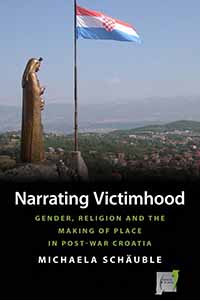
Picturing Post-War Croatia

In Michaela Schäuble’s ethnographic account, Narrating Victimhood: Gender, Religion and the Making of Place in Post-War Croatia, she examines religion, gender relations, and nation building in the newly independent country. Following, the author gives readers a photographic glimpse into the Republic of Croatia after its war for independence. See the other photos in the gallery here.

Continue reading “Picturing Post-War Croatia”

The Historic Influence of Intellectuals

In Gavin Smith’s Intellectuals and (Counter-) Politics: Essays in Historical Realism, which was published earlier this month, the author takes a look at the role of the intellectual (specifically the social scientist) in three important areas — studying capitalism, making histories, and producing places. According to the author, “Reflexivity for the social scientist, Bourdieu argued, involves an objectivist ethnography of ethnographers,” a task Smith himself undertook in both Spain and Peru. Following, he reflects on his time spent conducting ethnographic research in Peru.


Continue reading “The Historic Influence of Intellectuals”

Visual Voice: ‘Narrating Victimhood’ in Photos

The 1991-1995 war following the dissolution of socialist Yugoslavia is referred to as “Homeland War” (Domovinski rat) in Croatia. It is narrated both as a struggle of independence and a defense against aggression and occupation by Serbia. Postwar social and political processes continue to be dominated by competing nationalisms, aspects of which come into focus in Narrating Victimhood: Gender, Religion and the Making of Place in Post-War Croatia, published earlier this month. In the following photo essay, author Michaela Schäuble gives readers a visual glimpse into the role religion, and Marian veneration in particular, plays in these processes in contemporary post-war Croatia.


______________________________


Continue reading “Visual Voice: ‘Narrating Victimhood’ in Photos”

Doubly Disenfranchised: A Firsthand Account of Life as a Mizrahi Woman

The largest population of Mizrahi Jews, those with origins in Middle Eastern countries, lives in Israel. However, in this country Mizrahim are historically and currently disenfranchised, with preference given to Jews of European descent, or Ashkenazi. In Wrapped in the Flag of Israel: Mizrahi Single Mothers and Bureaucratic Torture, to be published this month, Smadar Lavie, herself a Mizrahi Jewish woman, explores the Israeli bureaucratic system and Mizrahi women’s relationship with it. Following, the author answers the question: What aspect of writing Wrapped in the Flag of Israel did you find most challenging? Most rewarding?


_____________________________________


Most challenging was weaving a text out of two decades worth of fieldwork data. Though I started my research efforts in 1990 as a tenured professor at U. C. Davis, the bulk of the fieldwork was collected during my years as a Mizrahi single mother on welfare between 1999-2007. For a typical book-length ethnography, most scholars spend a total of around two years in the field collecting data, supported by grants and sabbaticals. Afterward, they return to their home university and write the book manuscript, also supported by grants and sabbaticals.

Continue reading “Doubly Disenfranchised: A Firsthand Account of Life as a Mizrahi Woman”

The Reciprocal Relationship of Media and Movement

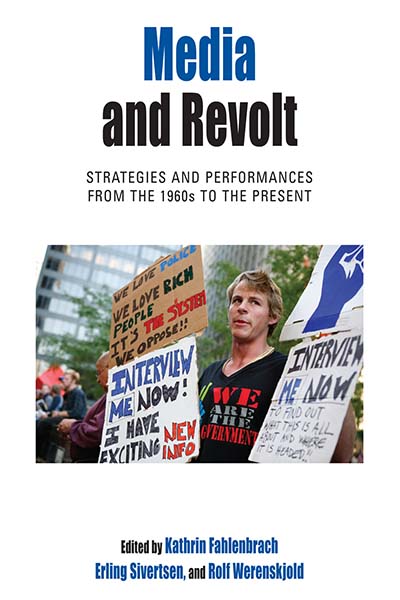
Editors Kathrin Fahlenbrach, Erling Sivertsen and Rolf Werenskjold’s volume Media and Revolt: Strategies and Performances from the 1960s to the Present was published last month. Following, the editors introduce the timely volume and share an excerpt from the Introduction. 


__________________________________________________


Looking at journals, television, or on the internet in these days, news dealing with protests abounds: the upheavals around the Euro-Maidan in the Ukraine, anti-governmental protests in Bangkok, the “Occupy-Gezi-Park”-manifestations in Istanbul or protest actions of NGOs like Greenpeace against oil companies or whale hunters. Obviously protest has an enormous “news value”: it offers spectacular pictures, it makes evident political conflicts and decisions by polarizing their actors, and it offers media the chance to perform as center of society.

Continue reading “The Reciprocal Relationship of Media and Movement”

A ‘Privileged’ Prisoner is Still a Prisoner

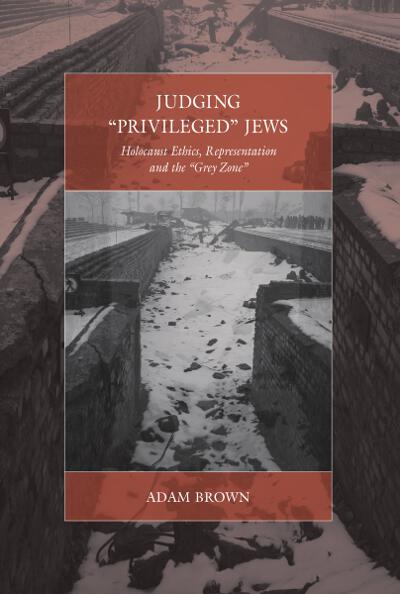
In German concentration camps, some Jewish prisoners were selected by their Nazi captors to hold more-advantaged positions within the population of the camp. This not only allowed them some protections, but also made them targets of disdain from other victims. Author Adam Brown sheds light on these “privileged” few in his volume Judging “Privileged” Jews: Holocaust Ethics, Representation, and the “Grey Zone,” published in July of last year. Following, Brown discusses about the origins of his interest in the Holocaust in general, and in this inspirational “Grey Zone,” in particular.


________________________________________________


The evolution of my book, Judging “Privileged” Jews: Holocaust Ethics, Representation and the “Grey Zone,” was – like most books no doubt – somewhat long and complex. To take the long-term view, the project began when I heard the moving personal stories spoken by survivor guides on a high school trip to the Jewish Holocaust Centre in 1999. As a non-Jewish teenager with next to no background knowledge of the event, the visit to the JHC inspired a lasting curiosity and sense of obligation to find out more.

Continue reading “A ‘Privileged’ Prisoner is Still a Prisoner”

In the Beginning, There Were ‘Visions of the End’

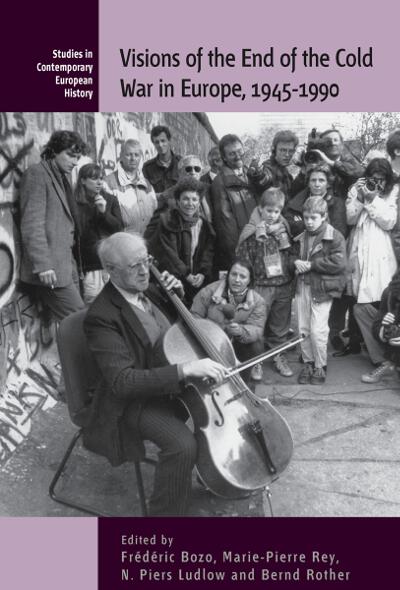
When WWII drew to a close in the late 1940s, the fighting may have stopped, but the tension was just building. This sustained Cold War friction lasted longer than four decades, the whole time of which, the main players had ideas of how it would look when it ended. The editors and contributors of Visions of the End of the Cold War in Europe, 1945-1990, to be published next month, explore these ‘conceived programmes’ and ‘utopian aspirations.’ Below, an excerpt from the Introduction sets the scene, starting at the end, with the fall of the Wall.


___________________________________________

The fall of the Berlin Wall on 9 November 1989 quickly came to symbolize the end of the Cold War as a whole, including the liberation of Eastern Europe from Soviet rule in 1989, the unification of Germany in 1990 and the break-up of the Soviet Union in 1991. Its twentieth anniversary in autumn 2009 was therefore an opportunity to celebrate not just that particular event – however meaningful – but an extraordinary period that in barely two years led from the dismantling of the Iron Curtain to the liquidation of the whole ‘Yalta’ order.


Continue reading “In the Beginning, There Were ‘Visions of the End’”

Souvenir of the Right: Reexamining Twentieth-Century French Politics

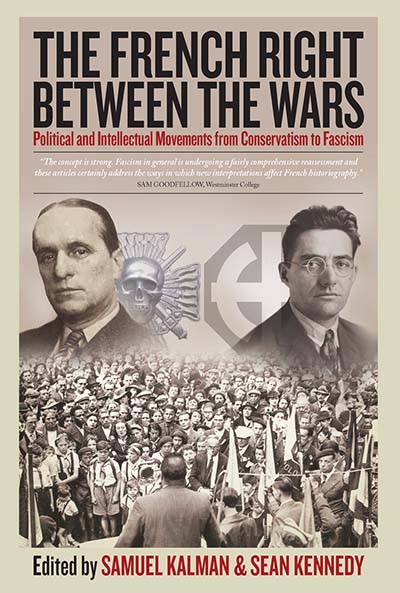
The French Right Between the Wars: Political and Intellectual Movements from Conservatism to Fascism, to be published this month, re-opens the history books on  France between World Wars I and II. In this collection of essays, scholars take a look at the polarized political scene, especially the right, within the country. Below, in an interview with editors Samuel Kalman and Sean Kennedy, the scholars speak to the challenges of compiling the collection as well as the potential controversy of writing on such a politically charged topic.


__________________________________________

Berghahn Books: What aspect of compiling an edited collection did you find most challenging?  Most rewarding?


Sean Kennedy: When we began this project I was anxious that coordinating thirteen different contributions – in terms of deadlines and ensuring consistency in format – would be a major challenge. I should not have worried so much. Our contributors did a fine job of sticking to the production schedule and carrying out editorial work.

Continue reading “Souvenir of the Right: Reexamining Twentieth-Century French Politics”