Hot Off the Presses – New Journal Releases for December

Focaal
Volume 67, Winter 2013
This issue features a theme section titled Divine kinship and politics edited by Alice Forbess and Lucia Michelutti.

French Politics, Culture & Society
Volume 31, Issue 3
This special issue is titled Algerian Legacies in Metropolitan France. It features articles that explore the topic of North-African migrants in France.

Journal of Educational Media, Memory, and Society
Volume 5, Issue 2
This issue features a special section devoted to children’s films.

Transfers
Volume 3, Issue 3
This “Asia Issue” is the first of what we hope will be a long sequence dedicated to non-Western mobility topics. We have also included a special section on rickshaws.

How the ‘Legacies of Two World Wars’ Compare to Current Conflict

In an excerpt from the Introduction, the editors explain the point of origin for The Legacies of Two World Wars: European Societies in the Twentieth Century. In the volume, published last month in paperback, contributors follow the European zeitgeist as the continent was plunged first into one war, then a second. Editors Lothar Kettenacker and Torsten Riotte pit the public feeling surrounding these World Wars with that of the U.S. people when the government invaded Iraq in 2003.


_______________________________________


The aim of this book is to trace the moods and attitudes of the people of four Western countries before, during and after the First and Second World Wars. The contributions examine public opinion in Great Britain, France, Germany and Italy during the crucial moments of the two major conflicts of the twentieth century (in their differences and similarities). The inspiration to look again at the attitudes of ordinary Europeans to the two wars came from the controversy surrounding the US invasion of Iraq in 2003.

Continue reading “How the ‘Legacies of Two World Wars’ Compare to Current Conflict”

Policy-Tracing Up, Down, Sideways

In an excerpt from the Introduction of A Policy Travelogue: Tracing Welfare Reform in Aotearoa/New Zealand and Canada, published in September, Catherine Kingfisher explains just how she came to be interested in the subject of welfare policy, and its existence as a living, working idea.


____________________________________

My interest in tracing policy began in the summer of 2000, when I was writing grant applications to work with welfare mothers in southern Alberta, where I had recently moved from Aotearoa/New Zealand. I discovered that in the early 1990s the Alberta provincial government of premier Ralph Klein, in the process of reforming its governing structures and welfare systems, had been heavily influenced by Roger Douglas, the former Finance Minister of New Zealand.

Continue reading “Policy-Tracing Up, Down, Sideways”

Jünger in Paris: A Writer’s Wartime Account in the City of Lights

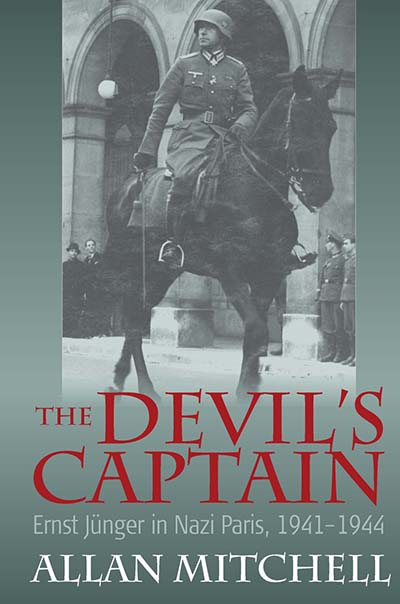
Allan Mitchell takes a look at Ernst Jünger, an under-appreciated twentieth century writer, but an important social figure. The Devil’s Captain: Ernst Jünger in Nazi Paris, 1941-1944 follows the writer at wartime, where he spent his stint in Paris as a military officer whose chief duty was to “mingle with French intellectuals.” Below is an excerpt from the volume, which was originally published in May 2011 and is soon to be released in ebook format.


________________________________________

Very few, if any, critics of German literature would rank Ernst Jünger among the greatest writers of the twentieth century. He simply does not compare, as a novelist, with giants like Thomas Mann, Franz Kafka, or Robert Musil. His signature work, Auf den Marmorklippen, has been often justly praised for its chiseled language and allegorical imagination. But for later generations raised on soaring flights of science fiction, Jünger’s 1939 work must seem brief, rather stilted, and now somewhat dated. In any event, it pales beside Buddenbrooks and Der Zauberberg, Das Urteil and Das Schloss, or Der Mann ohne Eigenschaften.

Continue reading “Jünger in Paris: A Writer’s Wartime Account in the City of Lights”

How Social Movements in Reality (Hopefully) Revitalize Theory

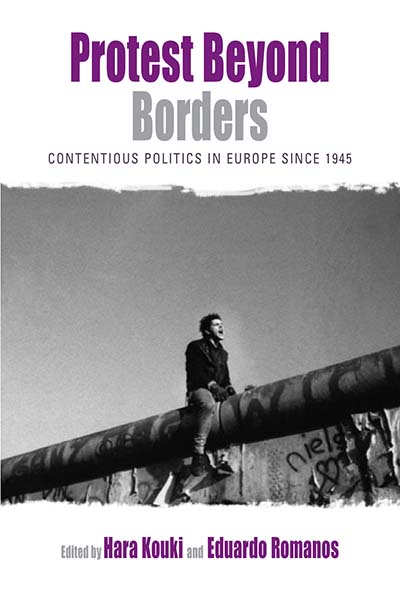
Protest beyond Boders: Contentious Politics in Europe since 1945, recently published in paperback, examines protest culture since the second World War from a variety of angles — historical, political, social, and cultural. But much has changed in worldwide politics since the volume’s original March 2011 publication. Below, the editors reflect on how the reality of the political protest sphere has renewed interest in studying the underlying theories of social movements.


___________________________________________________


In recent years, we have been all caught by surprise. A sudden outbreak of confrontations and protests erupted in unrelated places, such as Bulgaria, Spain, Greece, Hungary and beyond Europe, in Tunisia, Egypt, Thailand, United States and Brazil. Most often lacking clarity in terms of organization, membership, protest demands and goals, this rise of contention erupting across the globe is far from completed. Something new is unfolding, which could not have been predicted and cannot easily fit in our categories of thinking and classifying the world.

Continue reading “How Social Movements in Reality (Hopefully) Revitalize Theory”

The Life of Policy in Canada and New Zealand

Policies have their own lives, and these lives are not “a-cultural, rational, and straightforwardly technical,” puts forth Catherine Kingfisher in her volume, A Policy Travelogue: Tracing Welfare Reform in Aotearoa/New Zealand and Canada, published in September. Following is an excerpt from the monograph’s Introduction in which the author sets the scene for her discussion of how policy lives within welfare reform in two distinct countries.


______________________________________


I use the frames of translation and assemblage to gain insight into a range of policy-related phenomena in particular spaces and contexts of occurrence. First, I explore the transformation of objects as they are translated from one philosophical and political framework—Keynesianism—into another—neoliberalism. Brodie (2002:100) points out in this regard that the privatization characteristic of neoliberalism: “[i]nvolves much more than simply removing things from one sector and placing them in another….the thing moved is itself transformed into something quite different. Objects become differently understood and regulated.”

Continue reading “The Life of Policy in Canada and New Zealand”

Star-Studded Regime: A Look at Film Celebrity in Fascist Italy

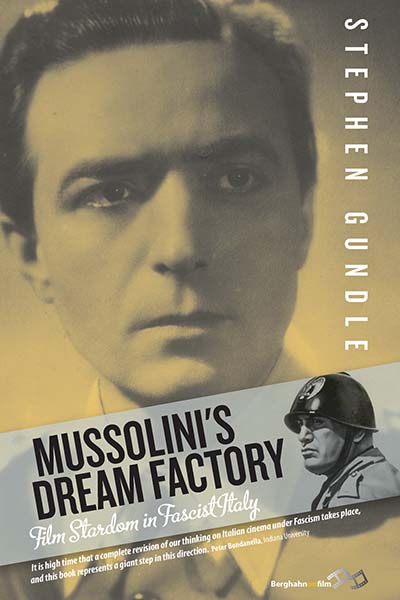
Celebrities today can perform political functions by sponsoring causes, supporting or opposing governments and shaping opinion. In Fascist Italy, celebrities also played an important role and the regime was well aware of the possible uses and dangers of their popularity. This important connection has been overlooked by scholars of both film and of Italian political history. Focusing on a period from the 1920s through 1945, Mussolini’s Dream Factory: Film Stardom in Fascist Italy looks at the star power of these often-overlooked celebrities and the fate of their careers after WWII. Author Stephen Gundle expands on these ideas and shares his thoughts on the subject, below.


_______________________________________________


Berghahn Books: What drew you to the study of film and film stardom in Fascist Italy?


Stephen Gundle: There are lots of books written about fascist Italy and it seems to be a topic that endlessly fascinates.  In the last few years books have appeared on topics such as the police force, diplomacy, road-building, women’s fashions and everyday life. Yet there are few books on fascist cinema – which is largely ignored by historians and neglected by film scholars who tend to concentrate on neorealism or other aspects of postwar cinema.

Continue reading “Star-Studded Regime: A Look at Film Celebrity in Fascist Italy”

An Uprising of Historical Importance

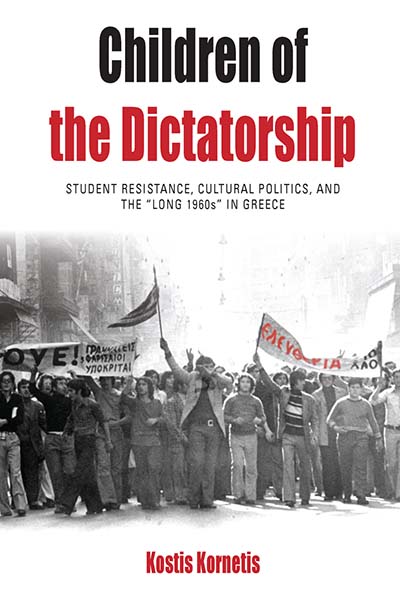
The cyclical course of history comes into sharp focus when one looks at Greek political uprisings. The widely publicized youth dissent in recent years is nothing new, but actually has earlier roots in 1973 — with different players, but with the same activist vigor. This 1970s group — later to be known as the Polytechnic Generation — comes into clear focus in newly published Children of the Dictatorship: Student Resistance, Cultural Politics and the “Long 1960s” in Greece, by Kostis Kornetis. Following is the opening to the volume’s introduction. 


___________________________________

In 2010 the well-known British Pakistani writer and political activist Tariq Ali commented that “were there a Michelin Great Protest guide, France would still be top with three stars, with Greece a close second with two stars.” Ali did not only refer to the 2005 riots in France and the 2008 civil disturbances in Greece, but to a longue durée structure of civil disobedience in the two countries that dates back to the 1960s and 1970s.


Continue reading “An Uprising of Historical Importance”

Are Law-Maker, Law-Breaker So Different?

In the past, the world’s political economy has not always been built through honorable dealings. In fact, not much may have been, according to the recently published volume The Hidden History of Crime, Corruption, and States, which sheds light on such shadowy parts of economic history. Below, editor Renate Bridenthal develops this idea to share how those in power and those illicitly taking power may not be so different after all.


____________________________________


A specter is haunting history. The ghostly presence of economic crime as political power has been all but absent in history writing, but not in history itself.


Like dark matter, its synergy has been palpable if not always visible. Yet in our time, more and more emerges from the shadows, exposed in newspapers and tried in courts, and compels us to consider the history of the illicit political economy and its effects in past and present.

Continue reading “Are Law-Maker, Law-Breaker So Different?”

Good Borders Make Good Neighbors

What are the social impacts as European political borders are being redefined? Using a variety of case studies, editors William Kavanagh and Jutta Lauth Bacas seek to answer that question in Border Encounters: Asymmetry and Proximity at Europe’s Frontiersto be published this month. The editors and contributors examine the implications as borders are strengthened in some parts of the continent, and weakened in others. Below, Kavanagh and Lauth Bacas share their thoughts on the volume.


________________________________________________


Berghahn Books: What drew you to the study of political and social borders? Why is this study important?


Jutta Lauth Bacas: The core experience which triggered my interest in border studies and in the topic of irregular crossing at a maritime border was my encounter with destroyed inflatable dinghies having been used by refugees to enter a Greek border island clandestinely.

Continue reading “Good Borders Make Good Neighbors”