Hot Off the Presses- New Book Releases

Newly released titles from Berghahn’s history list:
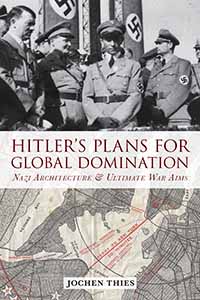
Hitler’s Plans for Global Domination: Nazi Architecture and Ultimate War Aims, Jochen Thies, with a Foreword by Volker R. Berghahn
The Holocaust and Historical Methodology, edited by Dan Stone
Changing Perceptions of the Public Sphere, edited by Christian J. Emden and David Midgley
Reassessing the Nuremberg Military Tribunals: Transitional Justice, Trial Narratives, and Historiography, edited by Kim C. Priemel and Alexa Stiller
Charismatic Leadership and Social Movements: The Revolutionary Power of Ordinary Men and Women, edited by Jan Willem Stutje

Newly released paperbacks from Berghahn’s history list:
Jewish Life in Nazi Germany: Dilemmas and Responses, edited by Francis R. Nicosia and David Scrase
Berlin Divided City, 1945-1989, edited by Philip Broadbent and Sabine Hake
Changing the World, Changing Oneself: Political Protest and Collective Identities in West Germany and the U.S. in the 1960s and 1970s, edited by Belinda Davis, Wilfried Mausbach, Martin Klimke, and Carla MacDougall


Interview with the Author – Britta McEwen, author of Sexual Knowledge: Feeling, Fact, and Social Reform in Vienna, 1900-1934

Britta McEwen is author of Sexual Knowledge: Feeling, Fact, and Social Reform in Vienna, 1900-1934, published earlier this year by Berghahn. Her work uncovers the transformation of sexual knowledge from the realm of specialized medical science to that of social reform for the wider populace. Here she discusses her work, some of the challenges she faced in writing about some of the key historical figures, and how she would utilize her apple pie making skills if she weren’t a historian.

1. What drew you to the study of sexual knowledge in the early twentieth century?

I actually got into this field through architecture!  Vienna has these amazing public housing projects from the interwar period, and as I investigated them I learned that they were intended for a new kind of people – upright, moral, hardworking small families.  This seemed to entail a new sexual system, starting with birth control at the very least.  That, combined with a well-timed read of Isabel Hull’s “Sexuality, State, and Civil Society in Germany,” made me think that there was a story to tell in Vienna’s early twentieth century about attitudes towards sex.

2. Did any perceptions on the subject change from the time you started your research to the time you completed the book?

On of my assumptions at the beginning of my project was that science was always a liberating voice vis-à-vis sexuality.  While scientific discourse was used to challenge Church teachings about sex, I found that many authors in the early twentieth century were actually using melodramatic language, rather than scientific language, to express the call to sexual and social justice.  At first I thought this was just a trick to popularize complex ideas, but as I went on I came to believe that melodrama offered people writing about sex a way to talk about ignorance, shame, and consequences in a way that would be convincing to a wide audience.

3. What aspect of writing this work did you find most challenging?  Most rewarding?

I’ll answer that one by combining the questions and talking about what was both challenging AND rewarding…  some of the historical characters I met in my research were so very colorful and compelling that they threatened to overshadow the “knowledge” they sought to impart.  Here I’m thinking of Wilhelm Reich, Johann Ferch, and above all, Hugo Bettauer.  Bettauer became a personal hero of mine as I wrote, which made it difficult to really focus on his journalism, rather than his person, for the book.  In another world, I think I would have ditched the reams of research I had collected and simply written about Bettauer’s humanism and his outrageous career.

4. To what extent do you think the book will contribute to debates among academics within the field?

Although one of the arguments of my book is that Vienna was a special site for the production and distribution of sexual knowledge in the early twentieth century, I think it would be interesting to see comparative work done on this issue.  How unusual were places like Vienna, Paris, and Berlin?  What made them unique?  I also wonder if books like mine will help dispel the belief that there was only one sexual revolution.  Finally, the debate in the German-speaking world about the “repressive” sexual regimes of the twentieth century is really heating up, and I think books like mine will help contextualize what sexual “liberation” meant to different historical actors.

5. If you weren’t a historian, what would you have done instead?

Although I am a hardly an entrepreneur, I do think I might have been able to run a public space.  Lord knows I waitressed enough to know a good cup of coffee when I see it, and I make a mean apple pie.  So some days I fantasize about running a bookstore specializing in science fiction and mysteries, where you could get something sweet to eat and sit all day (just like in Vienna), reading and gabbing.  I imagine it to be the kind of place with a bad pun in the title and a standing feminist knitting circle – come to think of it, the kind of place that could be lampooned on “Portlandia.”

Britta McEwen teaches European History at Creighton University in Omaha, Nebraska.

Hot Off the Presses- New Book Releases

New in print from Berghahn:
After The History of Sexuality: German Genealogies with and beyond Foucault, edited by Scott Spector, Helmut Puff, and Dagmar Herzog

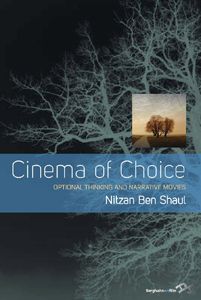
Cinema of Choice: Optional Thinking and Narrative Movies, by Nitzan Ben Shaul

Hitler’s Volksgemeinschaft and the Dynamics of Racial Exclusion: Violence against Jews in Provincial Germany, 1919-1939, by Michael Wildt, translated from German by Bernard Heise

Sharing the Sacra: The Politics and Pragmatics of Intercommunal Relations around Holy Places, edited by Glenn Bowman

Interview with the Author- Nitzan Ben-Shaul, Author of Cinema of Choice: Optional Thinking and Narrative Movies

Nitzan Ben-Shaul is the author of Cinema of Choice: Optional Thinking and Narrative Movies, which will be released by Berghahn this month. His book explores films such as Sliding Doors, Run Lola Run, Inglourious Basterds, and Rashomon that present alternate narrative paths and uses these films to examine how standard linear films close down thinking processes, while arguing that optional thinking in film can be stimulating and rewarding. Here, he answers questions about his research and topic.

1. What drew you to the topic of cinema that proposes alternate narrative paths?
I was initially drawn to these movies when working on my book on interactive cinema (Hypernarrative Interactive Cinema: Problems and Solutions, Rodopi, 2008). Being concerned there with drama-guided interaction I found movies like Run Lola Run, Sliding Doors, and Rashomon to be excellent models for devising engaging interactive movies given their bifurcating narrative paths. I also produced a feature length interactive movie entitled Turbulence (2009) based on my research into interactive movies. I then asked myself what is the added value of these films and realized that they encourage optional thinking, that is, they get you thinking about options in life, a process that most movies actually derail by their encouraging closed-mindedness in their one-track narrative trajectory leading in an apparent strict causality to a relieving closure. Continue reading “Interview with the Author- Nitzan Ben-Shaul, Author of Cinema of Choice: Optional Thinking and Narrative Movies

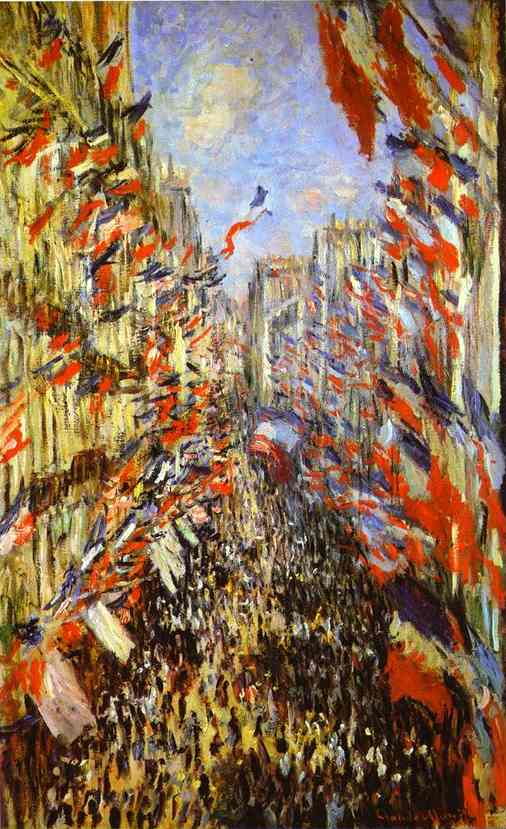
Happy Bastille Day- A Brief History of the Holiday and French Revolution Resources from Berghahn

Most national days celebrate about what you would expect a national day to celebrate. Some, like the national days of the United States, Albania, and Haiti mark the signing of a declaration of independence from a colonial power. Other countries, like much of Africa, choose to remember the day the colonial power actually left. Countries like Germany and Italy celebrate unification. Others are a little quirkier, like Austria which celebrates its declaration of neutrality and Luxembourg which honors the Grand Duke’s birthday. A handful of countries such as the United Kingdom and Denmark have no national holiday. But few countries can top France for the sheer coolness of their national day which commemorates the day an angry mob stormed a prison. Continue reading “Happy Bastille Day- A Brief History of the Holiday and French Revolution Resources from Berghahn”

New to Berghahn Journals- European Comic Art

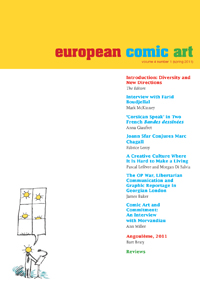
The release of the July 2012 issue of European Comic Art has been a big deal around our offices because it marks the journal’s relaunch as a Berghahn title. Published in partnership with the American Bande Dessinée Society and the International Bande Dessinée Society, it is the first English-language journal devoted to European graphic novels and comic strips.  Continue reading “New to Berghahn Journals- European Comic Art”

Interview with the Editor- Gemma Blackshaw, Co-Editor of Journeys into Madness: Mapping Mental Illness in the Austro-Hungarian Empire

Gemma Blackshaw, along with Sabine Wieber, is one of the editors of Journeys into Madness: Mapping Mental Illness  in the Austro-Hungarian Empire. In her own contribution to the volume, she discusses the work and life of Viennese author and poet and Peter Altenberg. Here, she answers questions about her research and herself.

1. What drew you to Peter Altenberg as a topic?
A caricature of Altenberg was chosen as the poster image for the Madness & Modernity exhibition I curated with Leslie Topp and Sabine Wieber, which looked at the relationship between mental illness and the visual arts in Vienna circa 1900 (Wellcome Collection, London and Wien Museum, Vienna, 2009-10). It was a last-minute addition to the exhibition, gratefully received from the Neue Galerie Museum for Austrian and German Art in New York, and I had little time to research its history. I touched upon Altenberg’s own experience of what was termed ‘nervous disorder’ in the accompanying catalogue in an essay on the artist Oskar Kokoschka, who painted Altenberg’s portrait in 1909, and made a mental note to follow up what seemed to me to be an intriguing set of questions: was Altenberg as ‘mad’ as he appeared in the caricature; did an answer to that question even matter; what were the circumstances of his being institutionalised; what was the value and the differences in being represented, and representing yourself, as ‘mad’? These questions formed the starting point of a long research journey which became so compelling a trail that I produced not only this essay but also a documentary film collaboration with artist and filmmaker David Bickerstaff titled Altenberg: The Little Pocket Mirror. Continue reading “Interview with the Editor- Gemma Blackshaw, Co-Editor of Journeys into Madness: Mapping Mental Illness in the Austro-Hungarian Empire”

Hot Off the Presses- New Book Releases

European Foundations of the Welfare State, by Franz-Xavier Kaufmann, translated by John Veit-Wilson, foreword by Anthony B. Atkinson

Fortune and the Cursed, the Sliding Scale of Time in Mongolian Divination, by Katherine Swancutt

Investigating Srebrenica: Institutions, Facts, Responsibilities, edited by Isabelle Delpla, Xavier Bougarel, and Jean-Louis Fourn

Journeys into Madness: Mapping Mental Illness in the Austro-Hungarian Empire, edited by Gemma Blackshaw and Sabine Wieber

Learning from the Children: Childhood, Identity and Culture in a Changing World, edited by Jacqueline Waldren and Ignacy-Marek Kaminski

A Lover’s Quarrel with the Past: Romance, Representation, Reading, by Ranjan Ghosh

The Making of the Pentecostal Melodrama: Religion, Gender and Media in Kinshasa, by Katrien Pype

Ordinary Lives and Grand Schemes: An Anthropology of Everyday Religion, edited by Samuli Schielke and Liza Debevec

The Politics of Educational Reform in the Middle East: Self and Other in Textbooks and Curricula, edited by Samira Alayan and Achim Rohde, and Sarhan Dhouib

Revisiting Feminist Approaches to Art Therapy, edited by Susan Hogan

Event Announcement: Book Launch for Journeys into Madness: Mapping Mental Illness in the Austro-Hungarian Empire

The latest addition to Berghahn’s Austrian and Habsburg Studies series, Journeys into Madness, co-edited by Gemma Blackshaw and Sabine Wieber, launches at the Freud Museum London on 26 June 2012. The editors, along with many of the authors, will be there to talk to members of the public about the book, and advance copies will be available to purchase at the event. Gemma’s essay for the book considers the intriguing case of the ‘mad’ Austrian writer, Peter Altenberg. The book launch is combined with the UK première of her recent documentary film collaboration with award-winning artist and filmmaker David Bickerstaff, Peter Altenberg: The Little Pocket Mirror, which introduces the life and work of this troubled man to English-speaking audiences. To find out more information, and to book a place to attend the book launch and film screening see http://www.freud.org.uk/events/74694/altenberg-the-little-pocket-mirror/. Continue reading “Event Announcement: Book Launch for Journeys into Madness: Mapping Mental Illness in the Austro-Hungarian Empire”

Hot Off the Presses- New Book Releases

Recent Releases from Berghahn Books:
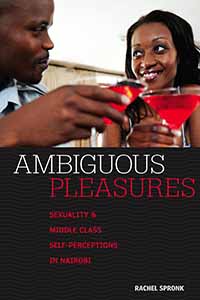
Ambiguous Pleasures: Sexuality and Middle-Class Self-Perceptions in Nairobi, by Rachel Spronk
Collaborators Collaborating: Counterparts in Anthropological Knowledge and International Research Relations
, edited by Monica Konrad
Conversion and the Politics of Religion in Early Modern Germany, edited by David M. Luebke, Jared Poley, Daniel C. Riley, and Warren Sabean
Cultures of Colour: Visual, Material, Textual, edited by Chris Horrocks
Czechs, Germans, Jews: National Identity and the Jews of Bohemia
, by Kate?ina ?apková, translated by Derek and Marzia Paton
Dark Trophies: Hunting and the Enemy Body in Modern War, by Simon Harrison
Marginal at the Center: The Life Story of a Public Sociologist
,
by Baruch Kimmerling, translated by Diana Kimmerling
Moving Subjects, Moving Objects: Transnationalism, Cultural Production and Emotions, edited by Maruška Svašek
Postcolonial Migrants and Identity Politics: Europe, Russia, Japan, and the United States in Comparison, edited by Ulbe Bosma, Jan Lucassen, Gert Oostindie
Walls, Borders, Boundaries: Spatial and Cultural Practices in Europe, edited by Marc Silberman, Karen E. Till, and Janet Ward