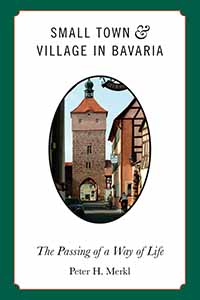
 Note: Berghahn recently published Peter H. Merkl’s Small Town and Village in Bavaria: The Passing of a Way of Life, a study of that region’s modernization efforts in the 1970s and 1980s that led to a considerable reduction in the autonomy of its small communities. Here the author discusses how the decline of iconic village life (and the broader implications) motivated his study:
Immense changes have occurred in German agriculture and in the economic and social life of very small towns, which I explore in my work Small Town and Village in Bavaria: The Passing of a Way of Life. In many ways, these changes mirror transformations occurring in small towns across the industrialized world. While many people in today’s urbanized society actually come from small town backgrounds or grew up in the countryside and feel nostalgia for the closeness of small communities or for a family farming way of life, these settings have nearly vanished in the last 100 years or so. Where once a majority of the German population were farmers, only a tiny percentage remain so today and most of them are part-time farmers. The majority of really small places have lost their taverns and other local businesses while both schoolchildren and adults commute daily to distant, larger towns.
While the populations of small places decline, the charms of their old historical structures endure, highlighted in art and literature. When we travel through very old towns we are struck by the medieval walls, gates and turrets, and ancient churches that manifest the venerable age of communities that have witnessed centuries of political and social change. Tourists have discovered such places all over Europe, especially in the United Kingdom, France, and Germany where such well-known medieval towns as Rothenburg on the Tauber River or the small villages along the Romantic Road in Bavaria still enchant the visitor.
My book not only focuses on the long-term changes in German agriculture and in fifteen old Franconian mini-towns but also examines the effects of an ambitious modernization project by the Bavarian state that sought to deprive all communities under a certain size of their autonomy and to force them into “administrative unions” with other small places. It was a process not unfamiliar in the U.S. and many European countries, though usually in a more voluntary form, but resulting in far fewer, modernized local units in either case.
The tension between the preservation of these small communities amid the slow dynamics of social change on the one hand and the massive state intervention to modernize Bavarian local government at the periphery on the other is what drew me to this project. It seemed preposterous to force groups of medieval, independent small towns to merge for the sake of modernization. Through my research, which included several mail surveys of mayors, interviews with state and local officials, and statistical materials, I have created a fuller picture of these micro-towns and placed them within the larger hierarchy of German and European levels of government, providing a clearer context for the changes in these localities.
Peter H. Merkl is Professor Emeritus of Political Science at the University of California, Santa Barbara. He has published extensively on comparative and German government and politics, in particular the origin of the West German Republic and German unification.
 Join our Email List




 Post-Cosmopolitan Cities: Explorations of Urban Coexistence, edited by Caroline Humphrey and Vera Skvirskaja