Variations on an Educational Theme

When the traditional educational system of colonizing societies was disseminated to indigenous societies, it was not accepted by the colonized “as-is,” but was adopted as merely an underlying framework. This hybridization led to a multitude of varied, yet similar, educational systems across the post-imperialized world. In the following excerpt from the Introduction of Connecting Histories of Education: Transnational and Cross-Cultural Exchanges in (Post)Colonial Education, to be published this month, editors Barnita Bagchi, Eckhardt Fuchs and Kate Rousmaniere further explain the connections within modern educational culture.


______________________________
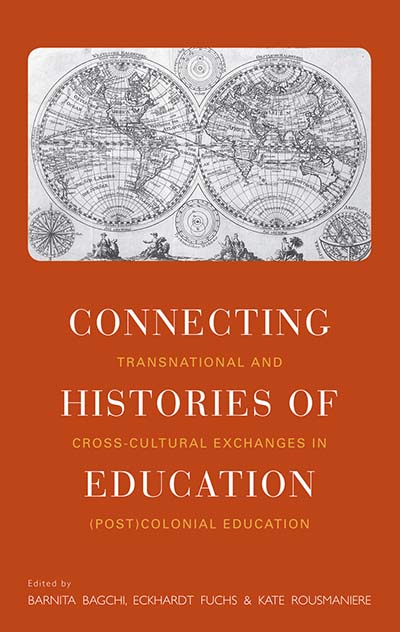
Connecting Histories of Education bears a double meaning. The volume connects historians of education from South Asia and other parts of the world to enhance a comparative perspective and create a wider research network beyond the Euro-Western world. In addition, it presents local, regional, national and transnational research, with the goal of highlighting the interconnectedness of histories of education in the modern world.
Continue reading “Variations on an Educational Theme”

Vienna, Dream City within a ‘Paradoxical Republic’

For the next three weeks, New York City will resonate with the energy of Austria. Vienna: City of Dreams will feature a slate of events presented by Carnegie Hall. Capping the festival will be symphony performances of the Vienna Philharmonic, an orchestra which has been celebrated since its first concert in 1842. This arrangement of musicians became a cultural beacon in post-World War II Austria, the subject of Oliver Rathkolb’s The Paradoxical Republic: Austria 1945-2005. Following, in an excerpt from the volume, which will soon be published as a paperback, Rathkolb discusses the Philharmonic’s presence in a discordant time.


_________________________________________________

In 1953 . . . neither the Vienna Staatsoper nor the Burgtheater had yet been rebuilt; they were not yet functional as memory sites. However, this did not detract from the importance of the aesthetic role music, notably classical music, played in the postwar era. The sense of purpose felt when the old and new political and economic elites gathered for the first Philharmonic concerts on 27 and 28 April 1945 was highly significant. There was a strong admixture of the Soviet military in the audience, deliberately encouraged by the liberal dispensation of free tickets by the Philharmonic.


Continue reading “Vienna, Dream City within a ‘Paradoxical Republic’”

A Class Issue: Language and Education in India

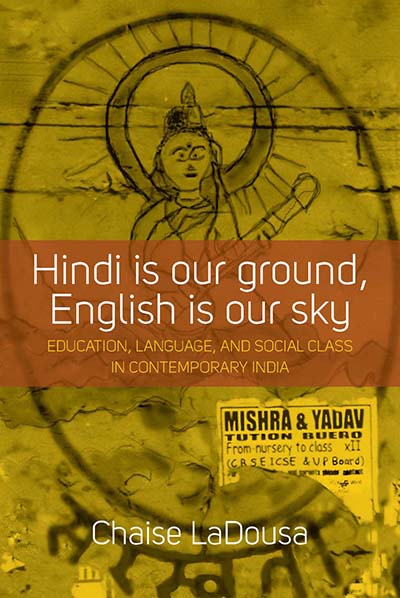
In the past three decades within India, a knowledge of the English language has become more important for economic advantage. All the while, Hindi is essential to those who wish to pursue class mobility. These “mediums” form a divide within the country’s educational system, which come to the forefront in Chaise LaDousa’s Hindi is our Ground, English is our Sky: Education, Language, and Social Class in Contemporary India, published this month. Following are two excerpts from the book, the first from the Foreword by Krishna Kumar, and the second from the Preface.

__________________________________________________


[Chaise LaDousa] has studied India’s vertical language divide in the North Indian city of Varanasi. The study takes us well beyond the shibboleths proffered about India’s linguistic plurality. The key word that enables LaDousa to enter the separate yet interwoven milieus of Varanasi is “medium.” The term is so omnipresent in the Indian urban environment that no one marvels at the versatile service it renders to India’s society and state. It resides securely in the phrase “medium of instruction” that is used across India as a public code to identify two types of schools and the opportunity markets to which they promise access.

Continue reading “A Class Issue: Language and Education in India”

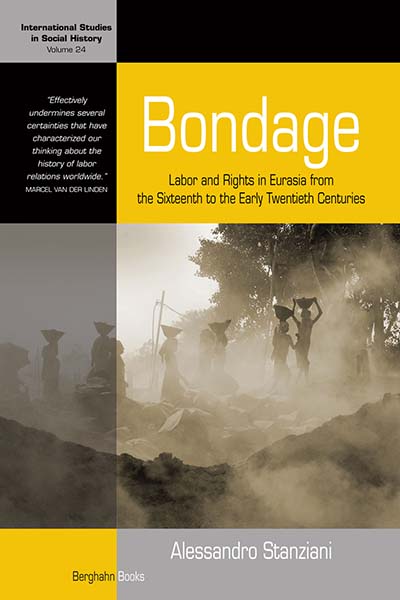
Unfree, but not Exploited in Eurasia

Is “unfree labor” good for business? Is it good for the unfree? Author Alessandro Stanziani aims to answer questions of labor, rights and freedoms in a comparison of Russian labor and business practices with those in Asia, Europe, and the Indian subcontinent. He covers this topic extensively in his new book, Bondage: Labor and Rights in Eurasia from the Sixteenth to the Early Twentieth Centuries, to be published this month. Below, in an excerpt from the volume, Stanziani gives an glimpse into nearly four centuries of Eurasian labor.

_____________________________________________


This book is about the evolution of labor and labor institutions in Russia as compared with Europe, Central Asia, and the Indian Ocean region, between the sixteenth and early twentieth centuries. It questions common ideas about the origin of labor institutions and market economies—their evolution and transformation in the early-modern and modern world.

Continue reading “Unfree, but not Exploited in Eurasia”

Policy-Tracing Up, Down, Sideways

In an excerpt from the Introduction of A Policy Travelogue: Tracing Welfare Reform in Aotearoa/New Zealand and Canada, published in September, Catherine Kingfisher explains just how she came to be interested in the subject of welfare policy, and its existence as a living, working idea.


____________________________________

My interest in tracing policy began in the summer of 2000, when I was writing grant applications to work with welfare mothers in southern Alberta, where I had recently moved from Aotearoa/New Zealand. I discovered that in the early 1990s the Alberta provincial government of premier Ralph Klein, in the process of reforming its governing structures and welfare systems, had been heavily influenced by Roger Douglas, the former Finance Minister of New Zealand.

Continue reading “Policy-Tracing Up, Down, Sideways”

Forest Protection Fail: How ‘Things Fall Apart’

Pauline von Hellermann seeks the root causes of African deforestation in Things Fall Apart? The Political Ecology of Forest Governance in Southern Nigeria, published in September. The volume stems from Hellermann’s ethnographic and historic research within the tropical forest of Nigeria’s Edo State as she digs to uncover the failings of forest protection. The following is an excerpt from the Introduction.


____________________________________________

To international foresters and conservationists, there are clear links between recent management failure and deforestation in Nigeria. The Conservation Atlas of Tropical Forests, for example, states that Nigeria’s ‘natural forests were carefully managed in the early part of the century, [but] they have since been severely over-exploited’ (Lowe, et al. 1992: 230; see also Oates 1999). Nigerians themselves routinely blame corruption and greed amongst foresters and politicians for forest loss and the depletion of timber. Such accounts fit smoothly into the broader perception of Nigerian governments as corrupt and inefficient; into the constant refrain that ‘things fall apart’ in Nigeria.

Continue reading “Forest Protection Fail: How ‘Things Fall Apart’”

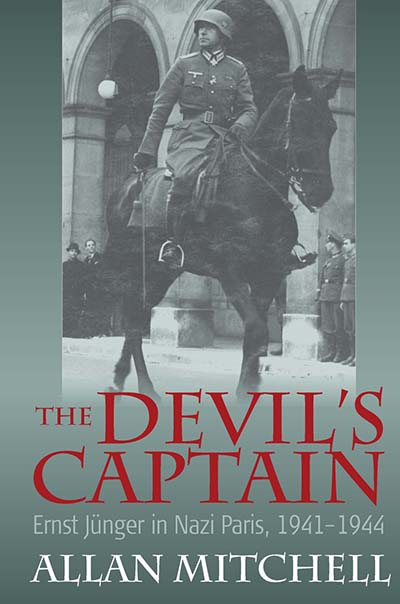
Jünger in Paris: A Writer’s Wartime Account in the City of Lights

Allan Mitchell takes a look at Ernst Jünger, an under-appreciated twentieth century writer, but an important social figure. The Devil’s Captain: Ernst Jünger in Nazi Paris, 1941-1944 follows the writer at wartime, where he spent his stint in Paris as a military officer whose chief duty was to “mingle with French intellectuals.” Below is an excerpt from the volume, which was originally published in May 2011 and is soon to be released in ebook format.


________________________________________

Very few, if any, critics of German literature would rank Ernst Jünger among the greatest writers of the twentieth century. He simply does not compare, as a novelist, with giants like Thomas Mann, Franz Kafka, or Robert Musil. His signature work, Auf den Marmorklippen, has been often justly praised for its chiseled language and allegorical imagination. But for later generations raised on soaring flights of science fiction, Jünger’s 1939 work must seem brief, rather stilted, and now somewhat dated. In any event, it pales beside Buddenbrooks and Der Zauberberg, Das Urteil and Das Schloss, or Der Mann ohne Eigenschaften.

Continue reading “Jünger in Paris: A Writer’s Wartime Account in the City of Lights”

The Life of Policy in Canada and New Zealand

Policies have their own lives, and these lives are not “a-cultural, rational, and straightforwardly technical,” puts forth Catherine Kingfisher in her volume, A Policy Travelogue: Tracing Welfare Reform in Aotearoa/New Zealand and Canada, published in September. Following is an excerpt from the monograph’s Introduction in which the author sets the scene for her discussion of how policy lives within welfare reform in two distinct countries.


______________________________________


I use the frames of translation and assemblage to gain insight into a range of policy-related phenomena in particular spaces and contexts of occurrence. First, I explore the transformation of objects as they are translated from one philosophical and political framework—Keynesianism—into another—neoliberalism. Brodie (2002:100) points out in this regard that the privatization characteristic of neoliberalism: “[i]nvolves much more than simply removing things from one sector and placing them in another….the thing moved is itself transformed into something quite different. Objects become differently understood and regulated.”

Continue reading “The Life of Policy in Canada and New Zealand”

The Very Human Experiences of the Other

If the search for self was a game, migrants would be more than a few chips down. Having to overcome physical and cultural displacement in addition to psychological uncertainty makes the search, for those who are transient, a complicated quest. Below, in an excerpt from the Introduction of Being Human, Being Migrant: Senses of Self and Well-Being, published in October, editor Anne Sigfrid Grønseth addresses the difficulties of migration and asserts that these hardships are of larger breadth than simply issues of movement.


____________________________________


This volume is as much about being human as it is about being a migrant. It takes as its starting point from the proposition that migrant experiences tell us about the human condition, on the basis that senses of well-being, self, other and humanity are challenged when people move between shifting social and cultural contexts. Our contemporary world is characterised by an increasing degree of movement that highlights how societies and cultural units are never separate but overlapping, rapid changing and engaged in repeated processes of fission and fusion.

Continue reading “The Very Human Experiences of the Other”

An Uprising of Historical Importance

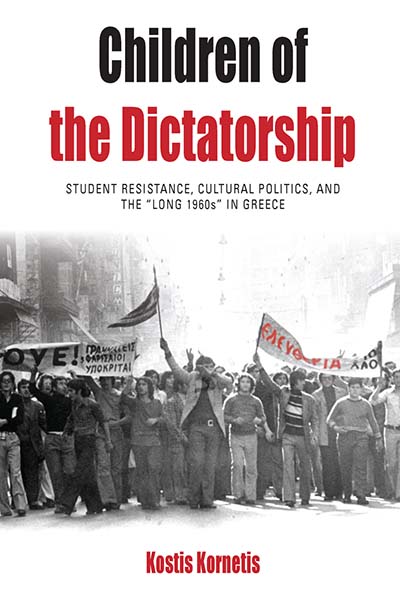
The cyclical course of history comes into sharp focus when one looks at Greek political uprisings. The widely publicized youth dissent in recent years is nothing new, but actually has earlier roots in 1973 — with different players, but with the same activist vigor. This 1970s group — later to be known as the Polytechnic Generation — comes into clear focus in newly published Children of the Dictatorship: Student Resistance, Cultural Politics and the “Long 1960s” in Greece, by Kostis Kornetis. Following is the opening to the volume’s introduction. 


___________________________________

In 2010 the well-known British Pakistani writer and political activist Tariq Ali commented that “were there a Michelin Great Protest guide, France would still be top with three stars, with Greece a close second with two stars.” Ali did not only refer to the 2005 riots in France and the 2008 civil disturbances in Greece, but to a longue durée structure of civil disobedience in the two countries that dates back to the 1960s and 1970s.


Continue reading “An Uprising of Historical Importance”