In the latest issue of the Anthropological Journal of European Cultures, Ullrich Kockel opens the discussion on the 21 years of AJEC‘s history with his own reflections:
“As I settle down to put together this issue, it occurs to me that the development of AJEC in its various phases displays an uncanny correspondence with my personal professional trajectory so far. Its inception and first volume happened during my postdoctoral fellowship when I was happy to place one of my first (coauthored) academic articles in its inaugural issue. The remainder of AJEC’s first approximate decade coincides with my time as a lecturer. At the time I took up my first chair, the format of AJEC changed, eventually turning it, for a while, into a Yearbook rather than a journal. And in the year I moved to my second chair, I was invited to take on the editorship of AJEC, which would now be published by Berghahn and returning to the format of two issues per year. This correspondence raises a curious question: What significant turning point for the journal will correspond with my own as I am becoming an emeritus professor?”
To continue reading a free PDF of his editorial in its entirety, click here.
Michael Haneke’s latest film, Amour, premiered at the 2012 Cannes Film Festival and went on win the Palme d’Or, making it his second win of the award in four years (The White Ribbon won in 2009). At the 25th European Film Awards, Amour was nominated in six categories and won in four, including Best Film and Best Director. The acclaim for the film further confirms Haneke’s position as one of the most significant living filmmakers.
Catherine Wheatley’s detailed study of his work, Michael Haneke’s Cinema, was published by Berghahn in 2009. Screen magazine described it as “a bold, lucid, fiercely intelligent book, a vital addition to the study of contemporary cinema by one of the UK’s brightest young film critics.” It was also Sight & Sound Magazine Book of the Month, September 2009.
“Wheatley provides excellent close readings of a number of films and crucial film scenes. The book as a whole could be used in conjunction with a film course on Haneke, or its various chapters would lend themselves to discussions in graduate and even undergraduate courses on contemporary European film…The writing style is clear and while it pursues a critical theoretical analysis, it remains free from jargon. “ · Monatshefte
Here’s the trailer for Amour, which can be seen in the United States starting December 21st.
Rex Clark and Oliver Lubrich are the editors of Cosmos and Colonialism and Transatlantic Echoes, two volumes that collect writings by and about Alexander von Humboldt – the first collection of its kind. Below, the editors discuss their enthusiasm for von Humboldt’s life and work, and its continued relevance in the 21st century.
What drew you to the study of Alexander von Humboldt?
Humboldt was a fascinating character—explorer of South American tropics, extreme mountain climber in the Andes, darling of the salon society in Paris and Berlin, and a celebrity intellectual known around the world in his time. His vision of society and knowledge discovery was truly intercultural and multidisciplinary and throughout his long life he sparked controversy and attracted attention.
In our original discussions about the project we were struck by how scholarship and conference presentations seemed very isolated and split between English, Spanish, and German language topics and traditions of Humboldt research. We planned to bridge this with a volume of representative essays from around the world. In researching the background contexts we discovered a rich history of literary and critical responses to Humboldt. So then the project morphed and grew to become a cultural history of those responses. We were drawn to how Humboldt appeared in poetry and fiction from his day to the present and we collected the literary responses which became the 100 texts in Transatlantic Echoes. The philosophical discussions and critical works inspired by Humboldt became the 50 essays of Cosmos and Colonialism.
So our two volumes are not really focused on Humboldt per se, but rather on the works of authors who created their own stories and myths, their own theories and propaganda. A mash up of Humboldt’s life and works, if you will, imagined by other writers, crossing two centuries and mixing up genres and nationalities. Other media are there as well, films, plays, comics. And since many of these were originally published in other languages, we had those texts translated so we can present everything in English to our readers. For us it was a big adventure of discovery—to find texts, research authors and their context, and then make the selections. And then we had to get the translations done and deal with all the issues of editing and copyright permissions, that was the part of the journey where we could identify with some of the hardships of Humboldt’s travels.
As should any item or idea in which its creator has invested more than fifteen years, this book very strongly reflects my own life course and concerns. Having cut my teeth on the canon of English language anthropological studies of Japanese farming villages as an undergraduate student, but then having trouble reconciling what I experienced in Ogata-mura in 1995–1996 with what I had previously encountered in this body of literature, I came to want to make my own contribution to the study of Japanese farming villages in the twentieth (and twenty-first) century, but in my own way. As an anthropologist who earned post–graduate degrees in both the USA and Japan, I have attempted to marry the respective ethnological traditions of these two countries, while aiming for a broad audience of social scientists and students of Japan and its society.
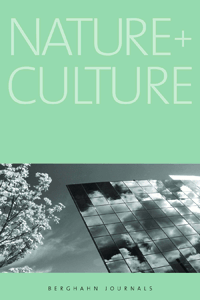
Nature and Culture Volume 7, Number 3, Winter 2012
Including articles on the Second Darwinian Revolution, environmentalism in Iran, what is necessary for sustainability in the water sector, and the environmental impacts of militarization.
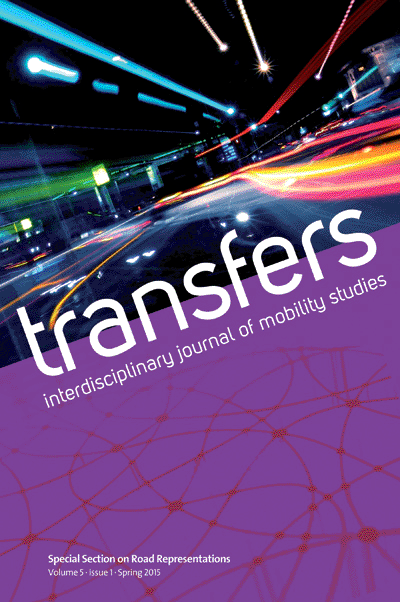
Transfers Volume 2, Number 3, Winter 2012
Featuring a Special Section on Cultural Appropriation containing articles that comment on the “cultural appropriation” of, respectively, literary genres, stories, and sausages.
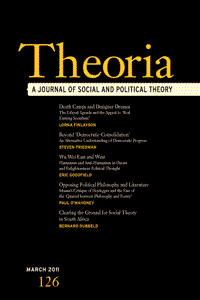
Theoria Volume 59, Number 133, Winter 2012
With articles on the national debt to Africa, democracy and democide in the Weimar Republic, moral relativism, the politics of theatre, and the revival of political philosophy.
Journal of Romance Studies Volume 12, Number 3, Winter 2012
With a special focus on Antonia Gramsci, exploring various intersections between culture and politics, fostering the cross-fertilization of new Gramscian specialisms and traditional disciplines.
Focaal Volume 2012, Number 64, Winter 2012
Featuring a theme section on the anthropology and radical philosophy of Antonio Negri and Michael Hardt, as well as articles on issues in China, West Bengal, and South Korea.
Note: Berghahn recently released the paperback edition of Laurence Grove’s Comics in French and also publishes the journal European Comic Art, which he co-edits. Here he discusses his current work on an exhibit of comics for the Hunterian Art Gallery in Glasgow.
__________________________________________
One of the inspiring things about co-editing European Comic Art, apart from the buzz of working with Ann Miller and Mark McKinney, is the connections it creates. In recent times we have had the pleasure of receiving scholarship on comic art from England, France, Greece, Canada, Italy, Spain, Argentina and Germany, and from the eighteenth century to the twenty-first. It is not long before you are reminded that whatever your speciality, there are unexpected link-ins elsewhere and contradictions to the knowledge we might have taken for granted.
It may seem strange, therefore, that one of my current projects is to prepare an exhibition whose provisional title, Scotland and the Birth of Comics, could appear to bask in positivist certainties. The display, which will open in Glasgow’s Hunterian Art Gallery before touring, will bring to light a little-known work of primary importance, The Glasgow Looking Glass of 1825. The Looking Glass appears to be the world’s oldest comic, predating the earliest published ‘comics’ by Rodolphe Töpffer by eight years, Le Charivari by seven, and Punch by sixteen. Building on the historic angle and taking the notion of graphic narrative in its widest sense, the exhibition will allow us to showcase Hunterian treasures from the Roman period to Hogarth and on to contemporary selections, as well as key manuscripts and printed works from Glasgow University Library’s Special Collections and certain related items from Glasgow’s museums.
“Consumption of Smoke: Present” and “Consumption of Smoke: Future” From Vol. 1, no. 8: Northern Looking Glass, 17th September 1825 With the permission of Special Collections, University of Glasgow Library. (Sp Coll Bh14-x.8)
At the initial research stage (I have the Glasgow Looking Glass in front of me as I write) I have been struck by the intertwining connections. The Looking Glass inspired Punch, but its characters—the street musicians, the clergymen, the medics, and so on—also offer firm reminders of the styles of Töpffer, Rowlandson, and Hogarth. It is thus inevitable that the exhibition will lure the visitor in with the promise of newly-found canonical certainties (comics started in a specific time and place, and that is Glasgow in 1825), only then to make it clear that the complexities are so that such certainties must be flawed.
“Domestic Intelligence: Home, Sweet Home”, From Vol. 1, No. 2: Glasgow Looking Glass, June 25th, 1825 With the permission of Special Collections, University of Glasgow Library (Sp Coll Bh14-x.8)
This week I am going to Geneva to meet with the Director of the Bibliothèque de Genève, Alexandre Vanautgaerden, and his team, with a view to a possible loan of a Töpffer manuscript. Ironically, having made the notion that Töpffer did not invent the comic strip (nor did anyone else) a central theme of my Comics in French (Berghahn Books), I am strangely excited about getting to see the Swiss schoolteacher’s creations in the flesh.It is the fact that life is a hybrid art full of contradictions that makes it such fun. A bit like comics.
__________________________________________
Laurence Grove is is Reader in French and Director of the Stirling Maxwell Centre for the Study of Text/Image Cultures at the University of Glasgow.
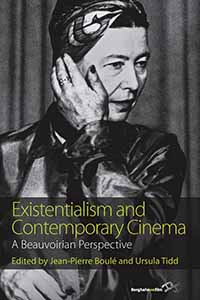
Ursula Tidd: As far as I was concerned, I was keen to show the immense relevance of Beauvoir’s thought to film studies and hence, to take her work more deeply into the area of film studies. I have noticed that Beauvoir’s work is often implied in discussions in film studies about ‘the male gaze’ and on the topic of gender relations more broadly, but not always made explicit in what it contributes to the debates.
Jean-Pierre Boulé: A desire to use The Second Sex to show that Beauvoir still has a lot to say about human relationships.
How did you hope it might influence the field?
J-PB: For people to go back to or discover Beauvoir and realise that she has a place in film studies.
UT: I hope that this volume will inspire more people to look at film through Beauvoirean eyes, so to speak! And to engage more closely with her phenomenologically-based philosophy on gender and ageing.
Which aspect of co-editing did you find most difficult?
J-PB: Not difficult as such, but bearing in mind a student readership, making the volume accessible to them. And choosing the front cover photograph.
UT: Yes, it’s important to keep in mind the future readership of a volume like this – although one can’t please everyone…
Would the films discussed be the kind of films Simone de Beauvoir would be interested in?
UT: For sure! Beauvoir was highly eclectic in her cultural interests and an avid film-goer, at least for most of her life. She enjoyed art house as well as Hollywood cinema so I think that all the films discussed would have engaged her.
J-PB: Absolutely! I like to think she would have liked the various genres under study, as she herself wrote in a variety of genres. I think she would have loved Revolutionary Road, set in 1955, with its story of oppression and liberation.
______________________________
Jean-Pierre Boulé is Professor of Contemporary French Studies at Nottingham Trent University.
Ursula Tidd is Senior Lecturer in French Studies at the University of Manchester.
 Join our Email List




 What drew you to the study of Alexander von Humboldt?
 As should any item or idea in which its creator has invested more than fifteen years, this book very strongly reflects my own life course and concerns. Having cut my teeth on the canon of English language anthropological studies of Japanese farming villages as an undergraduate student, but then having trouble reconciling what I experienced in Ogata-mura in 1995–1996 with what I had previously encountered in this body of literature, I came to want to make my own contribution to the study of Japanese farming villages in the twentieth (and twenty-first) century, but in my own way. As an anthropologist who earned post–graduate degrees in both the USA and Japan, I have attempted to marry the respective ethnological traditions of these two countries, while aiming for a broad audience of social scientists and students of Japan and its society.