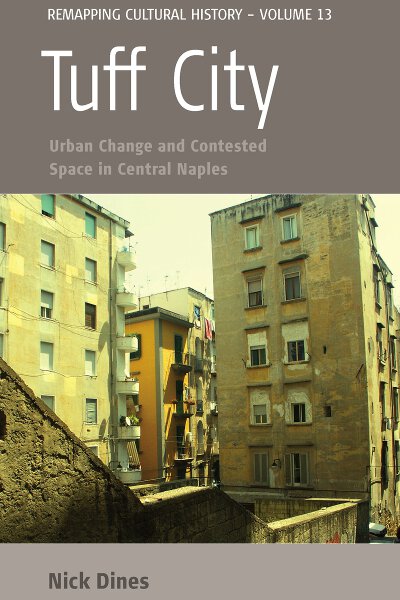
An Excerpt from Tuff City: Urban Change and Contested Space in Central Naples

Tuff City is an ethnographic history of urban renewal in the historic centre of Naples during the 1990s under the stewardship of the city’s first directly elected mayor, former communist Antonio Bassolino. Through the study of two major piazzas and a squatted centro sociale (social centre), the book explores the pivotal role of public space in the administration’s efforts to reorder and redefine a city that had hitherto been commonly regarded as an urban outcast. It thus sets out to investigate how changes to the built environment were, on the one hand, produced and publicly endorsed and, on the other, experienced and contested by different groups of people.  Understanding public space means grappling with the messy and perhaps ugly pluralism that constitutes urban life, rather than unwittingly confirming normative and institutional ideals about a ‘good’ (and, especially in the case of Naples, ‘well-behaved’) city.


The following extract is taken from the case study of DAMM located in the popular quarter of Montesanto.  As a local resident, I grew to appreciate the complex dynamics of the surrounding social milieu that some outside observers have hastily (mis)labelled ‘inner city’ or ‘working class’ and which local orthodox leftists had in the past dismissed as ‘lumpen’ and ‘pre-political’. Following the occupation of a three-storey building in 1995, the occupants of DAMM – a mix of local residents, students and cultural workers – sought to develop an alternative idea of public space through the self-management of an adjacent park and public escalator system that were built following the 1980 earthquake, but which had been left in a state of abandonment. This extract highlights a theme that lies at the heart of Tuff City, namely, how the politics of regeneration was continually stymied and reformulated through everyday uses of, and struggles over urban space. Continue reading “An Excerpt from Tuff City: Urban Change and Contested Space in Central Naples

Hurricane Sandy and the Climate Change Debate

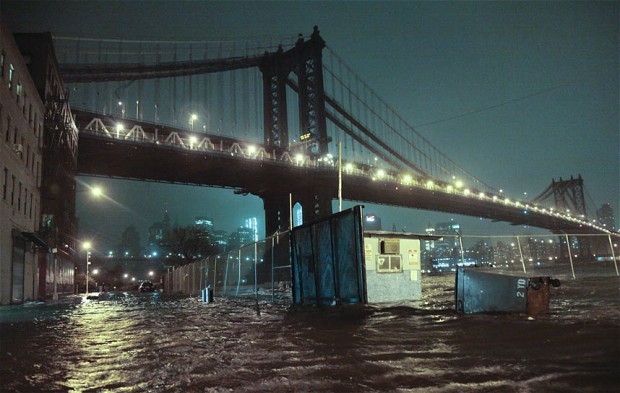
This was the scene just down the street from the Berghahn offices in DUMBO the night of Hurricane Sandy – our office is just outside the frame of this particular photo:


(Photo: AP Photo/Bebeto Matthews)

Over 3 million gallons of water have been pumped from the basement of our office building since then, and we are glad to report that everyone on staff made it through safe and sound (albeit without heat this week but we’re bundled up and hanging in there).

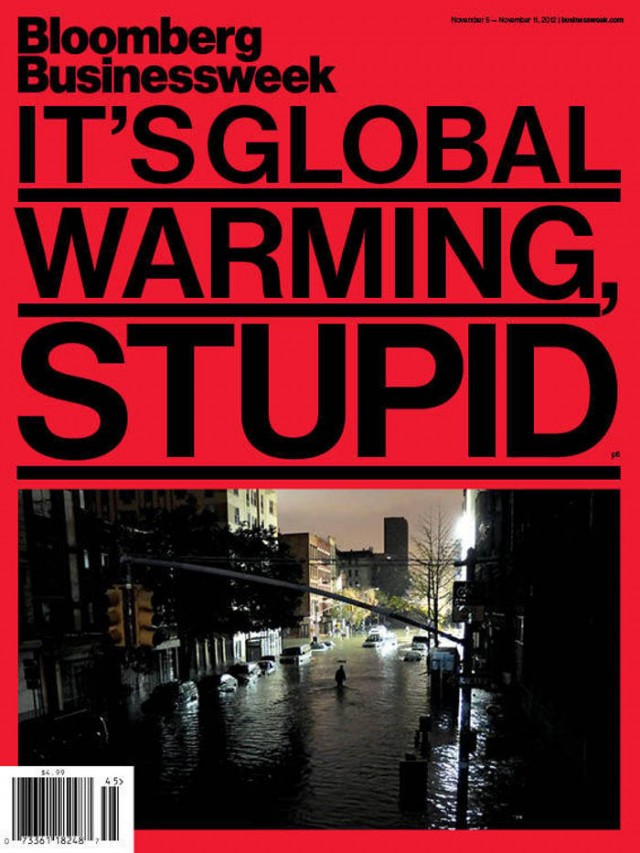
Though recovery has been fairly swift in our area, the images of the “Frankenstorm” and its aftermath have brought the issues of climate change and sustainability to the forefront of political discourse in the United States. Bloomberg Businessweek took the blunt approach:


(Photo: Bloomberg Businessweek)

At Berghahn Journals, we’re proud to publish a selection of journals that take a more scholarly approach to environmental issues.

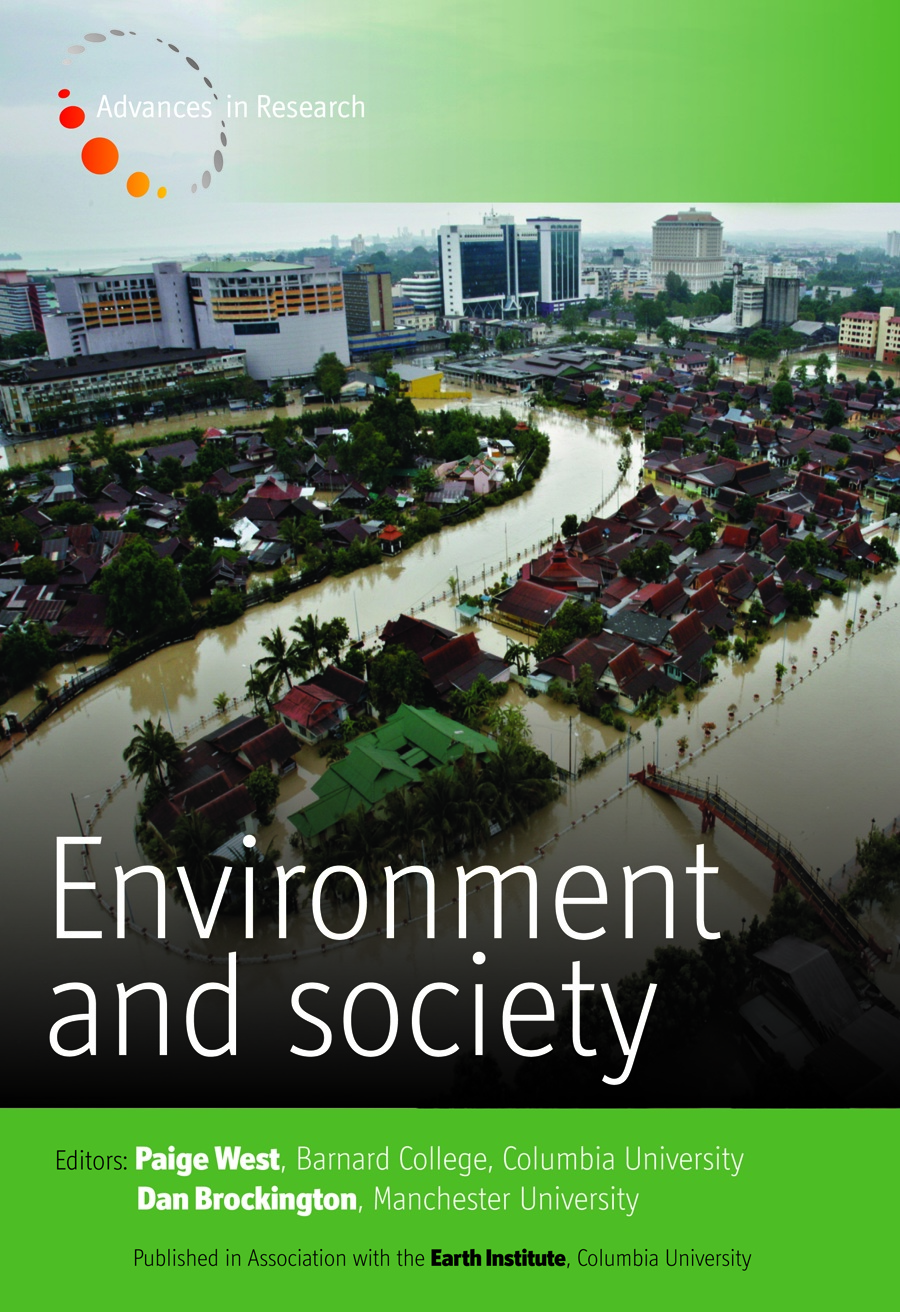
In the next few weeks, we will be posting the online version of Environment and Society Volume 3, which focuses on Capitalism and the Environment. Preview the Table of Contents on the journal’s main page, here.

Next Spring, we are excited to be publishing Nature + Culture’s Special Symposium on “Nature, Science, and Politics, or: Policy Assessment to Promote Sustainable Development?”, the Table of Contents for which is posted on the journal’s main page, here.


In our most recent issue of Nature + Culture, several articles focus on approaches to sustainability:

Sustainability in the Water Sector: Enabling Lasting Change through Leadership and Cultural Transformation by Wendy Lynne Lee

The Environmental Impacts of Militarization in Comparative Perspective: An Overlooked Relationship by Andrew K. Jorgenson, Brett Clark, Jennifer E. Givens

Review Essay: Just Plain Disappointment: Why Contemporary Thinking About Environmental Sustainability Needs To Be More Courageous by Wendy Lynne Lee


Moving forward, we hope that the work of scholars such as those published in our journals will continue to contribute to the discourse on climate change.


Hot Off the Presses: New Journal Releases from Berghahn

New journal releases from Berghahn:

Asia Pacific World
Volume 3, Number 2, Autumn 2012
Including a special feature article on Creating a Poverty-Free World, as well as articles on issues in Japan, Myanmar, Guam, and Indonesia.

Critical Survey
Volume 24, Number 2, Summer 2012
Focusing on Shakespeare’s hometown, Stratford-upon-Avon, the essays in this special issue consider the various manifestations of the physical and metaphorical town on the Avon, across time, genre and place, from America to New Zealand, from children’s literature to wartime commemorations.

Historical Reflections/Reflexions Historiques
Volume 38, Number 3, Winter 2012
Featuring a special section entitled “(Re)presenting Women, the Female, and the Feminine,” with articles that investigate the ways in which women are embodied by, or embody in themselves, the social, cultural, or political ethos of a particular era or region.

International Journal of Social Quality
Volume 2, Number 1, Summer 2012
In this issue, the authors apply the social quality theory to topics including sustainability, social innovation, and urban development.

Israel Studies Review
Volume 27, Number 2, Winter 2012
Guest edited by Gad Barzilai, this special issue of ISR focuses on “Law, Politics, Justice, and Society: Israel in a Comparative Context,” with articles that reveal, explain, and conceptualize these processes that have characterized Israeli politics, law, and society

Projections
Volume 6, Number 2, Winter 2012
Focusing on the psychological, social, and physiological constituents of meaning and emotion in cinema, the essays and book reviews illuminate the multiple dimensions that connect movies and mind.

Meet the Editors – Interview with Andrew Whitehouse, co-editor of Landscapes beyond Land: Routes, Aesthetics, Narratives

Landscapes beyond Land: Routes, Aesthetics, Narratives, edited by Arnar Árnason, Nicolas Ellison, Jo Vergunst, and Andrew Whitehouse has recently been released as part of the EASA series. Here Andrew Whitehouse takes us behind the makings of the volume and shares how through his involvement he overcame his own skepticism for the usefulness of landscape as an idea in anthropology.

________________________

1. What drew you to the study of how landscapes are constituted and recollected?
We were initially encouraged by getting some funding from the UK Arts and Humanities Research Council to run a series of workshops on the theme of landscape. The four of us (myself, Jo Vergunst, Nicolas Ellison and Arnar Arnason) were all interested in environmental anthropology and we were keen to see how different anthropologists were thinking about landscapes. Nicolas is from France and one of our aims was to compare French and British approaches. This really came to the fore when we had a workshop in Paris. We also wanted to see how ethnographic writing about landscape could draw together different elements, from very direct perception to large scale and long-term structural dimensions.

2. What aspect of writing or assembling this work did you find most difficult?
Probably just the sheer task of communicating with all of the different people who have been involved in the book. That’s one of the challenges of an edited volume, I guess. Sometimes there were different perspectives within the editorial team, but in many ways we wanted the book to reflect different ideas about landscape, so that wasn’t a problem.

3. How did your perceptions of the book’s topic change from the time you started your research to the time you completed the book?
I definitely learnt a lot about landscape! When we began the series of workshops on which the book was based, I’ll confess to being a bit skeptical about the usefulness of landscape as an idea in anthropology. I thought it was a problem that it had so much baggage and that it lacked precision. I’ve come to rather like that baggage though, because it tends to take things in an interesting direction. I love the way that landscape seems to encourage us to draw nature, culture and history together.

4. If you weren’t an anthropologist, what would you have done instead?
I used to work on a nature reserve and in fact became an anthropologist initially as a way to think about that sort of landscape. I certainly wouldn’t mind working on a reserve these days. As anyone who knows me will tell you, I’m fairly obsessed with wildlife and it would be good to work outdoors a bit more than I do.

____________________

Andrew Whitehouse is a Teaching Fellow in Anthropology at the University of Aberdeen. He has conducted research in various parts of Britain and elsewhere on conservation issues and human–animal relations, with a particular focus on relations with birds through sound.

The fantasy of a historical source

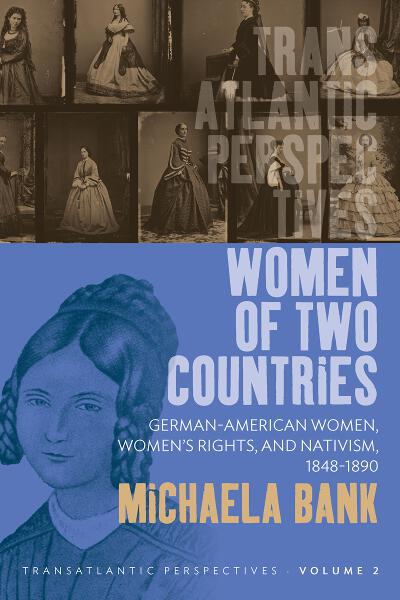
Michaela Bank’s Women of Two Countries: German-American Women, Women’s Rights and Nativism, 1848-1890 has just been released by Berghahn. The second volume in our new series Transatlantic Perspectives, it focuses on the challenges faced by three German-American feminists not only with the US women’s rights movement itself but also within their own ethnic community. In the following post, the author recounts the discovery of a seemingly significant event while undertaking her research.

_______________________________

When I first spent long days in libraries and archives to find out more about German-American women’s participation in the US women’s rights movement I stumbled over an extensive report of a German women’s rights convention that took place in 1868 near Boston. Reading the report, which had been published in a German-language paper by Karl Heinzen, who was one of the rather more radical political editors of the time, I found the presented ideas clear and expressed in sharp language. To give an example, here is what one female speaker is recorded as having said to the audience:

“I predict that, if women are granted the right to vote, the political party that seeks to limit the freedom of social life by moral police and seeks to expand the authority of the clerics by religious coercion will be significantly strengthened. What it has not achieved so far, it will conceivably achieve now with the help of American women who are generally more dependent on the representatives of religion than American men. This party’s goal will be achieved if those women’s additional votes are not made powerless by a pull in the opposite direction. And who shall and will provide this pull? Only the German women!”

Such an openly aggressive opposition to the US-American women’s rights movement among German-American women struck me as rather exceptional. I was thrilled as this convention report was a marvelous source for my study on German-American women, nativism and women’s rights in this period, and so I continued to dig deeper into the sources to find out more about it. How did the grand ladies of the US-American movement, Elizabeth Cady Stanton, Lucy Stone and other prominent advocates of women’s rights, react to this opposition?

…Yet, not all paths in historical research lead to success: I could not find any records of the Roxbury convention anywhere. Then, a few weeks later, I found a short note revealing that Karl Heinzen’s report had actually been a fictional one. Suddenly the shockingly clear and sharp language made sense to me.

Although a fantasy, it remained a fascinating report for me because it illustrated pointedly what a group of German-Americans interested in reform politics thought of the women’s rights movement and why conflict arose so often between the two groups. As I discovered, only a few German-American women were willing to stand up and raise their voice strongly and even aggressively. Such were the women who could endure the tension between their ethnic community, which was often at odds with the US-American women’s rights movement because of its nativist and prohibition stances, and the women’s rights movement that they wanted to be a part of. The efforts of Clara Neymann, Mathilde Wendt, and Mathilde Franziska Anneke for an idea of equal women’s rights are special – special, because they were not at all common while still being powerful and influential. In the end, I was still more than happy that I had found the report of the fictional convention even if it was just a „Hirngespinst“ – a pipe-dream – as a newspaper article called it.

_______________________________

 Michaela Bank received her doctoral degree in American Studies from Goethe-University in Frankfurt/Main, Germany in 2009. She was a fellow in the graduate research training group “Public Spheres and Gender Relations” funded by the German Research Foundation from 2005 to 2008. From 2008 to 2010 she was a Lecturer of American History and Gender Studies at Goethe-University in Frankfurt/Main.


Book launch for Foodscapes, Foodfields, and Identities in Yucatán

On September 20, 2012, a special presentation of Foodscapes, Foodfields, and Identities in Yucatán was held at  the Universidad Autónoma de Yucatán where author Steffan Igor Ayora-Diaz is Professor of Anthropology. Along with Ayora Diaz, scholars Ramona Perez, Sarah Bak-Geller, and Francisco Fernández Repetto discussed the book from both historical and anthropological perspectives. Fittingly, a reception featuring just one of Yucatán’s culinary specialties, cohchinita pibil, followed.

Click here for pictures of the event. Video footage of the presentation can be found here [in Spanish]