Join our Email List
Series
Volume 7
Film Europa
Email Newsletters
Sign up for our email newsletters to get customized updates on new Berghahn publications.
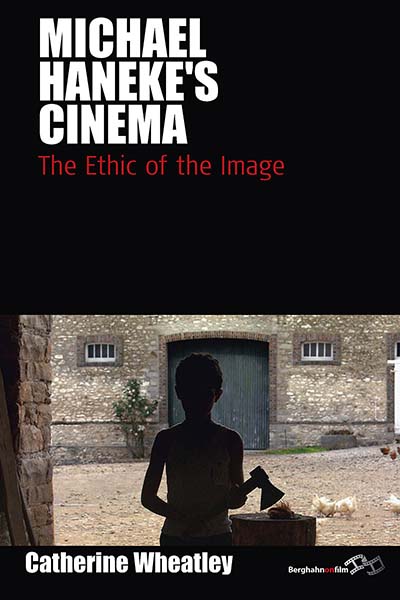
Michael Haneke's Cinema
The Ethic of the Image
Catherine Wheatley
234 pages, 7 illus., bibliog., index
ISBN 978-1-84545-557-6 $135.00/£104.00 / Hb / Published (January 2009)
ISBN 978-1-84545-722-8 $19.95/£15.95 / Pb / Published (September 2009)
eISBN 978-1-80758-613-3 eBook
SHORT-LISTED FOR BEST MOVING IMAGE BOOK BY THE AND/OR BOOK AWARDS
SHORT-LISTED FOR THE 2009 WILLY HAAS AWARD
NOMINATED SIGHT & SOUND MAGAZINE BOOK OF THE MONTH, SEPTEMBER 2009
Reviews
“Wheatley provides excellent close readings of a number of films and crucial film scenes. The book as a whole could be used in conjunction with a film course on Haneke, or its various chapters would lend themselves to discussions in graduate and even undergraduate courses on contemporary European film…The writing style is clear and while it pursues a critical theoretical analysis, it remains free from jargon. “ · Monatshefte
“What distinguishes Catherine Wheatley's work from other scholarship on Haneke is her close examination of spectatorship and the consideration of the connection between film medium and self-awareness... In rich detail, Wheatley cleverly interweaves the narrative and formal aspects of Haneke’s films with audience response and Haneke’s ethical intention. Through analysing the forging of the amalgam of first- and second-generation modernist conventions, generic structure and the star system, this book develops a convincing paradigm for evaluating the spectatorship of Michael Haneke’s films and broadens the scope of what is called (in the book’s title) ‘the ethic of the image’.” · Senses of Cinema
“Both her exacting discussions of the films themselves and the even-handed, pointed summations of the critical debate around them are impressive feats…her succinct prose is eminently readable, even where couched in scholarly language.” · Sight & Sound, The International Film Magazine
“This is a bold, lucid, fiercely intelligent book, a vital addition to the study of contemporary cinema by one of the UK’s brightest young film critics.” · Screen
“Wheatley has initiated an important conversation regarding Haneke and the ethics of spectatorship that will bring a good many others to the table.” · New Review of Film and Television Studies
“Haneke stands as one of world cinema’s most important auteurs, and as such his work demands the kind of lucid and rigorous interrogation provided here. This is an essential book – the real first step in an understanding and an elucidation of Haneke’s oeuvre.” · Ben McCann, University of Adelaide
“Wheatley's compelling philosophical contextualization of the intrinsic rupture of filmic and spectatorial practice in Haneke's oeuvre provides a fresh and very rich platform for cinema and cultural studies. Her analysis of the filmmaker's sophisticated challenges and subversions suggests a path beyond traditional and counter-cinema, and will certainly shift established concepts of the art form and theoretical reception.” · Robert von Dassanowsky, Professor of German and Film Studies, University of Colorado at Colorado Springs
“... a timely and important contribution to film theory, European cinema history and to an understanding of Michael Haneke as an extremely important contemporary filmmaker. Wheatley provides a sophisticated but accessible philosophical framework within which to consider Haneke’s films and grounds this work firmly through close analysis of all of Haneke’s major films.” · David Sorfa, Liverpool John Moores University
Description
Existing critical traditions fail to fully account for the impact of Austrian director, and 2009 Cannes Palm d'Or winner, Michael Haneke’s films, situated as they are between intellectual projects and popular entertainments. In this first English-language introduction to, and critical analysis of, his work, each of Haneke’s eight feature films are considered in detail. Particular attention is given to what the author terms Michael Haneke’s ‘ethical cinema’ and the unique impact of these films upon their audiences.
Drawing on the moral philosophy of Immanuel Kant and Stanley Cavell, Catherine Wheatley, introduces a new way of marrying film and moral philosophy, which explicitly examines the ethics of the film viewing experience. Haneke’s films offer the viewer great freedom whilst simultaneously imposing a considerable burden of responsibility. How Haneke achieves this break with more conventional spectatorship models, and what its far-reaching implications are for film theory in general, constitute the principal subject of this book.
Catherine Wheatley holds degrees from the universities of Bath and Oxford, and is currently a researcher at the University of Southampton. She is a regular contributor to Sight & Sound magazine, as well as having published articles in several journals and books.