A Class Issue: Language and Education in India

In the past three decades within India, a knowledge of the English language has become more important for economic advantage. All the while, Hindi is essential to those who wish to pursue class mobility. These “mediums” form a divide within the country’s educational system, which come to the forefront in Chaise LaDousa’s Hindi is our Ground, English is our Sky: Education, Language, and Social Class in Contemporary India, published this month. Following are two excerpts from the book, the first from the Foreword by Krishna Kumar, and the second from the Preface.

__________________________________________________
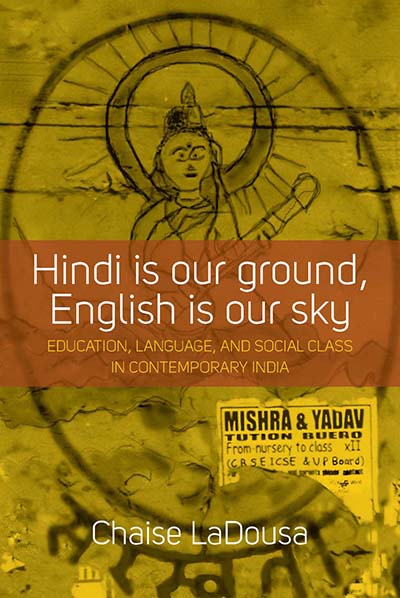
 

[Chaise LaDousa] has studied India’s vertical language divide in the North Indian city of Varanasi. The study takes us well beyond the shibboleths proffered about India’s linguistic plurality. The key word that enables LaDousa to enter the separate yet interwoven milieus of Varanasi is “medium.” The term is so omnipresent in the Indian urban environment that no one marvels at the versatile service it renders to India’s society and state. It resides securely in the phrase “medium of instruction” that is used across India as a public code to identify two types of schools and the opportunity markets to which they promise access.

Continue reading “A Class Issue: Language and Education in India”
Unfree, but not Exploited in Eurasia

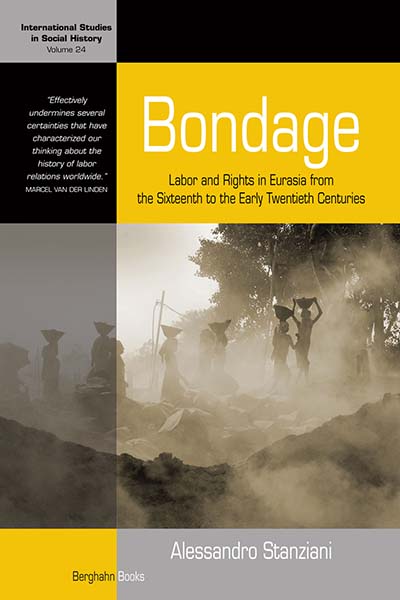
Is “unfree labor” good for business? Is it good for the unfree? Author Alessandro Stanziani aims to answer questions of labor, rights and freedoms in a comparison of Russian labor and business practices with those in Asia, Europe, and the Indian subcontinent. He covers this topic extensively in his new book, Bondage: Labor and Rights in Eurasia from the Sixteenth to the Early Twentieth Centuries, to be published this month. Below, in an excerpt from the volume, Stanziani gives an glimpse into nearly four centuries of Eurasian labor.

_____________________________________________


This book is about the evolution of labor and labor institutions in Russia as compared with Europe, Central Asia, and the Indian Ocean region, between the sixteenth and early twentieth centuries. It questions common ideas about the origin of labor institutions and market economies—their evolution and transformation in the early-modern and modern world.

Continue reading “Unfree, but not Exploited in Eurasia”

A Note on the Influence of ‘Rhetoric and Culture’

 Astonishment and Evocation: The Spell of Culture in Art and Anthropology, edited by Ivo Strecker and Markus Verne, was published earlier this year as the newest volume within the Studies of Rhetoric and Culture series. The volume and series have gained attention within the academic community, one such supporter being Michał Mokrzan, a future collaborator within the series and a scholar of rhetoric. In response to the newest volume, Mokrzan writes an entry of his own interactions with the series, series editors, and series volumes.

StreckerAstonishment
___________________________________________


Due to the fact that the Rhetoric Culture Project develops at a rapid pace – Astonishment + Evocation is the fifth volume of the Berghahn Books series Studies in Rhetoric and Culture – one can risk the thesis that we are now witnessing a crystallization of a new theoretical and methodological trend in anthropology, which can be described as a ‘rhetorical turn in anthropology’.


Continue reading “A Note on the Influence of ‘Rhetoric and Culture’”

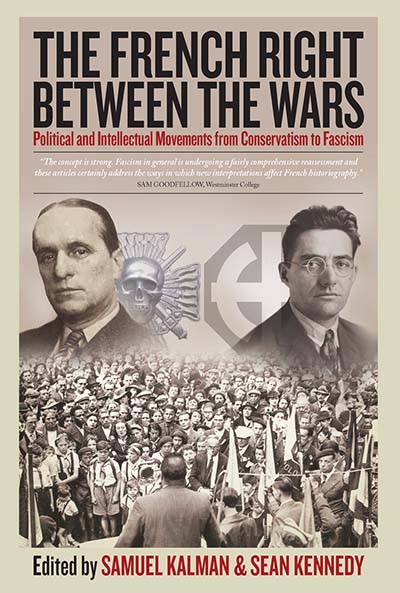
Souvenir of the Right: Reexamining Twentieth-Century French Politics

The French Right Between the Wars: Political and Intellectual Movements from Conservatism to Fascism, to be published this month, re-opens the history books on  France between World Wars I and II. In this collection of essays, scholars take a look at the polarized political scene, especially the right, within the country. Below, in an interview with editors Samuel Kalman and Sean Kennedy, the scholars speak to the challenges of compiling the collection as well as the potential controversy of writing on such a politically charged topic.


__________________________________________

Berghahn Books: What aspect of compiling an edited collection did you find most challenging?  Most rewarding?


Sean Kennedy: When we began this project I was anxious that coordinating thirteen different contributions – in terms of deadlines and ensuring consistency in format – would be a major challenge. I should not have worried so much. Our contributors did a fine job of sticking to the production schedule and carrying out editorial work.

Continue reading “Souvenir of the Right: Reexamining Twentieth-Century French Politics”

Author Becomes Subject: Droysen as Topic of Historical Volume

Scholarship has come full circle for Johann Gustav Droysen — a historian lauded for his much-cited volume on Alexander the Great — as the author-historian is now the subject of study. Author Arthur Alfaix Assis delves into the historical theories of Droysen in What is History For? Johann Gustav Droysen and the Functions of Historiography, to be published later this month. Assis precedes the publication by sharing the root of his interest in the scholar, why he believes Droysen is important, and what Assis might have done if he did not follow the path of academia.


______________________________________________


Berghahn Books: What drew you to the study of Johann Gustav Droysen?


Arthur Alfaix Assis: I like to think that part of it has to do with the great impression left on me by the very first text I read as an undergraduate: Max Weber’s ‘Science as a Vocation’. I was a freshman at a provincial university in central Brazil, and was very eager to get in touch with serious historical and philosophical literature. But after a single week of lectures came a three-month-long strike, and the only reading assignment left was Weber’s text.

Continue reading “Author Becomes Subject: Droysen as Topic of Historical Volume”

‘Screening Nature’ Turns the Cinematic Gaze to Mother Earth

Flora, fauna and film are the foci of Screening Nature: Cinema Beyond the Human, published in November 2013. The collection, edited by Anat Pick and Guinevere Narraway, hopes to open the film-viewers’ gaze to the often-overlooked nonhuman living subjects in film. The following is an interview with Pick and Narraway on the mission of Screening Nature, and on the environmental and ecocritical challenges to the discipline of Film Studies.


________________________________


Berghahn Books: What is the idea behind the collection and how did it come about?


Anat Pick and Guinevere Narraway: Screening Nature is one installment in a bigger project to push Film Studies to engage more closely with the natural world and with issues of ecology. It is fair to say that there is currently an “ecological turn” in Film Studies, and the book is part of what we hope will be a significant paradigm shift in the way we think and talk about film. But despite the growing interest in the ecological dimensions of cinema, both in terms of cinema’s representation of nonhuman nature and animals, and in terms of cinema’s ecological impact as a consumer and emitter of fossil fuels, Film Studies departments remain staunchly humanist and anthropocentric, with most courses theorizing and making films with little regard—in the literal sense of the word—to more-than-human concerns.

Continue reading “‘Screening Nature’ Turns the Cinematic Gaze to Mother Earth”

Policy-Tracing Up, Down, Sideways

In an excerpt from the Introduction of A Policy Travelogue: Tracing Welfare Reform in Aotearoa/New Zealand and Canada, published in September, Catherine Kingfisher explains just how she came to be interested in the subject of welfare policy, and its existence as a living, working idea.


____________________________________

My interest in tracing policy began in the summer of 2000, when I was writing grant applications to work with welfare mothers in southern Alberta, where I had recently moved from Aotearoa/New Zealand. I discovered that in the early 1990s the Alberta provincial government of premier Ralph Klein, in the process of reforming its governing structures and welfare systems, had been heavily influenced by Roger Douglas, the former Finance Minister of New Zealand.

Continue reading “Policy-Tracing Up, Down, Sideways”

The Life of Policy in Canada and New Zealand

Policies have their own lives, and these lives are not “a-cultural, rational, and straightforwardly technical,” puts forth Catherine Kingfisher in her volume, A Policy Travelogue: Tracing Welfare Reform in Aotearoa/New Zealand and Canada, published in September. Following is an excerpt from the monograph’s Introduction in which the author sets the scene for her discussion of how policy lives within welfare reform in two distinct countries.


______________________________________


I use the frames of translation and assemblage to gain insight into a range of policy-related phenomena in particular spaces and contexts of occurrence. First, I explore the transformation of objects as they are translated from one philosophical and political framework—Keynesianism—into another—neoliberalism. Brodie (2002:100) points out in this regard that the privatization characteristic of neoliberalism: “[i]nvolves much more than simply removing things from one sector and placing them in another….the thing moved is itself transformed into something quite different. Objects become differently understood and regulated.”

Continue reading “The Life of Policy in Canada and New Zealand”

The Very Human Experiences of the Other

If the search for self was a game, migrants would be more than a few chips down. Having to overcome physical and cultural displacement in addition to psychological uncertainty makes the search, for those who are transient, a complicated quest. Below, in an excerpt from the Introduction of Being Human, Being Migrant: Senses of Self and Well-Being, published in October, editor Anne Sigfrid Grønseth addresses the difficulties of migration and asserts that these hardships are of larger breadth than simply issues of movement.


____________________________________


This volume is as much about being human as it is about being a migrant. It takes as its starting point from the proposition that migrant experiences tell us about the human condition, on the basis that senses of well-being, self, other and humanity are challenged when people move between shifting social and cultural contexts. Our contemporary world is characterised by an increasing degree of movement that highlights how societies and cultural units are never separate but overlapping, rapid changing and engaged in repeated processes of fission and fusion.

Continue reading “The Very Human Experiences of the Other”

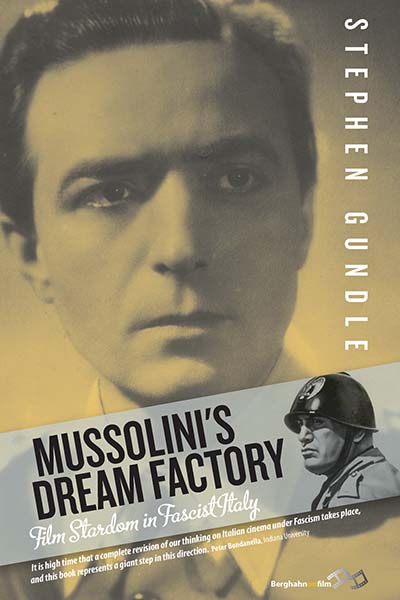
Star-Studded Regime: A Look at Film Celebrity in Fascist Italy

Celebrities today can perform political functions by sponsoring causes, supporting or opposing governments and shaping opinion. In Fascist Italy, celebrities also played an important role and the regime was well aware of the possible uses and dangers of their popularity. This important connection has been overlooked by scholars of both film and of Italian political history. Focusing on a period from the 1920s through 1945, Mussolini’s Dream Factory: Film Stardom in Fascist Italy looks at the star power of these often-overlooked celebrities and the fate of their careers after WWII. Author Stephen Gundle expands on these ideas and shares his thoughts on the subject, below.


_______________________________________________


Berghahn Books: What drew you to the study of film and film stardom in Fascist Italy?


Stephen Gundle: There are lots of books written about fascist Italy and it seems to be a topic that endlessly fascinates.  In the last few years books have appeared on topics such as the police force, diplomacy, road-building, women’s fashions and everyday life. Yet there are few books on fascist cinema – which is largely ignored by historians and neglected by film scholars who tend to concentrate on neorealism or other aspects of postwar cinema.

Continue reading “Star-Studded Regime: A Look at Film Celebrity in Fascist Italy”