 Join our Email List





Tag: author article
“Pockets of Hope”: Peaceful Coexistence in Israel & Palestine
An Interview with Nafisa Shah, Author of Honour and Violence
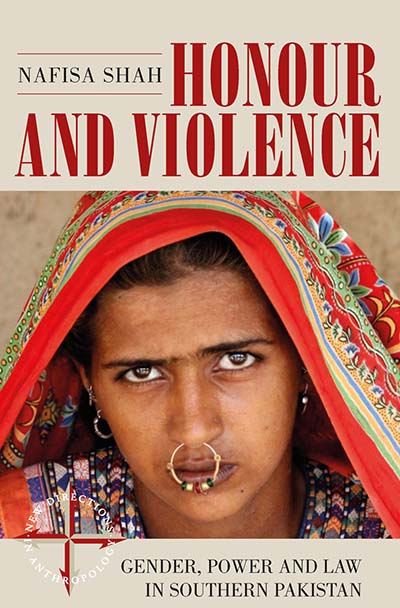 The following is an interview with Nafisa Shah about hew new book Honour and Violence: Gender, Power and Law in Southern Pakistan.
1) When did you begin working on Honour and Violence? Can you briefly tell us about your journey as a journalist, scholar, and politician following honor killings in Pakistan?
Honour and Violence is a process, a part of the journey, and not a product or a culmination. It is a coming together of different perspectives in the different roles through which I studied the phenomenon of karo kari, a practice that allows men to take lives of women in his family if accused and seen to be engaging in relationship outside or before marriage by invoking honour violation.
In 1992, as a young and fiery journalist, I travelled to Kashmore, and wrote the first story on honour based customs and practices in Upper Sindh for Newsline, a monthly news and features magazine headed by a woman editor, the late Razia Bhatti.
Then a few years later, as a Reuters fellow at Green College, Oxford I followed it up with a longer piece. My supervisor there, late Helen Callaway, was the first scholar to suggest I needed to convert these shorter journalistic pieces to something more longterm and showed me the academic route. And that’s where I built on whatever I saw and used the anthropological lens, which would allow me to communicate the problem to the wider world. Continue reading “An Interview with Nafisa Shah, Author of Honour and Violence”
Portrait of a Storyteller
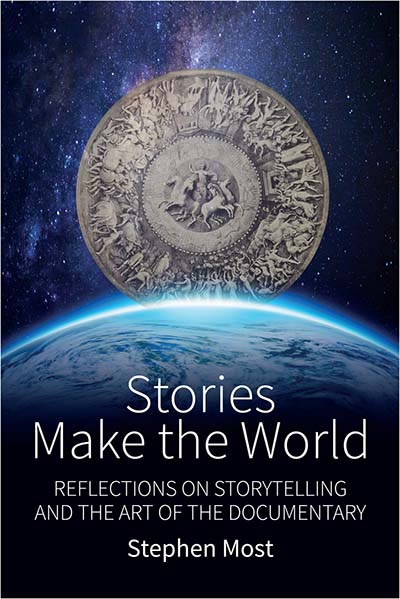
The following is a post by Stephen Most, author of Stories Make the World: Reflections on Storytelling and the Art of the Documentary.
Two portraits of the young man I once was, one oil-painted, the other shaped in clay, watch over my study. More than half a century after they were made I portrayed the painter, Pedro Azabache, and the sculptor, Eduardo Calderón, in the opening chapters of Stories Make the World.
My friendships with them began unexpectedly and unforgettably. As a college student I received a grant I hadn’t applied for to go to a country I knew nothing about where languages I did not understand were spoken. I had not even studied anthropology, the field in which I was supposed to do summer research. However, I did know the destination: a pueblo named Moche.
The only book I could find about Moche mentioned a descendant of Mochica Indians who had studied painting in Lima. When I met him, Pedro Azabache led a school of fine arts in Trujillo. Seen in retrospect, my request, uttered in barely coherent Spanish, was absurd. I told him I wanted to live at his home in Moche and write about his life. The maestro replied, “Encantado.”
My friendship with Eduardo Calderón, who taught wood and ceramic sculpture in Azabache’s school of fine arts, also began encantado, with enchantment. Calderón invited me to his adobe-walled home to make the bust that now rests on my cabinet. Soon after I got there, after he had plopped clay on a small round table and after his wife, María, served us a wooden bowl filled with chicha, a corn liquor, Calderón asked, “Do you know that I am a brujo?” I did know that word, having read, in John Gillin’s Moche, A Peruvian Coastal Community, about brujeria, which means both sorcery and its antidote, a way of healing physical and psychological maladies. On the radio a cumbia was playing as Calderón, gliding into a corner of his open-air studio, pulled the head and wings of a pelican skin over his shoulders and started dancing. Soon we were wearing the bird in turn as we danced to the catchy beat.

That summer, one of Azabache’s students who spoke English, José Li Ning, helped me translate the artist’s journals. A sentence I puzzled over, learning the subjunctive, was something Azabache’s father had said to him: “I hope my son knows to make good use of his time.” Those wise words applied, I felt, to me. Li Ning also came to the first mesa, or all-night healing ceremony, I attended. As Calderón presided over a ritual the pre-Incaic Mochica sculpted on pottery a thousand years ago, I realized that I, the unlikely recipient of a grant to do ethnology, was making good use of my time.
After that summer, wanting better to know my Peruvian friends and their world, I returned to the Trujillo region, starting with a two-year stint in the Peace Corps. Calderón invited me to be the godfather of his daughter Josefina, which made us compadres, friends with family bonds. Years later, his granddaughter Rosi Liliana became my second goddaughter.
Decades after that, while writing the reflections on storytelling and the art of the documentary that comprise Stories Make the World, I realized: both Azabache and Calderón were storytellers. Both combined a visual medium with narrative in different forms and with different techniques than are used in documentary making. And we all moved within a current flowing from cave painting ceremonies tens of thousands of years ago and surely from visual and verbal representations of the world made long before those. I had defined myself in terms of the specific medium in which I worked, whether as a playwright, a screenwriter, or an author. Only while writing Stories Make the World did I grasp a larger identity that potentially connects every human being, for we all tell stories; our lives are shaped by them and by the stories others tell.
Wanting to share memories of Azabache and Calderón with my goddaughters and other Peruvian friends, I asked Li Ning to translate the first two chapters of my book. He and his son, a professor of English, did so. Better yet, Li Ning found a magazine that will publish the Spanish version of those chapters. I’m glad my portraits of the men who portrayed me many years ago, whose friendship enriched my life, will be widely seen in their country before long.
See an earlier blog post from Stephen Most here, and learn more about the book Stories Make the World: Reflections on Storytelling and the Art of the Documentary here. To stream and download films in Stories Make the World, go to www.videoproject.com/Stories.
Why do so many American Parents Struggle with Nighttime Breastfeeding and Sleep?
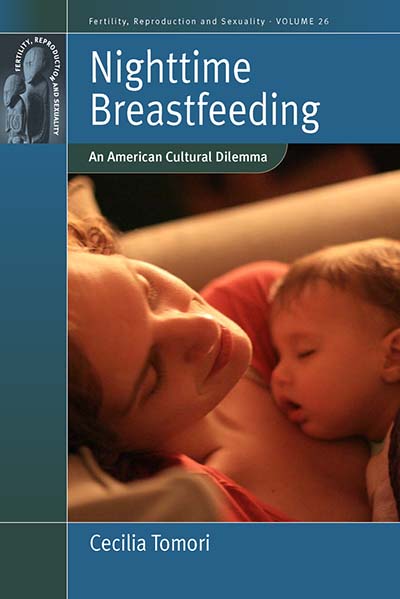
by Cecília Tomori
For World Breastfeeding Week, we’re delighted to offer FREE access to a chapter from Nighttime Breastfeeding for a limited time. Click here to access this chapter, titled Embodied Cultural Dilemmas: An Anthropological Approach to the Study of Nighttime Breastfeeding and Sleep.
Nighttime Breastfeeding addresses the central question: why do so many American parents struggle with nighttime breastfeeding and sleep? I set out to answer this question, which emerged from my preliminary fieldwork, using the classic anthropological technique of participant observation. I spent many months immersed in fieldwork, and then many more surrounded by all the materials I had collected – piles of fieldnotes to interview recordings, brochures, photos, and, most importantly, memories of being with families who have graciously let me into their lives. I revisited key moments over and over again – recalling certain phrases, pauses, and gestures, which I could examine through the lenses offered by my anthropological training. Continue reading “Why do so many American Parents Struggle with Nighttime Breastfeeding and Sleep?”
Promoting ‘self-reliance’ for refugees: what does it really mean?
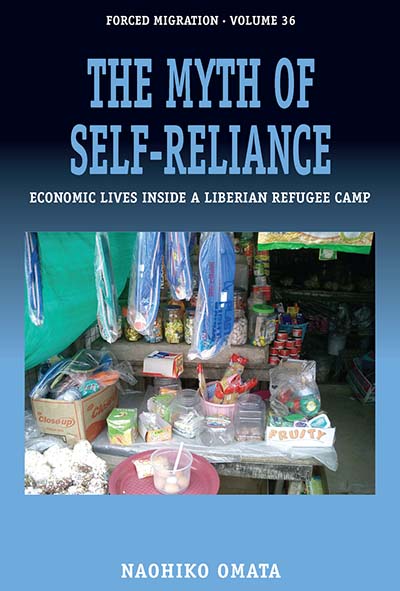
The following is a post by Naohiko Omata, author of The Myth of Self-Reliance: Economic Lives Inside a Liberian Refugee Camp.
Promotion of ‘self-reliance’ for refugees has occupied a central seat in the policy arena of the international refugee regime in recent years. The United Nations High Commissioner for Refugees (UNHCR) broadly defines self-reliance as ‘the social and economic ability of an individual, a household or a community to meet essential needs in a sustainable manner’. Its guiding philosophy can be summarised as: refugees have the skills, capacity and agency to stand on their own and be able to sustain themselves without depending on external humanitarian aid. This concept has been universally embraced by policy-makers and aid agencies and has now become an increasingly visible part in refugee assistance and protection programmes worldwide.
But on the ground, what does it really mean for refugees to attain self-reliance?
While many policies have rhetorically committed to the importance of ‘helping refugees help themselves’, some fundamental questions remain unanswered.
First, do refugees have enabling conditions to achieve self-reliance? Currently, many refugees in the Global South are unable to fully exercise their right to work and to move freely due to regulations by their host governments. These impediments can severely constrain refugees’ capacity to construct meaningful livelihoods and limit their access to commercial markets. Under these restrictions, is it sensible to assume that refugees can attain self-reliance regardless of how industrious and ingenious they are?
Next, how do we determine whether refugees have achieved self-reliance? Despite its extensive promotion, there are to date no universally agreed systematic and rigorous criteria for measuring refugees’ self-reliance. Instead of using objective benchmarks, UNHCR often perceives refugees as self-reliant when they live without external assistance. Is the situation in which refugees living without aid a plausible indicator of ‘meeting their basic needs in a sustainable manner’, as defined by UNHCR?
Most importantly, for whom is refugees’ self-reliance being promoted? In theory, nurturing refugees’ self-reliance should entail a strategic shift from traditional relief aid to development-oriented support and the provision of enabling conditions for refugees to establish gainful livelihoods. Yet this is not happening in the field. Meanwhile, UNHCR and donor states usually start decreasing assistance for refugees while promoting refugees’ self-reliance. Is refugees’ self-reliance meant to empower refugees’ economic capacities or to justify cutting down aid for refugee populations?
My authored book, The Myth of Self-Reliance, has explored these important but unsolved questions through a study of Buduburam refugee camp in Ghana. This Liberian refugee camp has been commended by UNHCR as an exemplary ‘self-reliant’ model in which refugees were sustaining themselves through robust businesses with little donor support. The UN refugee agency even boasted that the organization had facilitated their economic success by gradually withdrawing its assistance over the period of exile.
The book challenges the reputation of Buduburam refugee camp as a successful model for self-reliance and sheds light on considerable economic inequality between refugee households. Both qualitative and quantitative data reveal that a key livelihood resource for refugees in Buduburam was not their commercial activities but their access to overseas remittances, which had nothing to do with UNHCR’s initiatives to foster refugees’ self-reliance by withdrawing aid. While refugees who were receiving remittances were able to satisfy their basic day-to-day needs, those who had no connections to the diaspora were deeply impoverished.
There is increasing support for the idea that refugees are active and capable players with ingenuity and resilience. I agree wholeheartedly with this view in principle. However, it is irresponsible to assume that this can entirely replace the need for humanitarian aid and protection, in the absence of an enabling environment and adequate resources. Over-emphasis on the resilience, agency and capacity of refugees can obscure internal differentiations in their economic capacities, and universal celebration of refugees’ self-reliance can even undermine refugee protection and welfare. While we should certainly acknowledge and respect refugees’ capabilities and resourcefulness in the face of adversity, we should not dump all responsibilities on the shoulders of refugees alone.
Given the daunting scale of refugees globally, it is undeniable that we need to pioneer new ways to support and enable their socio-economic independence in the long-term. However, making refugee self-reliance a reality necessitates a strong commitment and investment from not only refugee but host governments, the donor community, development agencies, UNHCR, and other relief organizations.
Learn more about The Myth of Self-Reliance: Economic Lives Inside a Liberian Refugee Camp here and read the Introduction for free online.
Recreating universities to help revive democracy
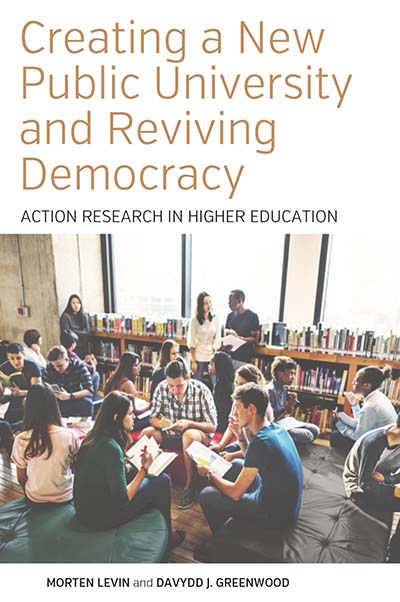 The following is a post by Davydd J. Greenwood, Goldwin Smith Professor of Anthropology Emeritus, Cornell University
The following are some management verities that abound in current university administrations:
- Good universities require highly-paid leaders hired by Boards of Trustees through executive search services.
- Good universities have large administrative staffs, often outnumbering the faculty.
- Good university leaders must impose accountability and quality control to make their university rise in the rankings.
- The cost of higher education will always go up.
All these verities are false as a single example can show. The Mondragón University in the Basque Country with 4,000 students and 4 colleges operating 8 campus locations throughout the Basque Country has a central administrative staff of 3 senior administrators and their secretaries. Highly ranked and successful, it operates daily through collaborative governance including the students, faculty, and staff who “run” the university. If this is possible, then having more managers than workers, having vast administrative overheads, and governing from the apex by imposed authority, are not laws of nature. Mondragón University shows that a successful university business model can be unlike any of our currently over-administered and radically inefficient universities. In science, an exception to the rule demonstrates that the rule is false.
Most explanations of the decline and fall of public higher education blame the corporatization of our institutions and implementation of business models for the problems. First-hand knowledge of innovative private sector organizations show they share more features with Mondragón University than with our current universities.
Successful businesses do not resemble our current universities. These institutions are poorly organized, over-staffed with administrators, and suffer from huge pay disparities and runaway costs. Successful businesses generally are team-based matrix organizations whose cross-disciplinary, cross-functional teams focus on products or key processes. Each team has experts from all relevant stakeholder/functional areas in the organization. The business leaders are coordinators and process champions, not authoritarian bosses. Salary differentials are generally modest. In these well-run organizations, the people who produce the “value” for the organization play a role in structuring and managing operations.
This contrasts sharply with the administrative bloat in universities, the authoritarianism of “parachuted in” academic leaders, and salaries for senior academic administrators that often are 40-50 times higher than those of the secretarial staff and groundskeepers. The power apex is remote from daily work processes and thus leaders cannot make competent management decisions. Nor can they understand why their decisions fail to produce the desired results. Failure instead is blamed on the faculty and the students. Ultimately, these policies prevent working and middle class students from having a high-quality education and gaining the consequent social mobility and civic awareness it can produce.
We are reaching the nadir in this race to the bottom. The only way forward is to create higher education anew through the democratic practices of participatory democracy, as in the Mondragón University. These practices are the core of Action Research. They require all the relevant stakeholders to collaborate in establishing the mission, structures, and practices of the institution. Together they must enact these missions and keep constant evaluation processes going to see how well they are accomplishing the goals they agreed on, making the necessary adjustments to improve on a continuing basis.
The “freedom to teach” and the “freedom to learn” essential to Bildung involves the ongoing recreation and reinforcement of universities that respect and practice academic freedom, academic integrity, and participatory democracy in every organizational dimension. These recreated universities would be schools for democracy and organized to produce Neue-Bildung for the university stakeholders and for society at large.
Critique and wringing of hands is easy; action research to create democratic universities is not. Where a powerful few currently dominate, they will react to any threat to their power and money and fight back. Changing universities into such organizations requires radical moves, the first being understanding that such change is possible. We have laid out the analysis and needed actions in our book, Creating a New Public University and Reviving Democracy: Action Research in Higher Education.
The current quagmires created by the neo-liberals in universities (and most other institutions) offers some hope. Most of the stakeholders, regardless of their politics, are aware that the current university system is broken. What matters now is to have concrete plans for a way out of the quagmire and to be ready for an arduous campaign to recreate universities, an essential element in the rebirth of democracy itself.
Learn more about Davydd J. Greenwood’s new book Creating a New Public University and Reviving Democracy: Action Research in Higher Education here.
Book Launch for Stories Make the World
The following is a post about the book launch for Stories Make the World: Reflections on Storytelling and the Art of the Documentary by Stephen Most.
It’s odd to see the result of years of work contained within a small object, whether it is a book, a DVD, or a phone on which films are streaming. Stories Make the World contains, in a sense, ideas I care about, a variety of subjects that interest me, and many of the films I’ve worked on.
It was odd as well to see a room enclose people from almost every aspect of my life. That happened at the party celebrating the launch of Stories Make the World. If my life were a book, many of its chapters appeared in my living room one Sunday afternoon. Convening beneath balloons were my brother, a cousin, and their wives, my wife, our son and his girlfriend, friends who live on my block, friends whose children grew up with my children, other friends I hadn’t seen in years, and colleagues I have worked with over the years.
That gathering of people I’ve known over a long span of time in disparate situations offered a sense of my life’s unity. But it was an illusion: a snapshot at a moment in time belies the experience of living. As Kierkegaard wrote in his journals, “Life can only be understood backwards, but it must be lived forwards.” Living forwards, it can be impossible to tell what direction one will take and whether pleasure or distress, success or failure will result. That applies to documentary films, almost every one of which is a high-risk project. It applies, of course, to a book from conception to publication and beyond. And it’s true for everyone’s life. The present moment is pregnant with the future. The outcomes and their connection with what came before become evident only in retrospect.
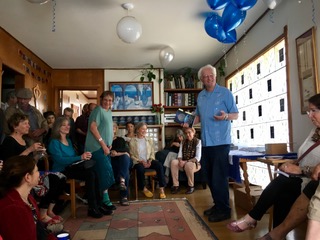
Looking around the room, I saw the youngest member of my family, two-year-old Nina, resting in her mother’s arms. I wondered, who will she be? What will the world be like when she is a woman? Across the room from Nina and her mother Katie stood Douglas Sharon, an explorer in Perú who, when we first met in our early twenties, was discovering ancient cities that Andean jungle had covered. His friendship with the shaman Eduardo Calderón inspired a career change: Douglas became an anthropologist.
I caught the eye of Claire Schoen. When we met, I was a playwright working with a comedic theater company and she was a documentary filmmaker. Living with her, I entered the community of independent media professionals in the Bay Area. Members of that community listened as I read passages from Stories Make the World: Judy Irving who, when I met her, was making Dark Circle, a mind-opening film about the nuclear age, with Chris Beaver and Ruth Landy; Ruth, who produced international media for the World Health Organization after Dark Circle premiered; Justine Shapiro, who apprenticed with Judy and Chris, then went on to make Promises, the Emmy-winning, Academy Award-nominated film about Israeli and Palestinian children; Gina Leibrecht, who has edited two films I’ve worked on: A Land Between Rivers and Wilder than Wild; and the director of those films, Kevin White, who arrived late, bringing a bottle of bubbly.
At that moment in time in that place, which seemed to encompass innumerable stories in my life and theirs, I released into the world a small object that I hope will be fruitful.
See an earlier blog post from Stephen Most here, and learn more about the book Stories Make the World: Reflections on Storytelling and the Art of the Documentary here. To stream and download films in Stories Make the World, go to www.videoproject.com/Stories.
Interview with Guy Delisle
Conducted in English by Kenan Kocak, 23 April 2014. This interview originally appeared in European Comic Art Volume 7 Number 2.
 Guy Delisle was born in Canada’s Quebec City in 1966. He studied animation at Sheridan College in Oakville, near Toronto, and has worked for animation companies in Canada, France, Germany, China and North Korea. His comics career started at L’Association, where from 1995 onwards he contributed to the French periodical Lapin, whilst also working on the Canadian magazine Spoutnik. Delisle is also an active animator strongly associated with Dupuis-Audiovisuel. He has just fi nished the third volume of his current series, Le Guide du mauvais père [A Users Guide to Neglectful Parenting], which will be available in January 2015.
In 2012, Chroniques de Jérusalem (Delcourt) won the Angoulême festival’s Best Album award. In it, Delisle follows on from previous travel accounts, in particular Shenzhen (L’Association, 2000, about China), Pyongyang (L’Association, 2003, about North Korea) and Chroniques birmanes (Delcourt, 2007, about Burma). In all of these he presents foreign, exotic and sometimes oppressive cultures through the everyday. In the case of the Jerusalem album, this is done via his own experiences as a child-minding father whilst his partner, Nadège, worked there for Médecins Sans Frontières in 2008.
The style of Chroniques de Jérusalem, like that of Delisle’s earlier work, is that of line drawings with clear representational elements, whilst remaining far from any notion of photo-realism. A main difference, perhaps due to the possibilities offered by Delcourt is the use of sepia tone and splashes of colour, albeit sparsely, to accentuate key incidents and objects. The style draws the reader in and situates the story in an exegetic ‘reality’, whilst keeping the distance that comes with caricature. It fits perfectly with the subject matter, one that presents traffic jams and the search for children’s playgrounds, allowing us momentarily to overlook the background events, those of the religious conflicts in the Middle East.
Although the book was a popular choice that frequently topped the weekly BD best sellers, it was also very much in keeping with literary trends within the graphic novel genre and beyond. Indeed, the non-A4 format, low-colour artwork and 334 pages keeps the work within the ‘graphic novel’ style championed by L’Association, Delisle’s previous publisher, and continued by the high-profile but trendy Shampooing collection to which the album belongs. Through the subject matter of the Middle East conflict, comparison with Jo Sacco is inevitable, although Delisle is considerably less politicised. Another point in common is the first-person diary format, although the viewing angle remains third person, as we look onto the line drawing of Delisle, not directly through his eyes. And the use of the everyday as a foreground to broader events plugs into the current trend for ‘everyday studies’, whilst putting the BD alongside other forms of ‘popular but intelligent’ literature that presents world-changing events via the backcloth of the preoccupations of ordinary life, as recently championed by the novels of Jean Teulé, Annie Ernaux and Jonathan Coe.
How Eurocentrism & Coloniality Shaped Africa
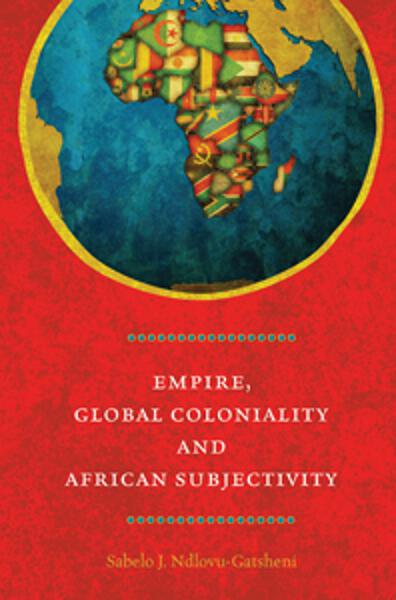
What is Eurocentrism? What is an Athens-to-Washington discourse of world history? And how does the continent of Africa fit into this worldview? Empire, Global Coloniality and African Subjectivity came about as a way for us to find answers to these questions and light Africa’s situation within the ‘zone of non-being.’ Below, Dr. Sabelo J. Ndlovu-Gatsheni explains the research and motivation behind the book.
I am interested in understanding how the world works.
My research into modernity, empire, colonialism, coloniality and African subjectivity is an attempt to understand how the world system and its international orders have been politically constituted.
Continue reading “How Eurocentrism & Coloniality Shaped Africa”