Join our Email List




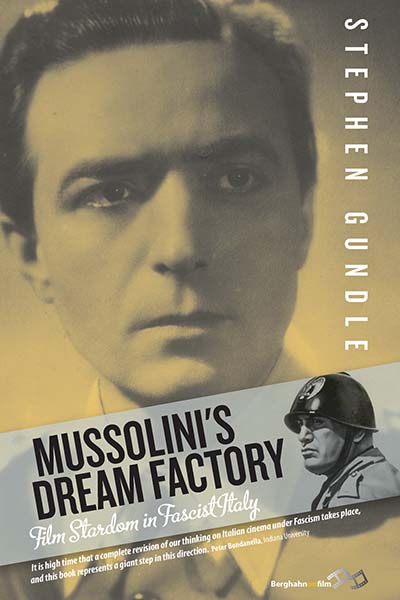
Celebrities today can perform political functions by sponsoring causes, supporting or opposing governments and shaping opinion. In Fascist Italy, celebrities also played an important role and the regime was well aware of the possible uses and dangers of their popularity. This important connection has been overlooked by scholars of both film and of Italian political history. Focusing on a period from the 1920s through 1945, Mussolini’s Dream Factory: Film Stardom in Fascist Italy looks at the star power of these often-overlooked celebrities and the fate of their careers after WWII. Author Stephen Gundle expands on these ideas and shares his thoughts on the subject, below.
_______________________________________________
Berghahn Books: What drew you to the study of film and film stardom in Fascist Italy?
Stephen Gundle: There are lots of books written about fascist Italy and it seems to be a topic that endlessly fascinates. In the last few years books have appeared on topics such as the police force, diplomacy, road-building, women’s fashions and everyday life. Yet there are few books on fascist cinema – which is largely ignored by historians and neglected by film scholars who tend to concentrate on neorealism or other aspects of postwar cinema.
Continue reading “Star-Studded Regime: A Look at Film Celebrity in Fascist Italy”



 The British print and online media has for the last year been awash with compelling stories about abuses of the welfare system: the mother who has 11 children and feels the state should fund her life choices; the recent immigrants who are entitled to welfare benefits notwithstanding a lack of accumulated contribution; the ‘disabled’ welfare claimants who are exposed as professional dancers or scuba divers.
 The early workers in the search for extra-terrestrial intelligence were concerned with the technical problems of sending and receiving radio signals across inter-stellar distances.