Recreating universities to help revive democracy

The following is a post by Davydd J. Greenwood, Goldwin Smith Professor of Anthropology Emeritus, Cornell University

The following are some management verities that abound in current university administrations:

  • Good universities require highly-paid leaders hired by Boards of Trustees through executive search services.
  • Good universities have large administrative staffs, often outnumbering the faculty.
  • Good university leaders must impose accountability and quality control to make their university rise in the rankings.
  • The cost of higher education will always go up.

All these verities are false as a single example can show. The Mondragón University in the Basque Country with 4,000 students and 4 colleges operating 8 campus locations throughout the Basque Country has a central administrative staff of 3 senior administrators and their secretaries. Highly ranked and successful, it operates daily through collaborative governance including the students, faculty, and staff who “run” the university. If this is possible, then having more managers than workers, having vast administrative overheads, and governing from the apex by imposed authority, are not laws of nature. Mondragón University shows that a successful university business model can be unlike any of our currently over-administered and radically inefficient universities. In science, an exception to the rule demonstrates that the rule is false.

Most explanations of the decline and fall of public higher education blame the corporatization of our institutions and implementation of business models for the problems. First-hand knowledge of innovative private sector organizations show they share more features with Mondragón University than with our current universities.

Successful businesses do not resemble our current universities. These institutions are poorly organized, over-staffed with administrators, and suffer from huge pay disparities and runaway costs. Successful businesses generally are team-based matrix organizations whose cross-disciplinary, cross-functional teams focus on products or key processes. Each team has experts from all relevant stakeholder/functional areas in the organization. The business leaders are coordinators and process champions, not authoritarian bosses. Salary differentials are generally modest. In these well-run organizations, the people who produce the “value” for the organization play a role in structuring and managing operations.

This contrasts sharply with the administrative bloat in universities, the authoritarianism of “parachuted in” academic leaders, and salaries for senior academic administrators that often are 40-50 times higher than those of the secretarial staff and groundskeepers. The power apex is remote from daily work processes and thus leaders cannot make competent management decisions. Nor can they understand why their decisions fail to produce the desired results. Failure instead is blamed on the faculty and the students. Ultimately, these policies prevent working and middle class students from having a high-quality education and gaining the consequent social mobility and civic awareness it can produce.

We are reaching the nadir in this race to the bottom. The only way forward is to create higher education anew through the democratic practices of participatory democracy, as in the Mondragón University. These practices are the core of Action Research. They require all the relevant stakeholders to collaborate in establishing the mission, structures, and practices of the institution. Together they must enact these missions and keep constant evaluation processes going to see how well they are accomplishing the goals they agreed on, making the necessary adjustments to improve on a continuing basis.

The “freedom to teach” and the “freedom to learn” essential to Bildung involves the ongoing recreation and reinforcement of universities that respect and practice academic freedom, academic integrity, and participatory democracy in every organizational dimension. These recreated universities would be schools for democracy and organized to produce Neue-Bildung for the university stakeholders and for society at large.

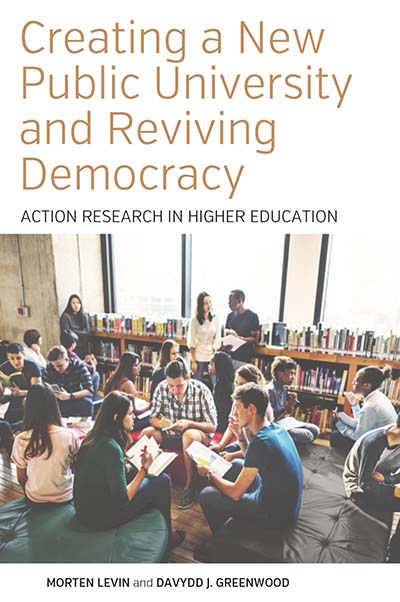
Critique and wringing of hands is easy; action research to create democratic universities is not. Where a powerful few currently dominate, they will react to any threat to their power and money and fight back. Changing universities into such organizations requires radical moves, the first being understanding that such change is possible. We have laid out the analysis and needed actions in our book, Creating a New Public University and Reviving Democracy: Action Research in Higher Education.

The current quagmires created by the neo-liberals in universities (and most other institutions) offers some hope. Most of the stakeholders, regardless of their politics, are aware that the current university system is broken. What matters now is to have concrete plans for a way out of the quagmire and to be ready for an arduous campaign to recreate universities, an essential element in the rebirth of democracy itself.


Learn more about Davydd J. Greenwood’s new book Creating a New Public University and Reviving Democracy: Action Research in Higher Education here.
Book Launch for Stories Make the World

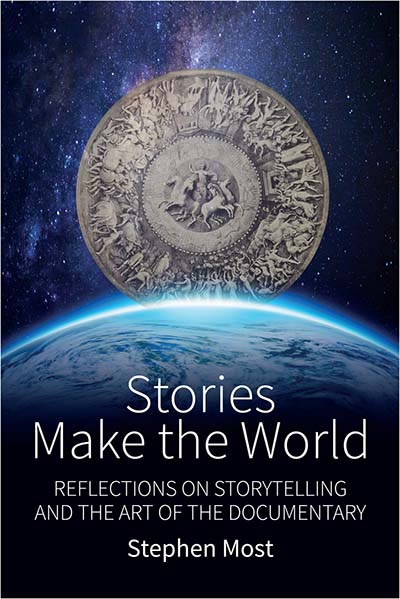
The following is a post about the book launch for Stories Make the World: Reflections on Storytelling and the Art of the Documentary by Stephen Most.

It’s odd to see the result of years of work contained within a small object, whether it is a book, a DVD, or a phone on which films are streaming. Stories Make the World contains, in a sense, ideas I care about, a variety of subjects that interest me, and many of the films I’ve worked on.

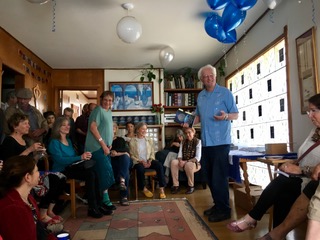
It was odd as well to see a room enclose people from almost every aspect of my life. That happened at the party celebrating the launch of Stories Make the World. If my life were a book, many of its chapters appeared in my living room one Sunday afternoon. Convening beneath balloons were my brother, a cousin, and their wives, my wife, our son and his girlfriend, friends who live on my block, friends whose children grew up with my children, other friends I hadn’t seen in years, and colleagues I have worked with over the years.

That gathering of people I’ve known over a long span of time in disparate situations offered a sense of my life’s unity. But it was an illusion: a snapshot at a moment in time belies the experience of living. As Kierkegaard wrote in his journals, “Life can only be understood backwards, but it must be lived forwards.” Living forwards, it can be impossible to tell what direction one will take and whether pleasure or distress, success or failure will result. That applies to documentary films, almost every one of which is a high-risk project. It applies, of course, to a book from conception to publication and beyond. And it’s true for everyone’s life. The present moment is pregnant with the future. The outcomes and their connection with what came before become evident only in retrospect.

Stories Make the World

Looking around the room, I saw the youngest member of my family, two-year-old Nina, resting in her mother’s arms. I wondered, who will she be? What will the world be like when she is a woman? Across the room from Nina and her mother Katie stood Douglas Sharon, an explorer in Perú who, when we first met in our early twenties, was discovering ancient cities that Andean jungle had covered. His friendship with the shaman Eduardo Calderón inspired a career change: Douglas became an anthropologist.

I caught the eye of Claire Schoen. When we met, I was a playwright working with a comedic theater company and she was a documentary filmmaker. Living with her, I entered the community of independent media professionals in the Bay Area. Members of that community listened as I read passages from Stories Make the World: Judy Irving who, when I met her, was making Dark Circle, a mind-opening film about the nuclear age, with Chris Beaver and Ruth Landy; Ruth, who produced international media for the World Health Organization after Dark Circle premiered; Justine Shapiro, who apprenticed with Judy and Chris, then went on to make Promises, the Emmy-winning, Academy Award-nominated film about Israeli and Palestinian children; Gina Leibrecht, who has edited two films I’ve worked on: A Land Between Rivers and Wilder than Wild; and the director of those films, Kevin White, who arrived late, bringing a bottle of bubbly.

At that moment in time in that place, which seemed to encompass innumerable stories in my life and theirs, I released into the world a small object that I hope will be fruitful.


See an earlier blog post from Stephen Most here, and learn more about the book Stories Make the World: Reflections on Storytelling and the Art of the Documentary here. To stream and download films in Stories Make the World, go to www.videoproject.com/Stories.


Celebrating Canada Day

canada-flags-659311_1920


Canada Day is the national day of Canada, a holiday celebrating the anniversary of the July 1, 1867, enactment of the British North America Act which united separate colonies into a “kingdom in its own right” within the British Empire named the Dominion of Canada.

As Canada celebrates its important national milestone, Berghahn is delighted to highlight some of our Canadian authors and editors and those currently based in Canada.


Continue reading “Celebrating Canada Day”

SIMULATED SHELVES: BROWSE JUNE 2017 NEW BOOKS

We’re delighted to offer a selection of latest releases from our core subjects of AnthropologyApplied Anthropology, Environmental Studies, Film Studies, History, Jewish Studies and Medical Anthropology, along with our New in Paperback titles.


Paperback Original

STORIES MAKE THE WORLD
Reflections on Storytelling and the Art of the Documentary
Stephen Most

Continue reading “SIMULATED SHELVES: BROWSE JUNE 2017 NEW BOOKS”

Berghahn Books will be attending NECS 2017!

We are delighted to inform you that we will be attending the NECS conference in Paris, France from the 29th June – 1st July 2017. Please stop by to browse our selection of titles on display at discounted prices, and take away some free journal samples.

If you are unable to attend, we would like to provide you with a special discount offer. Valid through August 1st, use discount code NECS17 at checkout and receive a 25% discount on all Film Studies titles found on our website.


Our most recent and forthcoming releases can be found in our Film and Media Catalogue while the titles featured below include a selection of those which will be highlighted at the conference.


Continue reading “Berghahn Books will be attending NECS 2017!”

Visit Berghahn Books at ECAS 2017!

African-StudiesWe are delighted to inform you that we will be attending the 7th European Conference on African Studies in Basel, Switzerland from the 29th June – 1st July 2017. Please stop by to browse our selection of titles on display, and take away some free journal samples.


If you are unable to attend, we would like to provide you with a special discount offer. Valid through August 1st, use discount code ECAS17 at checkout and receive a 25% discount on all African Studies titles found on our website.


Continue reading “Visit Berghahn Books at ECAS 2017!”

European Judaism at 50

This issue marks the beginning of the fifty-first year of publication of the journal, something to be registered with a degree of pride and not a little wonder. We have been served over this time with a remarkable series of editors, beginning with our founding editor Rabbi Dr Ignaz Maybaum z’l (1897-1976). In those early years the direction of the journal was led by Rabbi Michael Goulston z’l (1931-1972) as Managing Editor before his tragic early death. His vision for the journal is well expressed in his words:

Despite numerical depletion, the dangers of destructive assimilation, and the alienation of many in the wake of the European catastrophe, a Jewry with a will to independent existence has a future. We already possess enough intellectual and spiritual strength to achieve a great deal if we can focus it and give it a clear direction. For there can be no successor to the great European heritage except a reborn European Judaism itself.[i]

He was succeeded as Managing Editor by Anthony Rudolf (1972-1975) who shared Michael’s European vision and, as a poet, translator and critic, brought literary and political dimensions to the journal. We open this issue with his memoir of those early days. Rabbi Marcel Marcus (1976-1978) succeeded him and in an early ‘personal view’ noted the journal’s understandable preoccupation with the Holocaust, but that now ‘a new generation has arisen. A generation which does not know the Holocaust, but only knows of the Holocaust.’ He invited authors of the ‘new generation’ – ‘it is time for us, having established, to look into the future’.[ii] Continue reading “European Judaism at 50”