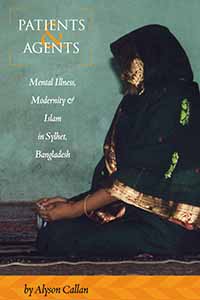
An Excerpt from Patients and Agents: Mental Illness, Modernity and Islam in Sylhet, Bangladesh

Note: Berghahn has just published Alyson Callan’s Patients and Agents: Mental Illness, Modernity and Islam in Sylhet, Bangladesh, an ethnographic study that explores how changes in the global economy have led to an increase in daughters marrying outside of their local kinship network, which in turn has increased their vulnerability to mental illness. An excerpt with images from Chapter 6 follows an introductory note from the author.

__________________________________________

Bangladesh is one of only five countries in the world where women have a shorter life expectancy than men. The low status of women in Bangladesh is underpinned by the virilocal rule of residence. As daughters leave their natal home to live with their husband’s family at the time of marriage, it is argued that nurturing them is regarded as a relative waste of resources, compared to nurturing sons who will stay and contribute to the wealth of the household.

However, women’s oppression is not experienced in a uniform way. Older women achieve a higher status as mothers, and, as mother-in-laws, may oppress their sons’ wives.  The concept ‘woman’ does not occupy a single analytical category and the status of women varies according to the role they occupy.  In this excerpt I suggest that the ‘Ma’ icons seen in most rural households provides evidence that the mother is revered on a par with Allah.

The mother in symbolic opposition to Allah
[There is] a tension evident in Bengali culture between the law of the father and the law of the mother. The popular Indian conception of the mother as self-sacrificing overlies an unconscious fantasy of the phallic, castrating mother (Nandy 1990). Bagchi (1990) suggests that Bengali culture is particularly prone to employing this threatening aspect of the mother. The powerful and murderous Kali, who dances on the corpse of her consort Shiva, is a goddess who enjoys greatest popularity amongst Bengalis (Fuller 1992). Wilce (1998a) argues that in Bangladesh mothers are feared and placed in symbolic opposition to Allah. He cites this famous passage from the Hadith: in answer to the question, ‘To whom do I owe the most respect?’ the Prophet replied, ‘Your mother.’ His answer remained the same when pressed to declare the second and third persons deserving respect. ‘Father’ was listed fourth [1998: 108].

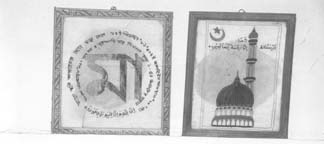
Another quotation commonly recited in Sylhet is ‘Heaven is under the mother’s feet’, meaning that obedience to the mother is the path to heaven. Yet whilst the mother-in-law in Sylhet is feared, conscious representations of the mother portray her to be loving and all-forgiving, if not to say indulgent. This latter attribute seems to me to be diametrically opposed to Allah who takes a meticulous account of his subjects’ good and bad works, doling out punishment and rewards as appropriate on Judgement Day. That the mother is revered on a par with Allah is demonstrated by the prevalence of ‘Ma’ iconography (ma is short for amma – mother). (Muslim) lorry drivers have ‘Ma’ painted on the front of their trucks; posters are sold reproducing poems and pictures celebrating the mother. Most strikingly of all, ‘Ma’ embroidery samplers and other ‘Ma’ icons are hung up on the wall next to Islamic icons – Allah’s name in Arabic, Qur’anic verse, pictures of Mecca. I saw these ‘Ma’ icons in every rural household that had grown-up children present; it was explained that ‘we have maya (love) for Allah and amma above everything else; for amma because she has suffered greatly for us’.
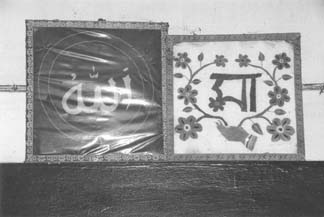
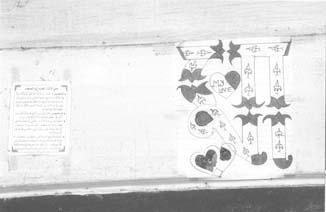
 

Figure 6.1: A ‘Ma’ embroidery sampler is hung to the right of Allah’s name in Arabic


Figure 6.2. Lines from the Qur’an on the left; handwritten ‘Ma’ decoration on the right


Figure 6.3. Left: Ma icon commemorating the date of death of the household’s mother; the Arabic reads: ‘Allah, we came from you and we will return to you’. Right: the mosque at Madina with lines from the Qur’an.


Alyson Callan is a psychiatrist and anthropologist. She currently works as a consultant psychiatrist in Brent for the Central and North West London NHS Foundation Trust.
Win a Copy of Where Have All the Homeless Gone? The Making and Unmaking of a Crisis

Berghahn Books is pleased to announce our latest contest. To be entered to win a copy of Anthony Marcus’s Where Have All the Homeless Gone? The Making and Unmaking of   a Crisis, follow Berghahn Books on Facebook by 5 p.m. EST Monday. We’ll select a winner at random from our new followers. Check back Tuesday to see if you won.

Drawing on five years of ethnographic research in New York City with African Americans and Latinos living in poverty, Where Have All the Homeless Gone? reveals that the US homeless “crisis” of the late 1980s and early 1990s was driven as much by political misrepresentations of poverty, race, and social difference, as the housing, unemployment, and healthcare problems that caused homelessness and continue to plague American cities.

From Idea to Book- Islam and Assisted Reproductive Technologies: Sunni and Shia Perspectives

From Idea to Book is an occasional series in which Berghahn authors and Editors discuss the origins of their work. Here, Marcia Inhorn and Soraya Tremayne describe how the volume Islam and Assisted Reproductive Technologieswhich was recently published by Berghahn, came about.

Islam and Assisted Reproductive Technologiesis the result of a wonderful conference workshop, held from 18 to 20 September 2009 at Yale University in New Haven, Connecticut, on the theme of “Islam and the Biotechnologies of Human Life.” Following a day of public presentations, the contributors to this volume remained at Yale for an intensive, two-day workshop discussion of their conference papers, which have ultimately become the polished chapters of this edited volume.

To our knowledge, this volume is unique, for it represents the work of nearly all of those scholars whose research focuses on Islam and assisted reproductive technologies (ARTs). Meeting (often for the first time), discussing our work, and producing this volume together has been an immensely rewarding experience. For us as co-conveners, the project and the process have been especially gratifying, for we have been able to bring together our junior colleagues, many of whom are producing nuanced, field-based research on ARTs in a variety of Islamic settings. As a result, all of the chapters in this volume can be said to be original, timely, and “cutting edge,” reflecting the rapidly evolving ART landscape in the Muslim world in the second decade of the new millennium. Continue reading “From Idea to Book- Islam and Assisted Reproductive Technologies: Sunni and Shia Perspectives”

Interview with the Editors- Alex Latta and Hannah Wittman, editors of Environment and Citizenship in Latin America

Alex Latta and Hannah Wittman are the editors of Environment and Citizenship in Latin America: Natures, Subjects and Struggles, recently published by Berghahn. The work aims to advance debates on environmental citizenship, while simultaneously and systematically addressing broader theoretical and methodological questions related to the particularities of studying environment and citizenship in Latin America. Here, they discuss the origins of their interest in the topic, where they see the work fitting within the field, and the process of putting the volume together.

___________________________

1. What drew you to the study of environmental citizenship?
We were both conducting extensive field research in different parts of Latin America (Wittman mainly in Guatemala and Brazil, Latta in Chile) during the early 2000s, when the field of citizenship studies was really picking up. At the same time, researchers working within a long tradition of “green” social theory started talking about “environmental citizens” and probing questions about what it means to think about ecological questions through the lens of citizenship. In the field we couldn’t help observing the way that struggles over environmental issues were closely bound up with debates over questions of recognition, inclusion, rights and inequality. The connection between environment and citizenship was plain to see in communities’ defense of their land rights, activists’ discourses around biodiversity or pollution, corporate agendas to tap natural wealth and government’s efforts to order and regulate different kinds of human-nature relationships. But as we observed this connection in practice, we were dissatisfied with debates about environmental citizenship amongst scholars from the Global North, which didn’t seem to offer the tools we needed to make sense of what was going on in Latin America. Before we even met we had independently decided to work at conceptual innovation to remedy this shortcoming


2. How did your perceptions of environment and citizenship change from the time you started work on this volume to the time you completed it?
Working on this volume was a good reality check for us. As a scholar it is easy to get wrapped up in one’s own self-referential bubble of theories, case studies and the like. Hearing what other scholars made of this connection between environment and citizenship had two kinds of outcomes. On the one hand, it confirmed our conviction that this is a fruitful intellectual space for thinking about a series of related ecological, social and political questions. There are all kinds of research avenues still to be explored. On the other hand, working with our collaborators during this project also reminded us that the terminology of citizenship, even as an analytical concept, is not innocent nor is there consensus about definitions and meanings. A number of the scholars who participated in the original workshop, including a couple whose pieces found their way into the book, were critical about the way the notion of citizenship potentially imposes a Western political ontology. They also pushed us with respect to the limits of citizenship as an analytical category (compared, for instance, to environmental justice). Even more importantly, these collaborators have demonstrated in their chapters how the discourses and practices of environmental citizenship can and have been mobilized by state and other actors as tools to re-enforce the subordination of politically marginal subjects such as indigenous peoples.


3. Do you think there are aspects of this work that will be controversial to other scholars working in the field? 
To the extent that the volume manages to complicate the terms of debate it is definitely our hope that other scholars in the field will feel the need to respond. There is a reason why the book is not titled “Environmental Citizenship in Latin America”. This collection is aimed to decentre the field of study, unsettling the easy union of these terms and putting in their place a more open-ended research agenda around the intersection of environment and citizenship. Obviously, the collection is also meant to stir the pot by reminding scholars that the Global South can’t be ignored as we seek to develop new paradigms of thought around environmental questions.


4. To what extent do you think the book will contribute to debates amongst academics and activists within the Latin American Region?
The fact that the book is in English is a partial barrier to uptake amongst Spanish or Portuguese speaking audiences, though there is an increasing amount of collaboration and cross-fertilization between work conducted in the three different languages, regardless of where it is written and published. Indeed, six of our own contributors are from the region. Moreover, we’ve had excitement about the collection expressed by other Latin American colleagues in research networks to which we belong. There seems to be a hunger amongst scholars and activists in the region for more exploration of the kinds of themes the book’s contributors grapple with. At the same time, in the context of this and other projects we constantly feel that more needs to be done to join up academic debate across the North-South divide, and also to reach out more effectively from the academic sphere into activist circles.


5. Putting together an edited volume is a lot of work. Was it worth it?
The opportunity to collaborate on a volume like this, both in terms of our work together as editors and with respect to the larger network of scholars involved in the project, brings significant rewards. We were lucky to have a really dedicated group of contributors, who worked diligently through numerous rounds of revision. In general there is a lot of good feeling around the collaboration that went into this project, and I think we are all pleased with the outcome.

___________________________

Alex Latta is an Associate Professor in the Department of Global Studies at Wilfrid Laurier University and in the Balsillie School of International Affairs.

Hannah Wittman is an Assistant Professor of Sociology and Associate Member of the Latin American Studies Program at Simon Fraser University.

From Idea to Book- The Cult and Science of Public Health

From Idea to Book is an occasional series in which Berghahn authors discuss the origins of their work. Here, Kevin Dew describes how a discussion with a student about Durkheim planted the seed that would eventually become The Cult and Science of Public Health: A Sociological Investigation, which was published by Berghahn this spring.

The impetus to write my book developed over a long period of time, but there were occasions that particularly focused my thinking. A pivotal moment was a discussion I had with a PhD student when I was a lecturer in a Department of Public Health at a medical school. She was using the work of Emile Durkheim to consider the role of neighbourhoods in relation to health. We were throwing around ideas about what sort of social factors foster solidarity or cohesion at a neighbourhood level, and we mentioned religion but moved on quickly as religion does not generally operate at a neighbourhood level. It was then that I had an ‘aha’ moment. Continue reading “From Idea to Book- The Cult and Science of Public Health”

Hot Off the Presses- New Book Releases

New in print from Berghahn:
After The History of Sexuality: German Genealogies with and beyond Foucault, edited by Scott Spector, Helmut Puff, and Dagmar Herzog

Cinema of Choice: Optional Thinking and Narrative Movies, by Nitzan Ben Shaul

Hitler’s Volksgemeinschaft and the Dynamics of Racial Exclusion: Violence against Jews in Provincial Germany, 1919-1939, by Michael Wildt, translated from German by Bernard Heise

Sharing the Sacra: The Politics and Pragmatics of Intercommunal Relations around Holy Places, edited by Glenn Bowman

Interview with the Author- Christien Klaufus, Author of Urban Residence: Housing and Social Transformations in Globalizing Ecuador

Christien Klaufus is the author of Urban Residence: Housing and Social Transformations in Urbanizing Ecuador, published this spring by Berghahn. Her work examines two contrasting populations in Ecuador’s cities: popular-settlement residents and professionals in the planning and construction sector to understand how they shape the city itself. Here she discusses her work, how she came to it, and her many varied interests outside the academy.

1. What drew you to the study of urban spaces in Ecuador?
My fascination for Latin America started when I was a child. I used to collect clippings about Peru, Bolivia, Mexico and Guatemala from the National Geographic journals that my father brought home. After graduating in Architecture in 1993, I travelled through South America for a few months. It was during that trip that I decided I wanted to switch careers from working in architectural design to becoming an academic researcher on urban spaces and architecture, preferably in Latin America. Ecuador became my favorite destination. So I applied for a BA and MA in Cultural Anthropology at the University of Amsterdam, which later resulted in a PhD dissertation on that topic. The book was a logical outcome of my multidisciplinary academic background and a long-lasting fascination for Latin America. Continue reading “Interview with the Author- Christien Klaufus, Author of Urban Residence: Housing and Social Transformations in Globalizing Ecuador”

An Excerpt from Fortune and the Cursed: The Sliding Scale of Time in Mongolian Divination

Note: Berghahn recently published Katherine Swancutt’s Fortune and the Cursed: The Sliding Scale of Time in Mongolian Divination, an ethnographic study of the world of Buryat Mongol divination. An excerpt from the book follows a note from the author which places it in the context of her larger argument.

It’s common knowledge that, when under duress, many people turn to religion. Yet the human penchant for inventing new magical practices during this ‘turn to religion’ is rarely revealed.

When I first went to Mongolia, I wanted to uncover how a shamanic cosmology comes to be reinvented over time. My plan was to document the shamanic practices – and especially the divinations (aka ‘fortune-tellings’) – undertaken by Buryat Mongols at the northeastern fringes of the country. These shamans manage everything from major health and business crises to everyday fluctuations in a person’s fortune, which, I learned, is not just a kind of luck-filled prosperity that can rise or fall dramatically. Fortune is also a driving force behind Buryat innovation-making. Continue reading “An Excerpt from Fortune and the Cursed: The Sliding Scale of Time in Mongolian Divination

Hot Off the Presses- New Book Releases

European Foundations of the Welfare State, by Franz-Xavier Kaufmann, translated by John Veit-Wilson, foreword by Anthony B. Atkinson

Fortune and the Cursed, the Sliding Scale of Time in Mongolian Divination, by Katherine Swancutt

Investigating Srebrenica: Institutions, Facts, Responsibilities, edited by Isabelle Delpla, Xavier Bougarel, and Jean-Louis Fourn

Journeys into Madness: Mapping Mental Illness in the Austro-Hungarian Empire, edited by Gemma Blackshaw and Sabine Wieber

Learning from the Children: Childhood, Identity and Culture in a Changing World, edited by Jacqueline Waldren and Ignacy-Marek Kaminski

A Lover’s Quarrel with the Past: Romance, Representation, Reading, by Ranjan Ghosh

The Making of the Pentecostal Melodrama: Religion, Gender and Media in Kinshasa, by Katrien Pype

Ordinary Lives and Grand Schemes: An Anthropology of Everyday Religion, edited by Samuli Schielke and Liza Debevec

The Politics of Educational Reform in the Middle East: Self and Other in Textbooks and Curricula, edited by Samira Alayan and Achim Rohde, and Sarhan Dhouib

Revisiting Feminist Approaches to Art Therapy, edited by Susan Hogan

Hot Off the Presses- New Book Releases

Recent Releases from Berghahn Books:
Ambiguous Pleasures: Sexuality and Middle-Class Self-Perceptions in Nairobi, by Rachel Spronk
Collaborators Collaborating: Counterparts in Anthropological Knowledge and International Research Relations
, edited by Monica Konrad
Conversion and the Politics of Religion in Early Modern Germany, edited by David M. Luebke, Jared Poley, Daniel C. Riley, and Warren Sabean
Cultures of Colour: Visual, Material, Textual, edited by Chris Horrocks
Czechs, Germans, Jews: National Identity and the Jews of Bohemia
, by Kate?ina ?apková, translated by Derek and Marzia Paton
Dark Trophies: Hunting and the Enemy Body in Modern War, by Simon Harrison
Marginal at the Center: The Life Story of a Public Sociologist
,
by Baruch Kimmerling, translated by Diana Kimmerling
Moving Subjects, Moving Objects: Transnationalism, Cultural Production and Emotions, edited by Maruška Svašek
Postcolonial Migrants and Identity Politics: Europe, Russia, Japan, and the United States in Comparison, edited by Ulbe Bosma, Jan Lucassen, Gert Oostindie
Walls, Borders, Boundaries: Spatial and Cultural Practices in Europe, edited by Marc Silberman, Karen E. Till, and Janet Ward