The Berlin Wall Is Built

On August 13, 1961, Berlin woke up to a shock: the East German Army had begun construction on the infamous Berlin Wall. The Wall was initially constructed in the middle of Berlin, and expanded over the following months. It entirely cut off West Berlin from the surrounding East Germany, prohibiting East Germans to pass into West Germany.

The Eastern Bloc claimed that the wall was erected to protect its population from fascist elements conspiring to prevent the “will of the people” in building a socialist state in East Germany. In practice, the Wall served to prevent the massive emigration and defection that marked East Germany and the communist Eastern Bloc during the post-World War II period. The Berlin Wall came to symbolize the “Iron Curtain” that separated Western Europe and the Eastern Bloc during the Cold War.


Browse Berghahn relevant titles on History of divided Germany:

Memorializing the GDR: Monuments and Memory after 1989MEMORIALIZING THE GDR
Monuments and Memory after 1989
Anna Saunders

Continue reading “The Berlin Wall Is Built”

Are There Sustainable Cities in the Arctic?

by Robert Orttung

Robert Orttung is the author of Sustaining Russia’s Arctic Cities: Resource Politics, Migration, and Climate Changewhich will be available in paperback in 2018. We’re offering 25% off the paperback with code ORT427 on our website.

More than four million people live in the Arctic, but so far few scholars have addressed urban conditions there. In fact, most people living in the Arctic reside in cities. Sustaining Russia’s Arctic Cities: Resource Politics, Migration, and Climate Change is one of the first to try to examine how sustainable these cities are.

The edited volume Sustaining Russia’s Arctic Cities grew out of a multi-disciplinary and multi-national team of scholars interested in the Arctic. The idea to focus on cities came from one of the book’s contributors, Nikolay Shiklomanov, during a meeting of faculty with an interest in the Arctic at George Washington University. Participants represented both natural scientists who study permafrost and climate change, and social scientists interested in migration and energy development. Cities proved to be the meeting ground where all of our interests converged. As resource extraction continues in the Arctic, more workers are moving to the region and building more infrastructure there. However, the extraction and subsequent combustion of fossil fuels leads to warming in many parts of the Arctic, typically at a rate much faster than on other parts of the planet.

The focus of this book is on Russian cities in the Arctic because Russia has gone the farthest of the Arctic countries in developing urban space in the far north. Stalin built large cities in the region as did subsequent Soviet leaders in an effort to develop the rich resources found there.

The book addresses the question of how humans can live in the Arctic while having minimal impact on the environment. There are no easy answers, so the various chapters consider the history of Arctic development in the Soviet Union and post-Soviet Russia, policy-making processes for the Arctic in Moscow, the administration of specific Arctic cities, the nature of the workers who make their living in the Arctic, the prospects for land and sea transportation in the region, and what we know about the future climate.

This book is the first of several that we hope to publish in an on-going research project. Currently, Sustaining Russia’s Arctic Cities serves as a foundation for developing an Arctic Urban Sustainability Index. This index will examine five types of variables – economic, social, environmental, governance and planning. The Index is in its early stages and we are reporting progress over time at our project website. The most recent publications include two reports in the 2017 Arctic Yearbook. The project has the support of the National Science Foundation Partnerships for International Research and Education.

We hope that readers from a wide variety of disciplines and perspectives will find the book useful in starting to think more serious about cities in the Arctic. Ultimately, we hope that this research program will lead to useful advice for mayors and other Arctic policy makers as they try to improve lives for the citizens of Arctic cities.


Robert W. Orttung is the research director for the George Washington University Sustainability Collaborative. He is also an associate research professor at GW’s Elliott School of International Affairs. He has written and edited numerous books on Russia and energy politics.

Who is María Lionza?

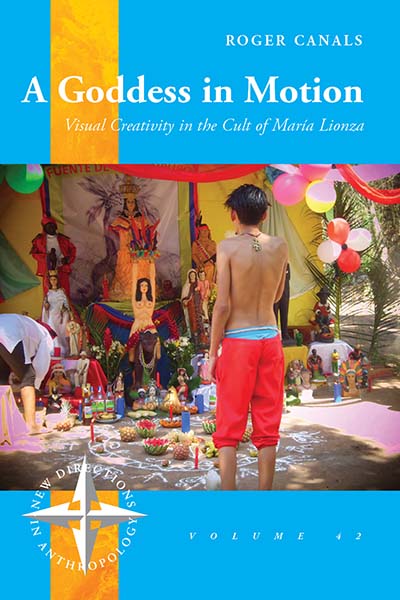
A GODDESS IN MOTION: Visual Creativity in the Cult of María LionzaBy Roger Canals, lecturer in the department of social anthropology at the University of Barcelona.


The book A Goddess in Motion: Visual Creativity in the Cult of María Lionza finds its origins in my vivid interest in Afro-Latin American religions, art and visual anthropology. I understand the latter in a broad sense, that is, as an anthropology of images, as an exploration on the act of seeing and being seen, as a visual ethnography and, lastly, as an attempt to write and publish the outcomes of our research, including visual material.


The main goal of A Goddess in Motion: Visual Creativity in the Cult of María Lionza  is to explore how this goddess is represented and what people do with –and through– her images in contemporary Venezuelan society and abroad. For those who do not know this amazing figure, let me tell you that María Lionza is a fascinating goddess, still highly unexplored by academia: symbol of the Venezuelan identity, she is represented as Indian, White, Mestiza and as a Black woman, sometimes benevolent and sometimes evil, at once represented with a high sexual component and at once depicted as a mature woman close to the Virgin Mary. The images of María Lionza may be found in many different locations, where they play a variety of roles: on religious altars, in museums and galleries, on television, on the Internet or on the walls of the streets of Venezuelan cities, to mention just a few. Moreover, María Lionza can “descend” into the mediums’ bodies or “appear” in dreams, visions and apparitions.


The challenge of this book is to think of all these images (material, corporeal and mental) as a whole, that is, as a sort of dynamic and open network in which practices, discourses and visual representations mingle.

Continue reading “Who is María Lionza?”

Happy Bastille Day

paris-1293750_1920Celebrated on July, 14, Bastille Day is the French national day and one of the most important bank holidays in France. The day commemorates the beginning of the French Revolution with the storming of the Bastille on the 14th July 1789, a medieval fortress and prison which was a symbol of tyrannical Bourbon authority and had held many political dissidents, and symbolizes the end of absolute monarchy and the birth of sovereign Nation.

The following year, the Fête de la Fédération was held in Paris and across the nation by a populace that largely believed the French Revolution was over. As it turned out, they were mistaken–and by 1791 there was little in the way of national unity to celebrate. The holiday wasn’t picked up again until 1878 when it was a one-time official feast to honor the French Republic, which was followed by an unofficial, popular celebration of the day in 1879, which in turn led to a call to make it an official holiday in 1880 complete with a military parade which has been an annual fixture ever since.


Continue reading “Happy Bastille Day”

An Interview with Nafisa Shah, Author of Honour and Violence

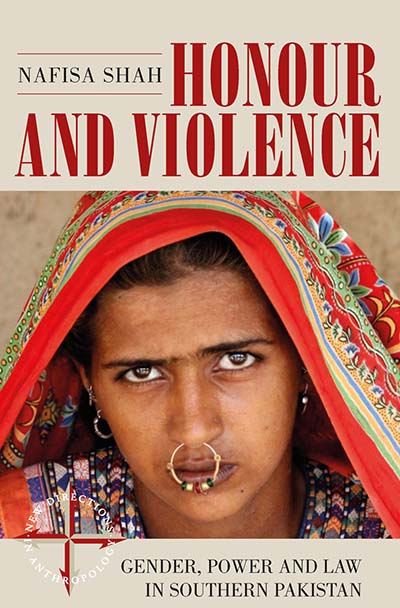
The following is an interview with Nafisa Shah about hew new book Honour and Violence: Gender, Power and Law in Southern Pakistan.

1) When did you begin working on Honour and Violence? Can you briefly tell us about your journey as a journalist, scholar, and politician following honor killings in Pakistan?

Honour and Violence is a process, a part of the journey, and not a product or a culmination. It is a coming together of different perspectives in the different roles through which I studied the phenomenon of karo kari, a practice that allows men to take lives of women in his family if accused and seen to be engaging in relationship outside or before marriage by invoking honour violation.

In 1992, as a young and fiery journalist, I travelled to Kashmore, and wrote the first story on honour based customs and practices in Upper Sindh for Newsline, a monthly news and features magazine headed by a woman editor, the late Razia Bhatti.

Then a few years later, as a Reuters fellow at Green College, Oxford I followed it up with a longer piece. My supervisor there, late Helen Callaway, was the first scholar to suggest I needed to convert these shorter journalistic pieces to something more longterm and showed me the academic route. And that’s where I built on whatever I saw and used the anthropological lens, which would allow me to communicate the problem to the wider world. Continue reading “An Interview with Nafisa Shah, Author of Honour and Violence

Promoting ‘self-reliance’ for refugees: what does it really mean?

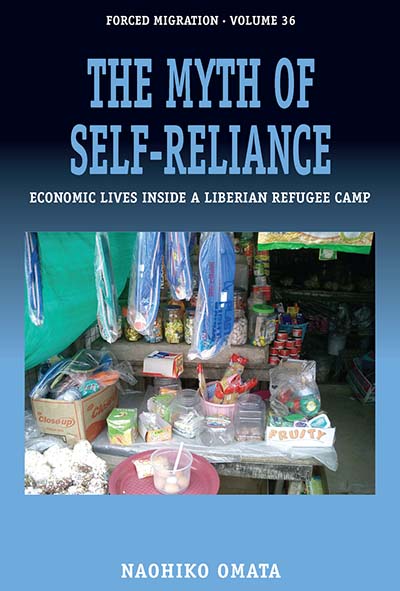
The following is a post by Naohiko Omata, author of The Myth of Self-Reliance: Economic Lives Inside a Liberian Refugee Camp.

Promotion of ‘self-reliance’ for refugees has occupied a central seat in the policy arena of the international refugee regime in recent years. The United Nations High Commissioner for Refugees (UNHCR) broadly defines self-reliance as ‘the social and economic ability of an individual, a household or a community to meet essential needs in a sustainable manner’. Its guiding philosophy can be summarised as: refugees have the skills, capacity and agency to stand on their own and be able to sustain themselves without depending on external humanitarian aid. This concept has been universally embraced by policy-makers and aid agencies and has now become an increasingly visible part in refugee assistance and protection programmes worldwide.

But on the ground, what does it really mean for refugees to attain self-reliance?

While many policies have rhetorically committed to the importance of ‘helping refugees help themselves’, some fundamental questions remain unanswered.

First, do refugees have enabling conditions to achieve self-reliance? Currently, many refugees in the Global South are unable to fully exercise their right to work and to move freely due to regulations by their host governments. These impediments can severely constrain refugees’ capacity to construct meaningful livelihoods and limit their access to commercial markets. Under these restrictions, is it sensible to assume that refugees can attain self-reliance regardless of how industrious and ingenious they are?

Next, how do we determine whether refugees have achieved self-reliance? Despite its extensive promotion, there are to date no universally agreed systematic and rigorous criteria for measuring refugees’ self-reliance. Instead of using objective benchmarks, UNHCR often perceives refugees as self-reliant when they live without external assistance. Is the situation in which refugees living without aid a plausible indicator of ‘meeting their basic needs in a sustainable manner’, as defined by UNHCR?

Most importantly, for whom is refugees’ self-reliance being promoted? In theory, nurturing refugees’ self-reliance should entail a strategic shift from traditional relief aid to development-oriented support and the provision of enabling conditions for refugees to establish gainful livelihoods. Yet this is not happening in the field. Meanwhile, UNHCR and donor states usually start decreasing assistance for refugees while promoting refugees’ self-reliance. Is refugees’ self-reliance meant to empower refugees’ economic capacities or to justify cutting down aid for refugee populations?

My authored book, The Myth of Self-Reliance, has explored these important but unsolved questions through a study of Buduburam refugee camp in Ghana. This Liberian refugee camp has been commended by UNHCR as an exemplary ‘self-reliant’ model in which refugees were sustaining themselves through robust businesses with little donor support. The UN refugee agency even boasted that the organization had facilitated their economic success by gradually withdrawing its assistance over the period of exile.

The book challenges the reputation of Buduburam refugee camp as a successful model for self-reliance and sheds light on considerable economic inequality between refugee households. Both qualitative and quantitative data reveal that a key livelihood resource for refugees in Buduburam was not their commercial activities but their access to overseas remittances, which had nothing to do with UNHCR’s initiatives to foster refugees’ self-reliance by withdrawing aid. While refugees who were receiving remittances were able to satisfy their basic day-to-day needs, those who had no connections to the diaspora were deeply impoverished.

There is increasing support for the idea that refugees are active and capable players with ingenuity and resilience. I agree wholeheartedly with this view in principle. However, it is irresponsible to assume that this can entirely replace the need for humanitarian aid and protection, in the absence of an enabling environment and adequate resources. Over-emphasis on the resilience, agency and capacity of refugees can obscure internal differentiations in their economic capacities, and universal celebration of refugees’ self-reliance can even undermine refugee protection and welfare. While we should certainly acknowledge and respect refugees’ capabilities and resourcefulness in the face of adversity, we should not dump all responsibilities on the shoulders of refugees alone.

Given the daunting scale of refugees globally, it is undeniable that we need to pioneer new ways to support and enable their socio-economic independence in the long-term. However, making refugee self-reliance a reality necessitates a strong commitment and investment from not only refugee but host governments, the donor community, development agencies, UNHCR, and other relief organizations.


Learn more about The Myth of Self-Reliance: Economic Lives Inside a Liberian Refugee Camp here and read the Introduction for free online.

Book Launch for Stories Make the World

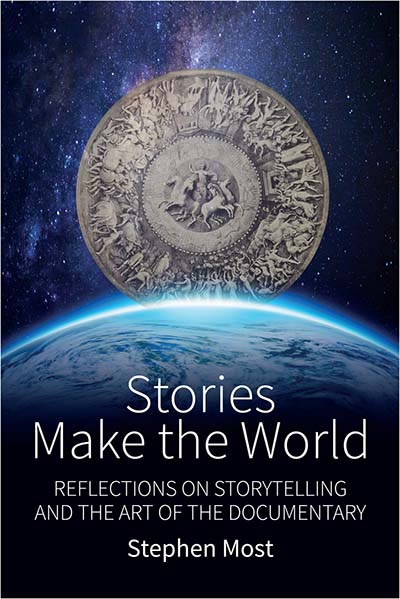
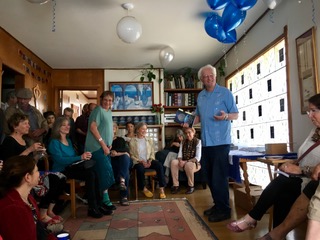
The following is a post about the book launch for Stories Make the World: Reflections on Storytelling and the Art of the Documentary by Stephen Most.

It’s odd to see the result of years of work contained within a small object, whether it is a book, a DVD, or a phone on which films are streaming. Stories Make the World contains, in a sense, ideas I care about, a variety of subjects that interest me, and many of the films I’ve worked on.

It was odd as well to see a room enclose people from almost every aspect of my life. That happened at the party celebrating the launch of Stories Make the World. If my life were a book, many of its chapters appeared in my living room one Sunday afternoon. Convening beneath balloons were my brother, a cousin, and their wives, my wife, our son and his girlfriend, friends who live on my block, friends whose children grew up with my children, other friends I hadn’t seen in years, and colleagues I have worked with over the years.

That gathering of people I’ve known over a long span of time in disparate situations offered a sense of my life’s unity. But it was an illusion: a snapshot at a moment in time belies the experience of living. As Kierkegaard wrote in his journals, “Life can only be understood backwards, but it must be lived forwards.” Living forwards, it can be impossible to tell what direction one will take and whether pleasure or distress, success or failure will result. That applies to documentary films, almost every one of which is a high-risk project. It applies, of course, to a book from conception to publication and beyond. And it’s true for everyone’s life. The present moment is pregnant with the future. The outcomes and their connection with what came before become evident only in retrospect.
Stories Make the World

Looking around the room, I saw the youngest member of my family, two-year-old Nina, resting in her mother’s arms. I wondered, who will she be? What will the world be like when she is a woman? Across the room from Nina and her mother Katie stood Douglas Sharon, an explorer in Perú who, when we first met in our early twenties, was discovering ancient cities that Andean jungle had covered. His friendship with the shaman Eduardo Calderón inspired a career change: Douglas became an anthropologist.

I caught the eye of Claire Schoen. When we met, I was a playwright working with a comedic theater company and she was a documentary filmmaker. Living with her, I entered the community of independent media professionals in the Bay Area. Members of that community listened as I read passages from Stories Make the World: Judy Irving who, when I met her, was making Dark Circle, a mind-opening film about the nuclear age, with Chris Beaver and Ruth Landy; Ruth, who produced international media for the World Health Organization after Dark Circle premiered; Justine Shapiro, who apprenticed with Judy and Chris, then went on to make Promises, the Emmy-winning, Academy Award-nominated film about Israeli and Palestinian children; Gina Leibrecht, who has edited two films I’ve worked on: A Land Between Rivers and Wilder than Wild; and the director of those films, Kevin White, who arrived late, bringing a bottle of bubbly.

At that moment in time in that place, which seemed to encompass innumerable stories in my life and theirs, I released into the world a small object that I hope will be fruitful.


See an earlier blog post from Stephen Most here, and learn more about the book Stories Make the World: Reflections on Storytelling and the Art of the Documentary here. To stream and download films in Stories Make the World, go to www.videoproject.com/Stories.