Fresh Ink on a Classic: Going ‘Beyond “Writing Culture”’

In 1986, Writing Culture: The Poetics and Politics of Ethnography was published, and it changed the perception of ethnographic study from then on. Little more than 20 years later, Olaf Zenker and Karsten Kumoll took its reach further with Beyond Writing Culture: Current Intersections of Epistemologies and Representational Practices, published originally in 2010 and published as a paperback last month. Below, the editors share how their work engages with the inspiration piece, how they came to publish the collection, and the ways in which their work corresponds to and challenges the original.


_____________________________


Berghahn Books: Tell us about the original Writing Culture? How does your volume expound on the principles set forth in this groundbreaking work, and how does your volume differ?
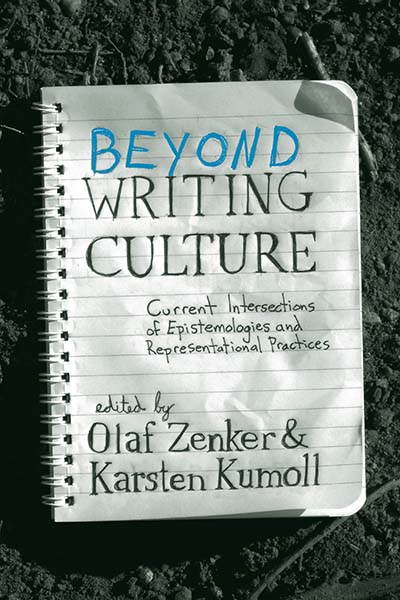
 

Olaf Zenker: The publication in 1986 of Writing Culture by James Clifford and George Marcus was crucial for the discipline of anthropology as a whole. Continue reading “Fresh Ink on a Classic: Going ‘Beyond “Writing Culture”’”
Good Borders Make Good Neighbors

What are the social impacts as European political borders are being redefined? Using a variety of case studies, editors William Kavanagh and Jutta Lauth Bacas seek to answer that question in Border Encounters: Asymmetry and Proximity at Europe’s Frontiersto be published this month. The editors and contributors examine the implications as borders are strengthened in some parts of the continent, and weakened in others. Below, Kavanagh and Lauth Bacas share their thoughts on the volume.


________________________________________________


Berghahn Books: What drew you to the study of political and social borders? Why is this study important?
 

Jutta Lauth Bacas: The core experience which triggered my interest in border studies and in the topic of irregular crossing at a maritime border was my encounter with destroyed inflatable dinghies having been used by refugees to enter a Greek border island clandestinely.

Continue reading “Good Borders Make Good Neighbors”

Likelihood of Contact Depends on the Lifetimes of Civilizations

If alien civilizations are anything like terrestrial civilizations, earthly beings may never encounter beings from outer space. Civilizations Beyond Earth contributor Alan J. Penny says our greatest chance for interaction will hinge on the longevity and attention span of an alien society — which must be long enough to give us a chance to interact.


________________________________________

To consider the number of extraterrestrial civilizations that may be out there and which we can detect by their emission of radio signals, we need to think about the likelihood that a star may host a planet with a civilization that can broadcast such signals.


But we also need to think about how long such civilizations last.

Continue reading “Likelihood of Contact Depends on the Lifetimes of Civilizations”

Berghahn Author Asks: ‘Quo Vadis FEMEN?’

FEMEN is a Ukrainian feminist protest group that has become infamous for its topless protests against patriarchy. The group, founded in 2008, has since grown to be a worldwide phenomenon, and not simply because its protests are often seen as “sextreme.” Marian Rubchak, editor of Mapping Difference: The Many Faces of Women in Contemporary Ukraine, takes a look into the history and meaning of the movement, and asks: Where is it going? 


________________________________________


Marian Rubchak

The year was 2008; 17 years had passed since Ukraine declared its independence and early advocates of change began to espouse high-minded ideals designed to promote women’s rights. These incipient feminists laid the groundwork for raising an awareness of discrimination against women, and were instrumental in advancing the passage of some of the most progressive pro-women legislation Ukraine had yet seen. Fast forward to 2008 — the promising beginnings were moving very slowly, too slowly. Clearly the work of reform would need to proceed to a higher level.

Continue reading “Berghahn Author Asks: ‘Quo Vadis FEMEN?’”

Looking ‘Against the Grain’ at German-Jewish Intellectuals

German-Jewish intellectuals in the twentieth century are the focus of Against the Grain: Jewish Intellectuals in Hard Times, published this month. The volume, edited by Ezra Mendelsohn, Stefani Hoffman, and Richard I. Cohen, looks at the key figures of German-Jewish thought: Scholem, Strauss, and Kohn, and examines how such thinkers reacted to, and were impacted by, the collection of crises lived by Central European Jews. Below, co-editor Mendelsohn speaks about the volume’s potential to “stir” the field and what brought him to the study in the first place.


____________________________________________


Berghahn Books: What drew you to the study of the trials and tribulations of Jewish men and women in the twentieth century?


Ezra Mendelsohn: The main reason resides in my  interest in the history of my own family.  Both my parents were born in Tsarist Russia, and both ended up in the United States, having lived for some time in British Palestine. 

Continue reading “Looking ‘Against the Grain’ at German-Jewish Intellectuals”

A New Model for Interstellar Communication

Communication between great distances is nearly instantaneous and is becoming faster every day. But when discussing communication with beings outside of our solar system, emails and text messages are still not fast enough to span the light-years of distance in one person’s lifetime. Civilizations Beyond Earth: Extraterrestrial Life and Society contributor Carl L. DeVito proposes that perhaps communication to the far reaches of space is about leaving a mark or a legacy, much like great civilizations of yore left for modern-day humans.


________________________________


The laws of physics and the discoveries of astronomy place serious restrictions on interstellar communication.


Stars are light-years apart, and the special theory of relativity tells us that there are restrictions on the speed at which information can be exchanged. The times involved in sending and receiving messages, which may exceed many generations, rule out a dialogue.

Continue reading “A New Model for Interstellar Communication”

Extra-Terrestrial Life: Good or Bad News?

Is there life beyond Earth? And how will the human race — specifically our media — react if there is? Civilizations Beyond Earth: Extraterrestrial Life and Society, which will be released as a paperback this month, is a collection of essays that address the (plausible) possibility that we are not alone in the universe. If that is true, and if we do one day make contact — wonders contributor Morris Jones — how will news outlets portray such an event? And will that lead to worldwide awe or global panic?


________________________________________________________


Let’s assume that evidence of intelligent extraterrestrial life is discovered tomorrow.


Continue reading “Extra-Terrestrial Life: Good or Bad News?”

Life Beyond Earth? Survey Says…

In 2005, a survey of 1,000 U.S. men and women of various backgrounds revealed that 6 in 10 Americans believe in the possibility of extraterrestrial life. If this slice of the public is correct, what does it mean for our world? That is one of the questions editors Douglas A. Vakoch and Albert A. Harrison attempt to answer through the collection Civilizations Beyond Earth: Extraterrestrial Life and Society, which was released in paperback August 2013. Below, volume contributor George Pettinico begs the question of the American reaction: How will the U.S. react if we discover life outside of our blue planet?

_____________________________________________


Imagine the day, if and when it should come, that the Search for Extraterrestrial Intelligence (SETI) confirms there is indeed intelligent life on other planets.


Continue reading “Life Beyond Earth? Survey Says…”

The ‘Life-World’ of Translation

Some words escape translation—a fact Stephen Barlau discovered quickly when he set about translating Rudolph van Thadden’s novel, originally published as Trieglaff. Eine pommersche Lebenswelt zwischen Kirche und Politik 1807-1948. Barlau brought the work into English as Trieglaff: Balancing Church and Politics in a Pomeranian World, 1807-1945, which was published this month by Berghahn. Below, the translator shares the importance of care and nuance when translating five generations worth of stories to English.


_____________________________________


The breadth and depth of meaning of German Lebenswelt, used in the original subtitle of Trieglaff, escapes capture in English.


It refers to the world of daily life in all its elements. Setting is immanent, environment is conjured; life extends beyond daily to happenings for an extended period with its characterizing features; both dynamic living and graphic life are encompassed. All these elements are denoted, not connoted; meaning fails if any are absent—or perhaps the word is all connotation, all shadow implication of meanings.


Continue reading “The ‘Life-World’ of Translation”

Where High Housing Prices Meet Activism

Earlier this year, Sam Beck, co-editor of Toward Engaged Anthropology, earned the Daisy Lopez Award of Churches United for Fair Housing. He earned the award for his work to help further the mission of CUFFH—that is, to provide affordable housing in North Brooklyn, where property values have skyrocketed in recent decades. Below, Beck discusses the work that helped him earn the award and why it is important.


_________________________________________

I received the 2013 Daisy Lopez Leadership Award of Churches United for Fair Housing (CUFFH). This organization’s mission is to promote the sustainability of the North Brooklyn Latino community by advocating affordable housing. This part of Brooklyn experienced the dramatic withdrawal of capital and city services in the 1970s, whose Puerto Rican and Dominican population suffered the consequences of low incomes, dilapidated housing, poor schools, and inadequate health care.

Continue reading “Where High Housing Prices Meet Activism”