NEW & NOTABLE BOOKS
Continue reading “New and Notable Titles from Berghahn Books & Journals”
 Join our Email List





Continue reading “New and Notable Titles from Berghahn Books & Journals”
 We’re pleased to announce the launch of an exciting new journal in 2015 titled Boyhood Studies: An Interdisciplinary Journal. The first issue will be published this month!
Boyhood Studies: An Interdisciplinary Journal is a peer-reviewed journal providing a forum for the discussion of boyhood, young masculinities, and boys’ lives by exploring the full scale of intricacies, challenges, and legacies that inform male and masculine developments. Boyhood Studies is committed to a critical and international scope and solicits both articles and special issue proposals from a variety of research fields including, but not limited to, the social and psychological sciences, historical and cultural studies, philosophy, and social, legal, and health studies.
Read the table of contents for the first issue here.
Read an excerpt, written by editor Diederik F. Janssen, from the Editorial of the first issue:
I am most excited to be announcing the first issue of Boyhood Studies: An Interdisciplinary Journal. The journal continues Thymos: Journal of Boyhood Studies, seven volumes of which were published between 2007 and 2013 by The Men’s Studies Press. Boyhood Studies will complement the prize-winning title Girlhood Studies: An Interdisciplinary Journal, published by Berghahn since 2008.
Having co-nurtured Thymos, initially with Miles Groth of Wagner College, on the basis of two exploratory bibliographies on boyhood and girlhood studies (unofficially web-published first in June 2005), I feel thrilled about the vitality and now co-residence of both journals ten years onward. Over the years, both journals have featured a wide range of scholarship, and have been helpful in imagining what, thereby, became eponymous fields of scholarship. I am most privileged to be able to thank both Dr. James Doyle of The Men’s Studies Press for his unrelenting dedication, his energy, and continued intellectual companionship, and Vivian Berghahn and the Berghahn production team, for their vision, support, and hard work in making this re-launch a possibility.
….
As originally envisioned in Thymos, we hope that Boyhood Studies: An Interdisciplinary Journal will be of help in making sense of all the awards, nominations, views, comments, and criticism that boy culture is, apparently, able to elicit. What (analytic) gaze do boys, young and older, deserve? What spectacle do they present to the observing eye, beyond that of the remnants or ruins of patriarchy? What do boys need from teachers, parents, friends, and loved ones? What are the latter asking of the boy? Historical, anthropological,
and practice-based contributions are all welcomed—they are all needed—to answer these global questions.
DIEDERIK F. JANSSEN is an independent researcher residing in Nijmegen, The Netherlands. A co-founder and later editor of Thymos: Journal of Boyhood Studies (The Men’s Studies Press 2007-2013), he is editor of Boyhood Studies: An Interdisciplinary Journal (Berghahn Journals), founding and current editor of Culture, Society & Masculinities (The Men’s Studies Press), and managing editor of The Journal of Men’s Studies (Sage).



European Comic Art
Volume 8, Issue 1
Articles in this edition of ECA pursue the theme of boundary crossing by examining negotiations between the national and the transnational from several different angles, including subject matter, influences, and critical traditions.
Continue reading “Hot Off the Presses – New Journal Issues Published in July”
This is a guest post written by Bernhard Forchtner, contributor to Volume 10: Issue 2 of the journal Nature and Culture . Bernhard Forchtner is a contributor to the article titled “The Nature of Nationalism: ‘Populist Radical Right Parties’ on Countryside and Climate.”
Conversations about “populist radical right parties” (Cas Mudde) in contemporary Europe usually turn to issues such as asylum seekers, ‘foreigners’ and the European Union. What tends to surprise audiences, however, are stories about far-right ecology. Environmental issues are, after all, issues supposedly covered by ‘the left’. However, even if far-right actors across Europe have hardly prioritised environmental protection over the last decades, these actors do intervene in such debates, making the latter meaningful on the basis of their nationalist stance. And maybe, this should not surprise us in the first place given that nature protection, in its beginnings in the 19th century, was often pushed by rather conservative forces.
In the article The Nature of Nationalism, my colleague Christoffer Kølvraa and I thus ask whether and how different types of “populist radical right parties”, the more mainstream Danish People’s Party and the more radical British National Party, have addressed the topic of the national countryside and the transnational issue of climate change.
Although differences in the ‘radicalism’ of the position of these actors exist, these differences are not fundamental. Instead, there is a fundamental difference in how national countryside and transnational climate are assessed. With regards to the countryside, both parties are ardent defenders of what they view as a quintessential national space, a position underpinned by what we call a nationalist symbolic aesthetics. That is, both parties frame the countryside in terms of its natural splendour coupled with a claim for historical continuity of the national community in this territory, thereby making manifest the political sovereignty the people enjoy over the land. In relation to the nature of climate too, the British National Party goes much further than the Danish People’s Party, the former voicing strong scepticism (if not denial) regarding the thesis of (man-made) climate change – something the latter rather insinuates. However, both parties share a symbolic materialism via which international bodies, arguably necessary in the fight against an inherently transnational phenomenon, are criticised as they apparently endanger national sovereignty and classical nationalist ideas of self-sufficiency. When nationalists justify their stance on environmental issues and claim that “we all hold our land in trust for future generations” (British National Party), one should not simply dismiss their arguments as strategic in order to attract voters. Instead, their notion of ecology and environmental protection is deeply embedded in their ideology.
While the topic has received rather scant attention in the literature to date, and thus research charters much previously unmapped territory, the topic has also proven to be challenging – something noticeable in particular in conversations with environmental activists. While the climate politics of “populist radical right parties” are easily rejected by these activists, many of their more subtle positions, for example on invasive species, cannot easily be distinguished from mainstream and even left-wing arguments. Where they exist, these similarities need to be taken seriously! As the modernization of the far-right across Europe does not seem to lose steam, more and more related, counter-intuitive cases emerge. Currently, a group of German neo-Nazis (Balaclava Küche) promotes veganism within their scene. Partly due to environmental concerns, they do so through their YouTube channel but have also offered catering service at neo-Nazi concerts, etc. In a series of interviews conducted after the completion of The Nature of Nationalism, actors (previously) belonging to “populist radical right parties” voiced ‘traditional’ views on a far-right ecology. For example, interviewees lamented about what they perceive as a cultural crisis which ignores the laws of nature. Instead, nations should be viewed as (eco)systems which – if too much alien elements enter – lose their natural equilibrium and collapse. Subsequently, “nomadic cultures and races” were rejected in favor of rooted (“sesshafte”) people who supposedly care for the environment. This can easily take an anti-Semitic twist but definitely contains a rejection of “foreigners” who are not committed to the beauty of ‘our’ country the way ‘natives’ supposedly are.
What these interviews have shown is that differences between these groups are worth investigating. While our paper foregrounds similarities based on a shared ideological ground, subsequent case-studies should equally focus on differences between various actors within a national space or across boundaries. There is work to do as these actors seem to have a future in, at least European, politics.
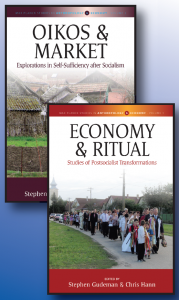 The following is a guest blog post written by Stephen Gudeman, Professor of Anthropology at the University of Minnesota and co-editor for the Max Planck Studies in Anthropology and Economy series. Below, Gudeman discusses connections between the current Greek Crisis and the first two volumes of this series.
The first two volumes in the Max Planck Studies in Anthropology and Economy series, which are edited by Chris Hann and myself, bring to mind the current Greek crisis. I wish I had been a fly on the wall throughout the negotiations, been able to interject a word or two, and talked to a few Greeks and other Europeans for their thoughts. From afar, I see they featured feisty personalities, as well as different visions about how economy operates, wellbeing, and the purpose of economic life. They reflect cultural differences within the Euro zone.
Continue reading “Demystifying “Austerity”: Series Editors Reflect on Greek Crisis”
 In its spring 2015 volume, The Cambridge Journal of Anthropology published the special issue “Remaking the Public Good: A New Anthropology of Bureaucracy”, edited by Laura Bear and Nayanika Mathur. In this blog post, Olaf Zenker – contributor of the article “De-judicialization, Outsourced Review and All-too-flexible Bureaucracies in South African Land Restitution” – describes how he came across the peculiar case analysed in his article and how this land claim ended up speaking about the “Remaking of the Public Good” in South Africa and beyond.
How is the new South African state imagined, enacted and contested, when citizens engage officials in the attempts to get back their land lost through racist colonial and apartheid dispossessions? What kinds of “public goods” are brought into play, by whom and with what effects, when the post-apartheid state simultaneously functions as the main driving force behind this land restitution process, as its judicial arbiter through the specialist Land Claims Court, and as its core reference point, as all claims are lodged against the state? Questions like these have driven my intermittent ethnographic fieldwork on South African land restitution since 2010 – not only with regard to claimant communities, but especially also concerning the operations within the two relevant state agencies: the Land Claims Commission and the Land Claims Court.
“You must prepare the invasion of Europe because we will never win this war unless we bring the war against Hitler on his own land” – Winston Churchill
June 6th will mark the 71st anniversary of The Normandy landings, the day when Western Allies landed in northern France, opening the long-awaited “Second Front” against Nazi Germany. The largest seaborne invasion in history, the operation began the invasion of German-occupied Western Europe, led to the restoration of the French Republic, and contributed to an Allied victory in the war.
_________________________________________________________________
Of related interest, please take a look at some of Berghahn’s recent books on WWII:
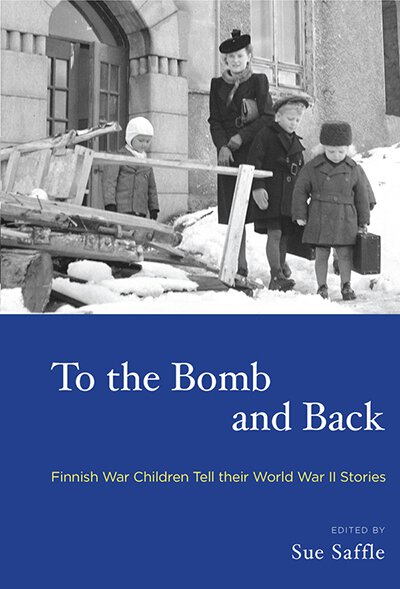 TO THE BOMB AND BACK
Finnish War Children Tell Their World War II Stories
Edited by Sue Saffle
Foreword by Kai Rosnell Continue reading “In History: 71st anniversary of D-Day”

The Global Day of Parents is observed on the 1st of June every year. The Day was proclaimed by the UN General Assembly in 2012 and honours parents throughout the world. The Global Day provides an opportunity to appreciate all parents in all parts of the world for their selfless commitment to children and their lifelong sacrifice towards nurturing this relationship.
In honour of this event, we would like to invite you to explore the following titles which examine global parenthood from a variety of disciplines and perspectives.
Read more about the Global Day of Parents here.
Continue reading “Appreciating Parents & Their Commitment to Children”
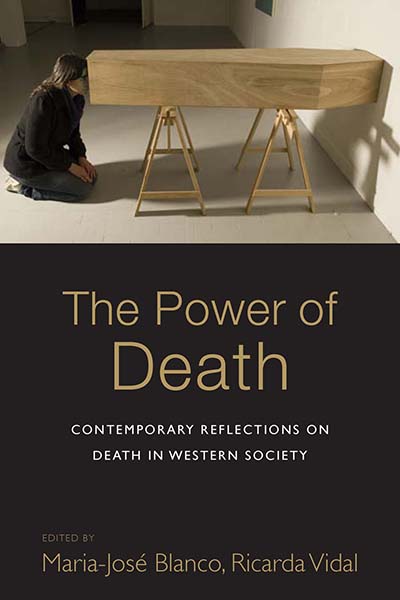 This is a guest post written by the authors of The Power of Death: Contemporary Reflections on Death in Western Society. Ricarda Vidal and Maria-José Blanco launched The Power of Death on May 15th, at the River Room, King’s Building, King’s College London. Below, the authors discuss the successful event.
We were very happy about the large turnout for our Round Table on the Aesthetics of Death, film screening and book launch of our edited volume The Power of Death: Contemporary Reflections of Death in Western Society.
The artist Sarah Sparkes started us off with a presentation about her work on ghosts and the world in-between life and death. Ricardo Gutierrez, a PhD candidate in the department of Spanish, Portuguese and Latin American Studies, gave a talk about femicide and the stylisation and sacralisation of the mothers of murdered women in Mexico. Photographer Briony Campbell closed with a very moving presentation about her work ‘The Dad Project’, which documented her father’s death by cancer.
Ricarda Vidal and Maria-Jose then presented the book The Power of Death, which covers the various aspects of death – the slow painful death of cancer, the grief and mourning of those left behind, as well as the more sensational side of violent death, sudden accidental death or the taboos and transgressions of murder.
The evening closed with a series of short films which ranged from the black humour of a spoof advertisement for a completely automatic Harakiri-kit to a thought-provoking, albeit poetic, criticism of the American justice system.
Anyone interested in buying the Harakiri-Kit or our book at a 50% discount, please get in touch with Ricarda Vidal (ricarda.vidal@kcl.ac.uk) or Maria-José Blanco (maria-jose.blanco@kcl.ac.uk).
Read more about this book here.
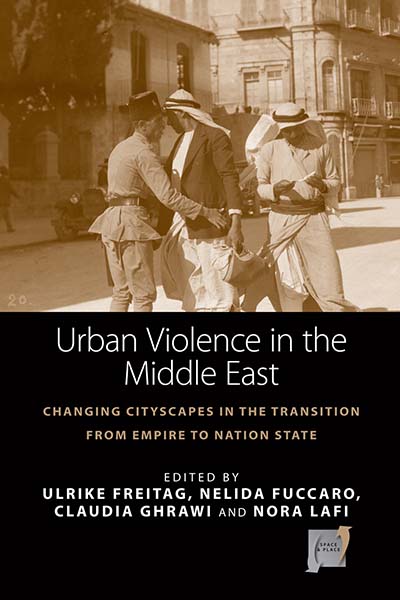 Covering a period from the late eighteenth century to today, Urban Violence in the Middle East explores the phenomenon of urban violence in order to unveil general developments and historical specificities in a variety of Middle Eastern contexts. Below, contributors to the volume tell about their personal relationship as historians to present echoes of their work.
Continue reading “Historians Relate to Present Echoes of their Work”