 Get New Issue Alerts
Browse Archive
 PDF issue available for purchase
 Print issue available for purchase
- Vol 29 Issue 1
- Vol 28 Issue 1
- Vol 27 Issue 1
- Vol 26 Issue 1
- Vol 25 Issue 1
- Vol 24 Issue 1
- Vol 23 Issue 1
- Vol 22 Issue 1
- Vol 21 Issue 1
- Vol 20 Issue 1
- Vol 19 Issue 1
- Vol 18 Issue 1
- Vol 17 Issue 1
- Vol 16 Issue 1
- Vol 15 Issue 1
- Vol 14 Issue 1
- Vol 13 Issue 1
- Vol 12 Issue 1
- Vol 11 Issue 1
- Vol 10 Issue 1
- Vol 9 Issue 1
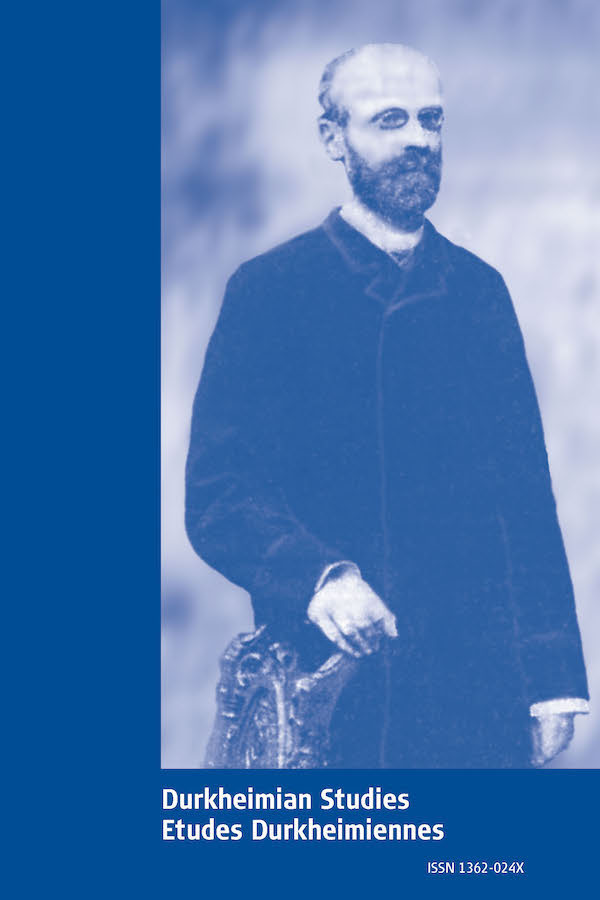
Durkheimian Studies
Études Durkheimiennes
ISSN: 1362-024X (print) • ISSN: 1752-2307 (online) • 1 issues per year
Volume 25 Issue 1
Get 35% discount when you checkout 3 or more PDF articles.
Decolonising Durkheimian Conceptions of the International
Colonialism and Internationalism in the Durkheimian School during and after the Colonial Era
Over the past 20 years, numerous scholars have called upon social scientists to consider the colonial contexts within which sociology, anthropology and ethnology were institutionalised in Europe and beyond. We explain how historical sociologists and historians of international law, sociology and anthropology can develop a global intellectual history of what we call the ‘sciences of the international’ by paying attention to the political ideas of the Durkheimian school of sociology. We situate the political ideas of the central figures explored in this special issue—Émile Durkheim, Marcel Mauss, Bronisław Malinowski and Alfred Métraux—in their broader context, analysing their convergence and differences. We also reinterpret the calls made by historians of ideas to ‘provincialise Europe’ or move to a ‘global history’, by studying how epistemologies and political imaginaries continued by sociologists and ethnologists after the colonial era related to imperialist ways of thinking.
Durkheim, the Action Française and the Question of Nationalism
This article concerns Émile Durkheim's critique of the Action Française as expressed in his seminal articles of 1898, which was an important moment in the Dreyfus Affair, where Durkheim's active engagement serves to challenge a still widespread view of him as a latter day traditionalist and positivist, He developed epistemological and political arguments against this proto-fascist movement, which have implications for his accounts of nationalism and internationalism.
The Gift of The Nation
Marcel Mauss and the Intersocial Turn of Sociology
In order to question the modernist common sense of mainstream sociology, epitomised today by the charge of methodological nationalism, this article offers an overall reading of Marcel Mauss's
Malinowski and Mauss Exchanging Knowledge in Interwar Europe
Lessons in Internationalism
Bronisław Malinowski sought throughout his career to make a scientific contribution to understanding and reforming the international order by making analogies with ‘primitive’ societies. His ethnographic material was important to Marcel Mauss's internationalist project in
‘Nothing Is Less Universal than the Idea of Race’
Alfred Métraux, American Social Science and UNESCO's Anti-Racist Campaign in 1950s Paris
In 1950, the cultural anthropologist Alfred Métraux, a student of Marcel Mauss, was appointed to head a new Race Bureau at UNESCO in Paris whose mission was to combat racism with the tools of social science. Métraux had worked in the Americas since the 1930s, and his appointment allowed French social scientists to join the global struggle to remove prejudice ‘from the minds of men’. To what extent did French scholars help shape Métraux's efforts, given that at the time American sociologists and social psychologists dominated the study of race relations? Booklets commissioned by UNESCO and authored by French and American scientists in the early 1950s suggest that linguistic and conceptual barriers made cross-national discussions of race difficult, but not impossible. Thanks in part to Métraux's campaign, the social scientific study of race relations in post-war France began earlier than is typically remembered.
From Neo-Kantianism to Durkheimian Sociology
Hermann Cohen and the Problem of Sacrifice
The phenomenon of sacrifice was a major problem in nineteenth-century social thought about religion for a variety of reasons. These surfaced in a spectacular way in a German trial in which the most prominent Jewish philosopher of the century, the neo-Kantian Hermann Cohen, was asked to be an expert witness. The text he produced on the nature of Judaism was widely circulated and influential. It presents what can be taken as the neo-Kantian approach to understanding ritual. But it also reveals the ways in which neo-Kantianism avoided becoming relativistic social science. In this case, it came to the edge and stopped. Cohen's account is compared to the similar, but ‘empirical’, account of the same material in Marcel Mauss and Henri Hubert, which completed the transition.
Frenchman, Jew, Positivist
Reading the and Mapping Émile Durkheim in Germany
This article investigates German-speaking scholarship's reception of the programme of scientific sociology that Durkheim presented in
The Gift and Open Science
This article illustrates how social structures and behaviours of scientists in the societal sub-system of open science resemble patterns analysed in
La typologie des crimes de Durkheim dans ses Leçons de sociologie criminelle (1892–1893)
This article presents the sociological typology of crimes developed by Durkheim for his course in criminal sociology of 1892–1893, of which a complete set of notes by his nephew and student Mauss was found among descendants in 2018. It can be broken down into four types of crimes: ataxic (theft, vagrancy), altruistic (homicide), alcoholic (blows and wounds, insults), anomic (fraudulent bankruptcy, swindling). This original typology in many ways announced the typology of suicides that would appear in 1897, and shows Durkheim's sociological theory at that time, while he was defending his thesis in 1893, at the end of that academic year. It sheds new light on the notions of regulation and integration and suggests the articulation between collective representations and social life, while Durkheim has not yet had his “revelation” (1894–1895).
Cet article présente la typologie sociologique des crimes élaborée par Durkheim pour son cours de sociologie criminelle de 1892–1893 dont un jeu de notes complet de son neveu et étudiant Mauss a été retrouvé chez des descendants en 2018. Elle se décompose en quatre types ou espèces de crimes : ataxiques (vols, vagabondage), altruistes (homicides), alcooliques (injures et coups et blessures) et anomiques. Cette typologie inédite préfigure, sur de nombreux aspects, la typologie des suicides qui paraîtra en 1897, et donne à voir la théorie sociologique de Durkheim à cet instant, alors qu'il soutient sa thèse à la fin de cette même année universitaire. Elle éclaire d'un nouveau jour les notions de régulation et d'intégration, alors à l'état de gestation, et donne à penser sur l'articulation entre les représentations collectives et la vie sociale, alors que Durkheim n'a pas encore eu sa « révélation » pour mener à bien son programme de sociologie religieuse (1894–1895).