 Get New Issue Alerts
Browse Archive
 PDF issue available for purchase
 Print issue available for purchase
- Vol 29 Issue 1
- Vol 28 Issue 1
- Vol 27 Issue 1
- Vol 26 Issue 1
- Vol 25 Issue 1
- Vol 24 Issue 1
- Vol 23 Issue 1
- Vol 22 Issue 1
- Vol 21 Issue 1
- Vol 20 Issue 1
- Vol 19 Issue 1
- Vol 18 Issue 1
- Vol 17 Issue 1
- Vol 16 Issue 1
- Vol 15 Issue 1
- Vol 14 Issue 1
- Vol 13 Issue 1
- Vol 12 Issue 1
- Vol 11 Issue 1
- Vol 10 Issue 1
- Vol 9 Issue 1
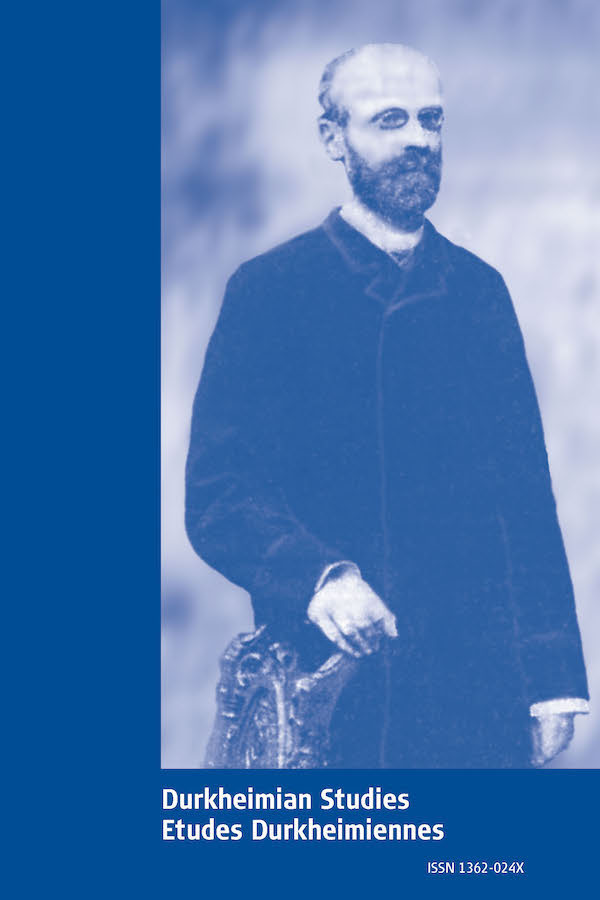
Durkheimian Studies
Études Durkheimiennes
ISSN: 1362-024X (print) • ISSN: 1752-2307 (online) • 1 issues per year
Volume 12 Issue 1
Get 35% discount when you checkout 3 or more PDF articles.
A Note on Durkheim's Creation of Les Formes Élémentaires
It is just a basic point that a help with understanding a work is to understand something about the process of its creation. In the case of Les formes élémentaires, it is evident from the lecture-course reading like a first draft of the work, and begun in 1906 (1907f), that the project started life as a concern, above all, with the study of early elementary religion. But even here, the logic of Durkheim’s argument – especially in his critique of animist and naturist theories of early religion – required him to make claims about basic elemental characteristics of all religion. And it is evident from correspondence of 1908, as well as from an article he started to write the same year and got published the following year (1909d), that the project had converted into a concern, above all, with a way to get at and understand basic continuing elemental forms of all religion.
Introduction
Durkheim's Contribution to the Debate on the Separation of Church and State in 1905
This is the first English translation of Durkheim's contribution to an important debate on the separation of church and state (1905) - in the course of which he remarked, to an outburst from those present, that 'From a sociological point of view, the Church is a monstrosity'. The translation comes with an introduction and editorial notes by W. S. F. Pickering, explaining the background to the debate, identifying the participants, and recommending some of the many books and articles on the issue.
Contribution to a Debate
'On the Separation of the Churches and the State'
This is the first English translation of Durkheim's contribution to an important debate on the separation of church and state (1905) - in the course of which he remarked, to an outburst from those present, that 'From a sociological point of view, the Church is a monstrosity'. The translation comes with an introduction and editorial notes by W. S. F. Pickering, explaining the background to the debate, identifying the participants, and recommending some of the many books and articles on the issue.
Durkheim, Rauh et la part qui revient à l'individu dans la genèse des phénomènes sociaux
This introduces and discusses the background to a virtually unknown text - Durkheim's speech at the funeral of his colleague and friend, Frédéric Rauh (1861-1909). The two men had known one another for some time, and had much in common. But a disagreement had arisen between them, over the individual's role in social life, and came to the fore in their exchange with one another during the debate on Durkheim's 'The Determination of Moral Facts' (1906). This traces the development of Rauh's career and of his views on ethics, outlines the argument of his main book, Moral Experience (1903), and indicates how his work increasingly referred to Durkheim, Lévy-Bruhl and the Année sociologique. But it is above all in an effort to pinpoint what was at stake. For it can seem more of a divergence of perspectives, generating disagreement over the questions it is important to ask, rather than over precisely the same issues.
Frédéric Rauh
Ce n’est pas seulement comme collègue de Frédéric Rauh que je viens lui adresser un dernier adieu; c’est aussi, c’est surtout comme ami, un ami très ancien et qui lui était tendrement attaché. Nous nous étions connus dès le lycée Louis-le-Grand. Il y arriva alors que j’étais à la veille d’y terminer mes études; il venait s’y préparer à l’École normale. Nous faisions partie de la même classe. Je le vois encore, assis devant moi, sur le gradin immédiatement inférieur. Outre la proximité matérielle, toutes sortes de raisons nous rapprochaient, et nos relations commencèrent tout de suite.
Action and the Question of the Categories
A Critique of Rawls
Durkheim's account of the categories is re-examined, in a critique of the fundamentally mistaken and philosophically uninformed interpretation put forward in Rawls's Epistemology and Practice (2004). This converts Durkheim into a pragmatist, even a behaviourist, more or less reducing conscience to an epiphenomenon of sounds, movements, and socially generated raw emotions. She bypasses the key role of representations and symbols, while her emphasis on collective 'forces' ignores Durkheim's concern with power as puissance and with the creativity of an effervescent fusion of energies. Thus action is central to his account of the categories, but not in the terms offered by Rawls. For action involves the full range of the functions of conscience. And these come into play through the power of representations and symbols, as an integral part of a whole creative fusion of energies and consciences in the 'dynamogenics' of collective action.
Civic Cohesion, and Sanctuaries for Coming to Terms with Modernity
The city is a key location of the modern social world, a home of rootlessness and transient everyday encounters between individuals. This essay explores the idea of 'the sanctuary' as a way in which people look for anchorage, and create and re-create images of a society, to cope with and negotiate life in the city. It mainly draws on Durkheim's work on ritual, symbolism and the sacred, together with his account of individual and collective representations. But it also discusses these concerns though other writers, notably Freud and Ricœur, and it draws on Kant's theory of art to introduce how Durkheim sees ritual -especially sacred drama - as at once a symbolism and an aesthetics, complete with the energies of a free creative 'surplus'. Even if in the end 'the sanctuary' is unequal to the marketplace, it is a necessary refuge of the transformative social imagination and a realm, not of everyday economics, but of civitas.
The De-familiazation of Inter-generational Relations
From the Family to the Groupe Professionnel
One of Durkheim's great 'unwritten books' was on the family. And one of the consequences has been insufficient attention to the issue's centrality in his work, and to the radical implications in the case of modern society. This essay is based on his lectures and articles on the family, but together with his many reviews on the subject in the Année sociologique. Given his evolutionary approach, a start is made with his interest in the origins and development of the family. But this helps to underline the far-reaching implications of his view that the modern family has narrowed down to the conjugal family. In a way the individual is emancipated from the bonds of kinship. But it is in a transformation of inheritance into an essentially private affair. Solidarity requires a rebuilding of links across the generations, while justice require a re-collectivization of inherited wealth, through new occupational groups.
Mauss et la sociologie française de la nation
For almost a century there was a lack of adequate reflection in French sociology on analysis of the nation. The explanation of this delay may lie in the foundations of the discipline itself. But in a major contribution, Marcel Mauss pointed the way to a sociology of the nation. For him, the development of the nation as an object of a new reflection depended on the insights of a multidisciplinary and comparative approach. But sociology had a pivotal role in this approach, helping to grasp the specificity of its object, and holding the key to its analysis, especially through the concept of integration. The slowness to utilize this text shows the difficulty in French sociological thought of working with a link between the social and the political.
Nouveau Durkheim? Vrai Durkheim?
This is an essay – along with another, by Frank Pearce – on The Cambridge Companion to Durkheim (2005). The collection is heterogeneous, and good in parts. But there are also basic themes, driven by the concerns of the editor-in-chief, Jeffrey Alexander – especially with a 'cultural turn' in how Durkheim is interpreted. Accordingly, a major criticism is that Durkheim's 'culturalism' isn't a relativistic 'culturalism', but looks for universals. His work conjugates the contextual and the universal. It also conjugates the rational and the emotional, in a continuation rather than a radical break with Kant. But it is above all in a commitment to science, and to a search for explanation through intelligible connections in the underlying dynamics of social life. Accordingly, another major criticism is not only the collection's tendency to downplay reason, but a sort of black hole in which it fails to tackle Durkheim's very idea of a social science.
A Modest Companion to Durkheim
This is an essay – along with another, by Raymond Boudon – on The Cambridge Companion to Durkheim (2005), edited by Jeffrey Alexander and Philip Smith. With becoming modesty, the editors admit that their argument for a 'cultural turn' in Durkheimian interpretation isn't universally accepted. Yet there is little sign, in their collection, of contributions that dispute their position. Certainly, some of the articles are interesting and stimulating, though others are modest in another sense, even quite flawed – as in some of their ideas about America. True, in his own article, Alexander makes a good enough case for a 'cultural turn'. But he seems unaware of Durkheim's last publication in his lifetime, 'The Politics of the Future' (1917). And in general, it is necessary to challenge 'culturalism'. This essay suggests an alternative, based not only on The Division of Labour, but the continuing relevance of Durkheim's belief in the need for socialism.
Book Review
Jennifer Mergy, ed., ‘Mauss et les durkheimiens’, L’Année sociologique, 54, 1, 2004.