 Get New Issue Alerts
Browse Archive
 PDF issue available for purchase
 Print issue available for purchase
- Vol 29 Issue 1
- Vol 28 Issue 1
- Vol 27 Issue 1
- Vol 26 Issue 1
- Vol 25 Issue 1
- Vol 24 Issue 1
- Vol 23 Issue 1
- Vol 22 Issue 1
- Vol 21 Issue 1
- Vol 20 Issue 1
- Vol 19 Issue 1
- Vol 18 Issue 1
- Vol 17 Issue 1
- Vol 16 Issue 1
- Vol 15 Issue 1
- Vol 14 Issue 1
- Vol 13 Issue 1
- Vol 12 Issue 1
- Vol 11 Issue 1
- Vol 10 Issue 1
- Vol 9 Issue 1
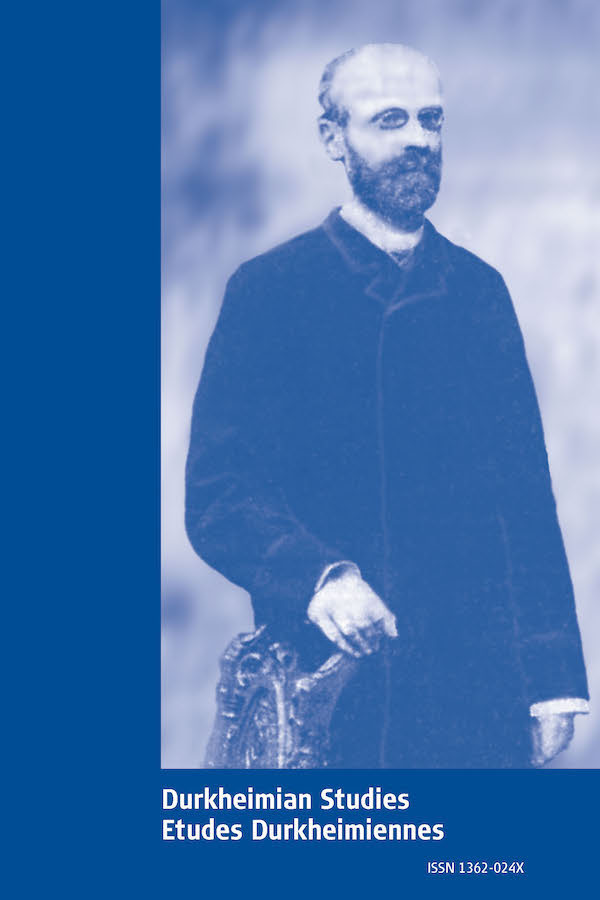
Durkheimian Studies
Études Durkheimiennes
ISSN: 1362-024X (print) • ISSN: 1752-2307 (online) • 1 issues per year
Volume 23 Issue 1
Get 35% discount when you checkout 3 or more PDF articles.
Society, Morality, Embodiment
Tracing Durkheim's Legacy
This issue of
What Do Religions Actually Fight About?
A Durkheimian Perspective
In this article, I use a reading of
The Current State of Anomie in Angola
In this article I explore the contemporary relevance of Émile Durkheim's classic theory of anomie with respect to both the discipline of social anthropology and the study of politics in Africa. I take as a case study present-day, post-war Angola, where an activist mobilisation (the Revolutionary Movement) has engaged in what I call ‘anomic diagnostics’ in opposing the country's current regime. Through a political reading of Durkheim's theory, I suggest that, while the French author situates anomie and suicide as cause and consequence respectively within a conservative view of society, Angolan activists instead see anomie as the starting point for a progressive political proposition productive of rupture.
From Durkheim to Hocart
Sacred Resources and the Quest for ‘Life’
In this article, I argue that the word ‘resource’ can be used to denote what is considered to be of high value in a given society. These values may relate either to society as a whole or to its parts. In the former case, resources often acquire the characteristics of the sacred as identified by Émile Durkheim and others. It is here argued that the Durkheimian approach captures the symbolic dimension of the collective sacred but ignores the social effects of people's attempts to obtain access to the highest value. To understand how concrete social forms evolve, one may rather turn to the writings of Arthur Maurice Hocart. His approach draws our attention to values (of ‘life’) and the social processes deriving from people's engagement with the sacred. To illustrate this approach, an ethnographic example from Odisha, India is provided.
What of Effervescence?
Durkheim in the Cathedral
In this article I explore the continued salience of Durkheimian effervescence through an examination of ritual activities contained within contemporary English cathedrals. My argument focuses less on collective occasions of creative or destructive tumult and more on ritualised forms of action where modalities of engagement and participation are nuanced, reflexively negotiated and small-scale. My aim is to render more subtle – and potentially productive – our understandings of gradations in ritual intensity.
Durkheim's Effervescence and Its Maussian Afterlife in Medical Anthropology
What, if not Durkheim's ‘collective representations’ acquired during exalted states of effervescence, gives rise to society, culture and science? Marcel Mauss provides another answer by pointing to the different rhythms of social relationships and the human effort to synchronise them. The seasonal cycle of the Eskimo [Inuit], Mauss argues, is in accord with their game; hence people disperse in summer to pursue economic activities in small bands, while they congregate in dense house-complexes in winter and engage in ritual. It would appear that Mauss draws heavily on Boas's contrast between the Kwakiutl winter celebrations and their ‘uninitiated’ livelihood in summer. These insights have traction for medical anthropologists who are interested in finding an anthropological explanation for the efficaciousness of ‘traditional’ medicines or ‘indigenous’ healing techniques.
The Bodily Efficacy of the Categories
Durkheim and Mauss's Intervention into the History of Philosophy
Between 1900 and 1912, Durkheim, Mauss and other contributors of the
From India to Australia and Back Again
An Alternative Genealogy of
This article argues that, although we think of Australian tribal ritual as Durkheim's source material for his masterwork
How Did Durkheim Die?
As we are commemorating the centenary of Durkheim's death in this issue, it seems appropriate to reflect on what we know about it. We know, of course, that he died on 15 November 1917 at the age of 59 – not a young age at which to die a hundred years ago, but not an old one, either. Also, we know that he died during World War I, but in his bed, unlike many of his younger colleagues, who died on the battlefield, including his own son.
Finding Durkheim's Grave
We walked the spine of Montparnasse
searching for Durkheim's grave.
Winter sun pinned us to sky,
illuminating turrets and spires:
ornate edges of civility in this city
of sensuality and light.