 Get New Issue Alerts
Browse Archive
 PDF issue available for purchase
 Print issue available for purchase
- Vol 29 Issue 1
- Vol 28 Issue 1
- Vol 27 Issue 1
- Vol 26 Issue 1
- Vol 25 Issue 1
- Vol 24 Issue 1
- Vol 23 Issue 1
- Vol 22 Issue 1
- Vol 21 Issue 1
- Vol 20 Issue 1
- Vol 19 Issue 1
- Vol 18 Issue 1
- Vol 17 Issue 1
- Vol 16 Issue 1
- Vol 15 Issue 1
- Vol 14 Issue 1
- Vol 13 Issue 1
- Vol 12 Issue 1
- Vol 11 Issue 1
- Vol 10 Issue 1
- Vol 9 Issue 1
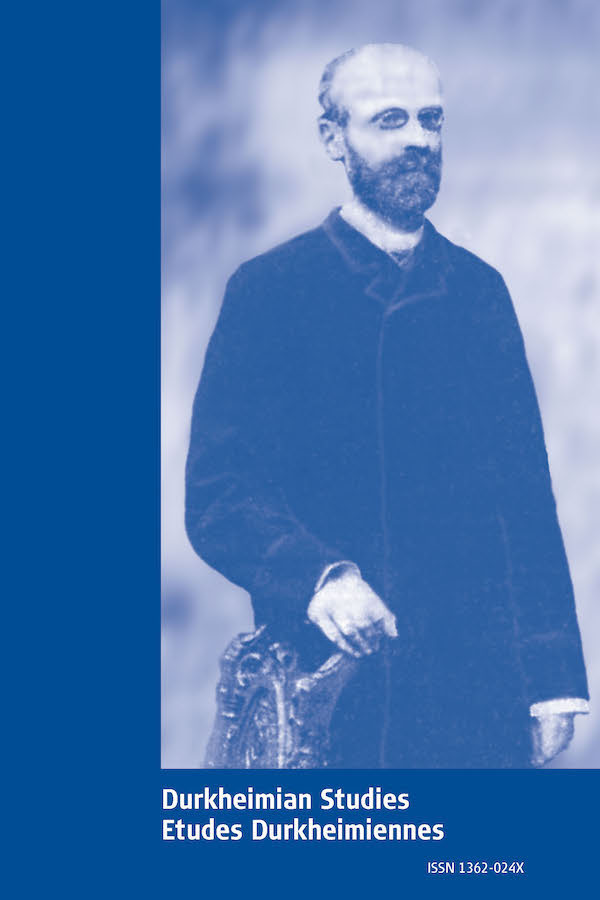
Durkheimian Studies
Études Durkheimiennes
ISSN: 1362-024X (print) • ISSN: 1752-2307 (online) • 1 issues per year
Volume 10 Issue 1
Get 35% discount when you checkout 3 or more PDF articles.
A Lost Lecture on Religion
The Ecole des Hautes Etudes Sociales organized a course of lectures during the academic session 1912-13 entitled Le problème religieux dans la pensée contemporaine. The opening lecture, with the same title, was given by Dominique Parodi. Not long after the end of the course it was published in the July issue of the Revue de métaphysique et de morale, and a footnote lists the surnames of those who had also given lectures (Parodi 1913:511). Spelt out and grouped according to generation, the course's four senior contributors, in their sixties or mid- to late-fifties, were Emile Boutroux (b.1845), Emile Boirac (b.1851), Alfred Loisy (b.1857) and Emile Durkheim (b.1858). The nine younger contributors, all in their forties, were Georges Dumas (b.1866), Georges Dwelshauvers (b.1866), Wilfred Monod (b.1867), Léon Brunschvicg (b.1869), Félix Le Dantec (b.1869), Edouard Le Roy (b.1870), Dominique Parodi (b.1870) and Henri Delacroix (b.1873).
Forms of Radicalism
Theoretical and Social Radicalism in Durkheim
In the following discussion I am not going to examine point by point the arguments that shape this charge, basically because I believe that we are dealing with a wrongly addressed criticism. What I mean is that this charge draws its meaning from a conceptual framework too extrinsic to Durkheim's one, and in fact from the Marxian framework. It seems to me that the critics, but also the defenders, of Durkheim's work either explicitly or implicitly judged his theory's 'critical power'-its analytical capacity to read modernity, and its normative capacity to criticize its pathologies-with a single yardstick, namely the Marxian one. Pearce's The Radical Durkheim (1989) is perhaps the most explicit case in point. But it is still a judgement at work in the background-even when the 'critical power' of Durkheim thought is not directly at stake-as in the account of Durkheim's intellectual development in the certainly very instructive writings of Jeffrey Alexander (1982 and 1989). My point, on the contrary, is that Durkheim was not so obsessed with the confrontation with Marx. His theory was constructed with other material and was concerned at least in part with different problems, so that it cannot just be assessed with the same yardstick.
Why Begin with Aristotle?
Durkheim on Solidarity and Social Morphology
Durkheim never repudiated or even revised the theory formulated in the Division, which was in its third edition by the time of the publication of his last major work. He did, however, admit privately to Mauss to having 'many hesitations' about bringing out a second edition, although he gave no indication of the nature of these reservations (1998a:277, 283). Furthermore his anthropological knowledge became more extensive after the publication of the Division, which is rather short on properly ethnographic materials (Lukes 1975:159; Allen 1995:49). It is not surprising, therefore, that his ideas concerning the social organisation of hunter-gatherer societies were modified.
La réception de Parsons dans la sociologie française de l'après-guerre (1945-1960)
Les études qui se sont penchées sur l'histoire de la sociologie française présentent les années 1945-1960 comme une période de 'refondation' qui marque la rupture avec la période précédente dominée par la sociologie durkheimienne, désormais considérée comme dogmatique, trop peu empirique, indissociable d'une morale laïque associée à la IIIe République, et donc à la guerre et à l'holocauste. Dans ce contexte historique de guerre froide en effet, les acteurs en présence insistent sur la nécessité de comprendre la société contemporaine pour rebâtir la France (et l'Europe), et partagent tous la conviction que la discipline sociologique est en crise, qu'elle n'a plus de paradigme unifié, et qu'il faut reconstruire l'explication en sociologie, selon les termes de Gurvitch (1956). Aussi les sociologues français, et en particulier ceux qui ont commencé leur carrière dans ces années, se considèrent-ils comme des 'pionniers', ainsi que le rappelle Pollak (1976:108ff)-les premiers 'vrai sociologues' dont le travail véritablement empirique rompt avec les débats épistémologiques et philosophiques, jugés stériles.
Constructing the Juristic Durkheim?
Paul Huvelin's Adaptation of Durkheimian Sociology
This article is concerned with law in the Durkheimian tradition: with Durkheim's approach to law and some ambiguities and limitations of this approach. What follows is part of an ongoing consideration of this subject centred on the way that Durkheim's ideas were adapted to serve the purposes of professional jurists who collaborated with him in the original project of the Année sociologique. Though several members of Durkheim's Année team had legal qualifications (Vogt 1983:177-178), only two, Paul Huvelin and Emmanuel Lévy, were actually professors of law. Colleagues in the law faculty of the University of Lyon for almost the whole of their academic careers, they were both active contributors to the journal. Lévy was in contact with Durkheim from 1896 and, as an editor and book reviewer, contributed to all volumes of the Année's first series from its commencement in 1898. Huvelin, whom Lévy first put in touch with the Durkheimians, began his association (via Marcel Mauss) in 1899 and contributed from the sixth volume, published in 1903, until the end of the first series (1931).
Truth and Social Relations
Durkheim and the Critique of Pragmatism
Durkheim's lecture course Pragmatisme et sociologie was given in 1913-14, and thus counts amongst the last of his works. It is interesting, not just for this reason, but because here we encounter Durkheim, less in his characteristic empirical sociological mode and more as a philosopher. Here we find him engaging in a logical attack on what was then a popular movement of philosophy and debating the logical issues arising out of pragmatism. William James and the movement of pragmatism had a huge prestige on the European continent and a great influence after the turn of the century and shared a cult of admiration with Bergson (Stuart Hughes 1958:112). Durkheim challenged this on a philosophical level and found what he held to be its weakest point—the question of truth.
Total Aesthetics
Art and The Elemental Forms
A minor mystery is when Durkheim began and how he crafted and created his monumental work, Les formes élémentaires de la vie religieuse: le système totémique en Australie. The first evidence comes with lectures he started to give in 1906. They contain a sort of prototype of the eventual text, but, though important, make clear there was still a long way to go. And they were roundabout when he decided on major changes to the Année sociologique, in order, he explained, to give more time to personal research. The next evidence comes with two letters of 1908. In fact, they are where we first overhear him talk about 'my book' as a definite project. In one he is happy to do the introduction and some preliminary material as a couple of articles, which came out in 1909. In the other he is not at all happy to let a new idea just slip into the world, but wants to save it for development, with maximum impact, in 'my book' itself. Indeed, there was no further publication of bits of the book. There has been no further discovery of letters by him about its contents. And there has been no discovery of any drafts, let alone a final revised and corrected manuscript. In sum, there is a documentary blank for the three key creative years that led to the appearance, in summer 1912, of a masterpiece.
Book Reviews
Philippe Besnard. Études durkheimiennes, Genève: Librairie Droz. 2003. pp.382.
Massimo Rosati. Solidarietà e sacro. Secolarizzazione e persistenza della religione nel discorso sociologico della modernità, Rome: Laterza. 2002. pp.190.
Camille Tarot. Sociologie et anthropologie de Marcel Mauss, Paris: La Découverte. 2003. pp. 117.
Alexander Riley and Philippe Besnard (eds.), Un ethnologue dans les tranchées, août 1914–avril 1915: Lettres de Robert Hertz à sa femme Alice, Paris: CNRS Editions. 2002. pp. 265.
Recent Publications
Recent Publications
In Memoriam
Philippe Besnard (1942–2003)
The British Centre for Durkheimian Studies has suffered a severe blow with the sad death of Philippe Besnard. He has continually supported the Centre from the time when it was founded in 1991, and indeed he might be called one of its ‘founding fathers’.
Past Conferences
Rethymno, Crete 9-11 December 2003
Oxford 15 November 2003 28 February 2004 19 June 2004
Perugia 13-14 May 2004
Acknowledgment
Jacqueline Redding has acted as the journal’s translation consultant ever since Durkheimian Studies / Etudes durkheimiennes published its first volume in a new series in 1995. She was formerly a lecturer in French in the University of Newcastle upon Tyne, and has given the editors great assistance in proof-reading texts in French, in checking up on and evaluating translations into English, and in taking part in debates about translating French words, such as délire, in vol. 5.
Contributors
Notes on contributors