 Get New Issue Alerts
Browse Archive
- Vol 29 Issue 1
- Vol 28 Issue 1
- Vol 27 Issue 1
- Vol 26 Issue 1
- Vol 25 Issue 1
- Vol 24 Issue 1
- Vol 23 Issue 1
- Vol 22 Issue 1
- Vol 21 Issue 1
- Vol 20 Issue 1
- Vol 19 Issue 1
- Vol 18 Issue 1
- Vol 17 Issue 1
- Vol 16 Issue 1
- Vol 15 Issue 1
- Vol 14 Issue 1
- Vol 13 Issue 1
- Vol 12 Issue 1
- Vol 11 Issue 1
- Vol 10 Issue 1
- Vol 9 Issue 1
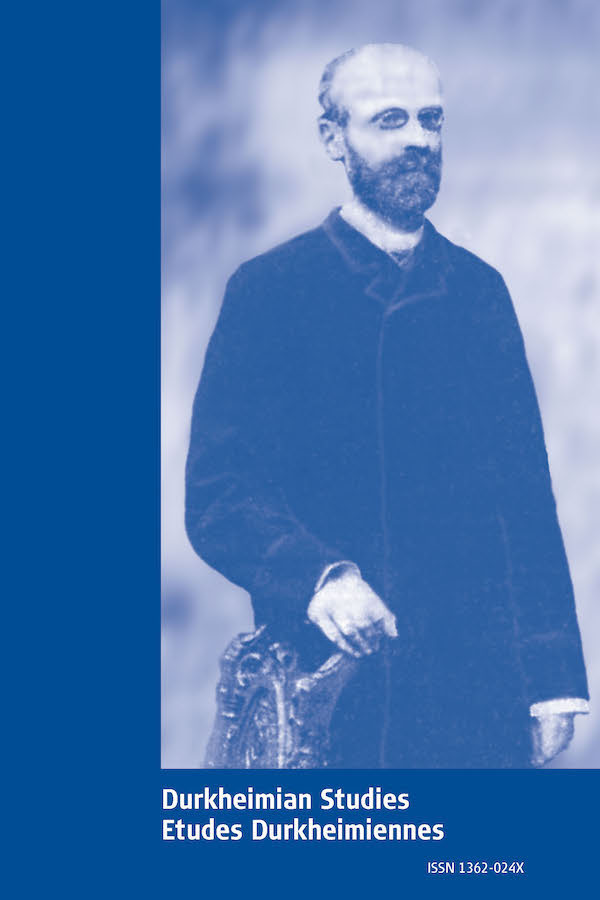
Durkheimian Studies
Études Durkheimiennes
ISSN: 1362-024X (print) • ISSN: 1752-2307 (online) • 1 issues per year
Volume 18 Issue 1
The Mystery of Some 'Last Things' of Émile Durkheim
Notes for a Research Project
For most of Durkheim’s admirers it all ended when he died on 15 November 1917. Or at least one is apt to get that impression in reading the classic study of Durkheim’s life by Steven Lukes (1973). He concludes his book, as indeed he intended to, with the death of the great pioneer of sociology in France. Lukes knew, as we all know, that Durkheim’s death did not mean the end of the appearance of items written by him. Attempts were made by a decimated Année sociologique group under the far less affi rmative leadership of Durkheim’s nephew, Marcel Mauss, to continue along the path set by the great master. Former manuscripts and letters of Durkheim’s were published as members of the group continued to write about him and propagate his ideas.1 But in one very certain way, his empire had come to an end. Beyond 1917, the general interest in France, that had been so strong in the first two decades of the twentieth century, waned. All that followed had to be seen as something that was purely historical, albeit a small number of disciples endeavoured to extend their master’s ideas.
Découverte d'une archive
l'« Esquisse d'une théorie de la magie »
Dans une livraison précédente de la revue, nous avions évoqué le cas particulier des archives de Marcel Mauss, désormais conservées à l’IMEC. Ce fonds d’archives retrace une grande part de la vie savante et politique de Marcel Mauss, mais également de celle d’Henri Hubert, son « jumeau de travail » décédé en 1927 et dont Mauss récupéra une partie des archives. Ces documents lui servirent, entre autres, pour terminer la publication, dans la collection « L’évolution de l’Humanité » dirigée par Henri Berr, des deux volumes que Hubert consacra à l’histoire des Celtes et des Germains (Bert, 2010).
Durkheim's Lost Argument (1895–1955)
Critical Moves on Method and Truth
Durkheim’s course of twenty lectures on pragmatism, given at the Sorbonne during the academic year 1913 to 1914, has been regularly reassessed, particularly since an apparently complete English translation (1983). Far from being marginal in Durkheim’s work, as claimed by Steven Lukes (1973), the lectures seem central for understanding Durkheim’s epistemology and methodology. This was initially set out in his two doctoral theses – the main one on the division of labour (1893) – then substantially reworked in later writings, particularly Les Formes élémentaires (1912). Unfortunately, we know the lectures only from a posthumous reconstruction by the faithful Durkheimian and sympathiser with Marxism, the philosopher Armand Cuvillier, who published Pragmatisme et sociologie in 1955, drawing on two anonymous sets of ‘student notes’ that later disappeared. It is thus difficult to know the scope and effect of Cuvillier’s own rewriting of these notes. Moreover, he made his reconstruction forty-two years after the actual presentation by Durkheim at the Sorbonne. The sociological context in France was by this time entirely different. The most prominent sociologists, such as Jean Stoetzel, were outspoken anti-Durkheimians in their demand for an empirical knowledge clearly severed from any philosophical foundation. The Durkheimians who tried to pursue the founder’s endeavour in the interwar period were dead. The very first reviews of Cuvillier’s edition indicate that Durkheimianism seemed to belong to the intellectual past, at least since the death of Marcel Mauss in 1950.
Leçon inaugurale
Pragmatisme et Sociologie Inaugural Lecture: Pragmatism and Sociology, 1913
La prise en note du cours de Durkheim a été fidèlement retranscrite et révisée depuis le manuscrit conservé à la Bibliothèque Victor Cousin de la Sorbonne. Nous indiquons par des chevrons la pagination originale de ce manuscrit. Les mots ou segments de phrase soulignés dans l’original ont été rendus par des italiques, les titres par du gras. Nos hésitations sur la transcription sont signalées par un point d’interrogation et placées entre crochets « [ ? sensitif] ». De même, les quelques mots ou segments illisibles sont indiqués entre crochets (« [illis.] »).
Durkheim's 'Dualism of Human Nature'
Personal Identity and Social Links
Durkheim's 'Dualism of Human Nature' (1914) is the last scientific work by him published in his lifetime. This circumstance, and the subject of the essay, can suggest it is the definitive exposition of his philosophical view of human nature as homo duplex. But readers do not agree about the description of this view. What kind of dualism has he in mind, and is he consistent about it throughout his work? The problem is that his essay gives different meanings to the doubleness of human nature and combines them in a complex model of explanation. Reconstructing this model can throw new light on what is really at stake in Durkheim's text and on the nature of the dualism he upheld at the end of his career.
From Ideas to Ideals
Effervescence as the Key to Understanding Morality
My main aim is to show that Les Formes élémentaires de la vie religieuse is a crucial work for understanding Durkheim's moral theory. A fundamental point is that he locates the 'ideal' at the core of morality. Accordingly, explaining the genesis of morality depends on establishing how he conceptualizes the ideal and traces its origins. Searching for the deepest roots of the ideal - basically understood as a sacred idea - takes us to the work's key concern with effervescence, and to issues it raises in the case of the modern world.
Échange, don, réciprocité
l'acte de 'donner' chez Simmel et Durkheim
This focuses on a key topic for comparison of two masters of sociological thought, Georg Simmel and Émile Durkheim: the question of giving in the context of social exchange. Durkheim deals with the issue in introducing the concept of organic solidarity, based on the division of social labour and implying the interdependence of individuals. This representation of solidarity links with the interest in credit and debt relations in Simmel's philosophy of money and with a perspective in which reciprocity is conceived as one of the main sociological functions involved in the representation of social bonds. After a comparison of Durkheim and Simmel's theories of reciprocity, a specific case discussed is the mortgage, conceived as a paradigm of the shape assumed by the immaterial reality of reciprocity in institutional and everyday life.
Les carrières de Durkheim en Amérique, Angleterre et France
François Pizarro Noël. Du désaveu du social à la présentation nominaliste: Le mouvement de réception de Durkheim (1893-1939), Thèse de Doctorat, Université du Québec à Montréal, 2009, 500 pp, en ligne : www.archipel .ugam.ca/3116/l/D1859.pdf.
Book Reviews
Émile Durkheim. Hobbes à l’agrégation. Un cours d’Émile Durkheim suivi par Marcel Mauss, edited by Jean-François Bert, Paris: Editions EHESS (Collection ‘Audiographie’), 2012, 64 pp.
Émile Durkheim, Les Règles de la méthode sociologique, édition établie par Jean-Michel Berthelot et présentée par Laurent Mucchielli, Paris, Flammarion (coll. « Champs classiques », n° 879), 2010, 336 pp.
Philippe Steiner. Durkheim and the Birth of Economic Sociology, translated by Keith Tribe, Princeton and Oxford: Princeton University Press, 2011, viii + 249 pp.
Jean Terrier. Visions of the Social: Society as a Political Project in France 1750–1950, Brill: Leiden and Boston, 2011, xxxi + 216pp.
Jean-François Bert. Marcel Mauss, Henri Hubert et la sociologie des religions. Penser et écrire à deux, Paris: La Cause des Livres, 2012, 171 pp.
Derek Robbins. French Post-War Social Theory, London: Sage, 2012, 193 pp.
Anni Greve. Sanctuaries of the City: Lessons from Tokyo, Farnham: Ashgate, 2011, 206 pp.