 Get New Issue Alerts
Browse Archive
- Vol 73 Issue 187
- Vol 73 Issue 186
- Vol 72 Issue 185
- Vol 72 Issue 184
- Vol 72 Issue 183
- Vol 72 Issue 182
- Vol 71 Issue 181
- Vol 71 Issue 180
- Vol 71 Issue 179
- Vol 71 Issue 178
- Vol 70 Issue 177
- Vol 70 Issue 176
- Vol 70 Issue 175
- Vol 70 Issue 174
- Vol 69 Issue 173
- Vol 69 Issue 172
- Vol 69 Issue 171
- Vol 69 Issue 170
- Vol 68 Issue 169
- Vol 68 Issue 168
- Vol 68 Issue 167
- Vol 68 Issue 166
- Vol 67 Issue 165
- Vol 67 Issue 164
- Vol 67 Issue 163
- Vol 67 Issue 162
- Vol 66 Issue 161
- Vol 66 Issue 160
- Vol 66 Issue 159
- Vol 66 Issue 158
- Vol 65 Issue 157
- Vol 65 Issue 156
- Vol 65 Issue 155
- Vol 65 Issue 154
- Vol 64 Issue 153
- Vol 64 Issue 152
- Vol 64 Issue 151
- Vol 64 Issue 150
- Vol 63 Issue 149
- Vol 63 Issue 148
- Vol 63 Issue 147
- Vol 63 Issue 146
- Vol 62 Issue 145
- Vol 62 Issue 144
- Vol 62 Issue 143
- Vol 62 Issue 142
- Vol 61 Issue 141
- Vol 61 Issue 140
- Vol 61 Issue 139
- Vol 61 Issue 138
- Vol 60 Issue 137
- Vol 60 Issue 136
- Vol 60 Issue 135
- Vol 60 Issue 134
- Vol 59 Issue 133
- Vol 59 Issue 132
- Vol 59 Issue 131
- Vol 59 Issue 130
- Vol 58 Issue 129
- Vol 58 Issue 128
- Vol 58 Issue 127
- Vol 58 Issue 126
- Vol 57 Issue 125
- Vol 57 Issue 124
- Vol 57 Issue 123
- Vol 57 Issue 122
- Vol 56 Issue 121
- Vol 56 Issue 120
- Vol 56 Issue 119
- Vol 56 Issue 118
- Vol 55 Issue 117
- Vol 55 Issue 116
- Vol 55 Issue 115
- Vol 54 Issue 114
- Vol 54 Issue 113
- Vol 54 Issue 112
- Vol 53 Issue 111
- Vol 53 Issue 110
- Vol 53 Issue 109
- Vol 52 Issue 108
- Vol 52 Issue 107
- Vol 52 Issue 106
- Vol 51 Issue 105
- Vol 51 Issue 104
- Vol 51 Issue 103
- Vol 50 Issue 102
- Vol 50 Issue 101
- Vol 49 Issue 99
- Vol 49 Issue 100
- Vol 48 Issue 98
- Vol 48 Issue 97
- Vol 47 Issue 96
- Vol 46 Issue 94
- Vol 46 Issue 93
- Vol 45 Issue 92
- Vol 45 Issue 91
- Vol 44 Issue 90
- Vol 44 Issue 89
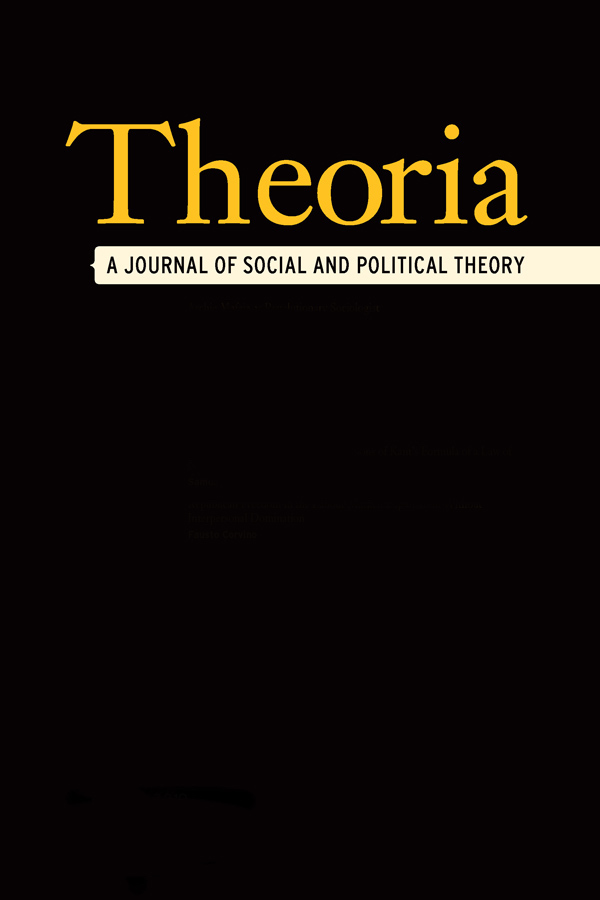
Theoria
A Journal of Social and Political Theory
ISSN: 0040-5817 (print) • ISSN: 1558-5816 (online) • 4 issues per year
Volume 54 Issue 112
Editorial
Conceptions of the ‘good life’ and the various accounts of human well-being almost always entail some reference—direct or indirect—to physical and psychic health. The very term ‘disease’ implies ‘disease’, an absence of that which renders the human condition agreeable. There are many dimensions to disease, and to its counterpoint, ‘good health’. These range from concerns with therapy and the therapeutic to the advance of our understanding—in the modern world through the natural and social sciences—of illness, and from the cultural significance of disease to the economic costs and implications of ill-health and its management. Under the conditions of ‘modernity’ the nature and meaning of illness and of disease, though still culturally contested, has changed. Modern science has rendered the previously ‘inscrutable’ open to scrutiny and explanation. The advance of therapy is now inextricably bound up with the explanation of illness at the microbial, molecular and genetic levels. One consequence of the modern science of medicine has been to underwrite a quest for cures—paradigmatically embodied in new surgical interventions and technologies as well as, iconically, in the quest for ‘magic bullets’ represented, to begin with, by Paul Ehrlich’s salvarsan and later extended to antibiotics and to new-generation ‘designer drugs’.
Justice, Health, and Status
Philosophical and political discussions of health inequalities have largely focused on questions of justice. The general strategy employed by philosophers like Norman Daniels is to identify a certain state of affairs—in his case, equality of opportunity—and then argue that health disparities limiting an individual's or group's access to that condition are unjust, demanding intervention. Recent work in epidemiology, however, has highlighted the importance of socioeconomic status in creating health inequalities. I explore the ways in which theories of justice have been expanded in light of this data, suggesting that more work is required if such theories are to provide an adequate framework for addressing health disparities. I conclude by sketching an alternative possibility for thinking about health disparities outside of the context of justice.
Doing Queer Love
Feminism, AIDS, and History
In this essay, I utilize the concept of the echo, as formulated in the historical and methodological work of Michel Foucault and Joan W. Scott, to help theorize the historical relationship between health feminism and AIDS activism. I trace the echoes between health feminism and AIDS activism in order to present a more complex history of both movements, and to try to think through the ways that the coming together of these two struggles in a particular place and time—New York City in the 1980s—created particular practices that might be effective in other times and places. The practice that I focus on here is one that I call 'doing queer love'. As I hope to show, 'doing queer love' both describes a particular history of health activism and opens up the possibility of bringing into being a different future than the one a conventional history of AIDS seems to predict. It is an historical echo that I believe we must try to hear now, not just in order to challenge a particular history of AIDS activism in the United States, but also in order to provide a model that can be useful for addressing the continuing problem of AIDS across the globe.
The Liberal Grounding of the Right to Health Care
An Egalitarian Critique
The language of rights is increasingly used to regulate access to health care and allocation of resources in the health care field. The right to health has been grounded on different theories of justice. Scholars within the liberal tradition have grounded the right to health care on Rawls's two principles of justice. Thus, the right to health care has been justified as being one of the basic liberties, as enabling equality of opportunity, or as being justified by the maximin principle. In this article, Filc analyzes—from a radical egalitarian standpoint—the limitations of the different attempts to ground an equal right to health on Rawls's theory of justice and offers a first approximation to a radical egalitarian formulation of the right to health.
Needs, Medical Necessity, and the Problem of Helping the Uninsured
The nature of health care, a multifaceted system of reimbursements, subsidies, levels of care, and trade-offs between economics, values and social goods, makes it both a problematic area of policy and critical to the well-being of society. In the United States, provision of health care is not a right as in some countries, but occurs as a function of a complex set of cross-subsidized mechanisms that, according to some analysts, exclude from coverage those who may be in the most need of it. Accordingly, this article examines some of the issues involved in making decisions on how to justly expand health insurance.
Normalizing Testing--Normalizing AIDS
Judge Edwin Cameron (South African Supreme Court of Appeal) makes a plea for a radical change of approach and of formal health policy in relation to HIV/AIDS in South Africa. Cameron delivered this lecture at the University of KwaZulu-Natal Forum on 4 May 2006 as part of the Ronald Louw Memorial Campaign, 'Get Tested, Get Treated'. Ronald Louw was a Professor of Law at the University of KwaZulu-Natal, an AIDS treatment activist and co-founder of the Durban Gay and Lesbian Community Centre. He died of AIDS in 2005. Cameron, who was appointed by Nelson Mandela to the high court in 1994, is a high profile AIDS activist and gay rights advocate. He has written about the experience of his decision to make public his own HIV positive status in the book, Witness to AIDS (Tafelberg).
Book Reviews
Daniel Dennet by Matthew Elton Simon Beck
Globalization and Justice by Kai Nielsen Glen M. Segell
The Blank Slate: The Modern Denial of Human Nature by Steven Pinker Deborah Roberts
Georges Bataille by Michel Surya Derek Hook
Thinking after Heidegger by David Wood Jeanne Marie Kusina
Book Announcements
The Dynamics of Democratization: Elites, Civil Society and the Transition Process, by Graeme Gill. London: Macmillan, 2000. ISBN 0-333-80197
History of Shit, by Dominique Laporte. Translated by Nadia Benabid and Rodolphe el-Khoury. Cambridge, MA: The MIT Press, 2000. ISBN 0-2626-2160-6
An Introduction to Philosophy, by Jon Nuttall. Cambridge: Polity, 2002. ISBN 0-7456-1662-3
Abstracts
Abstracts
Contributors
Contributors