 Get New Issue Alerts
Browse Archive
- Vol 73 Issue 187
- Vol 73 Issue 186
- Vol 72 Issue 185
- Vol 72 Issue 184
- Vol 72 Issue 183
- Vol 72 Issue 182
- Vol 71 Issue 181
- Vol 71 Issue 180
- Vol 71 Issue 179
- Vol 71 Issue 178
- Vol 70 Issue 177
- Vol 70 Issue 176
- Vol 70 Issue 175
- Vol 70 Issue 174
- Vol 69 Issue 173
- Vol 69 Issue 172
- Vol 69 Issue 171
- Vol 69 Issue 170
- Vol 68 Issue 169
- Vol 68 Issue 168
- Vol 68 Issue 167
- Vol 68 Issue 166
- Vol 67 Issue 165
- Vol 67 Issue 164
- Vol 67 Issue 163
- Vol 67 Issue 162
- Vol 66 Issue 161
- Vol 66 Issue 160
- Vol 66 Issue 159
- Vol 66 Issue 158
- Vol 65 Issue 157
- Vol 65 Issue 156
- Vol 65 Issue 155
- Vol 65 Issue 154
- Vol 64 Issue 153
- Vol 64 Issue 152
- Vol 64 Issue 151
- Vol 64 Issue 150
- Vol 63 Issue 149
- Vol 63 Issue 148
- Vol 63 Issue 147
- Vol 63 Issue 146
- Vol 62 Issue 145
- Vol 62 Issue 144
- Vol 62 Issue 143
- Vol 62 Issue 142
- Vol 61 Issue 141
- Vol 61 Issue 140
- Vol 61 Issue 139
- Vol 61 Issue 138
- Vol 60 Issue 137
- Vol 60 Issue 136
- Vol 60 Issue 135
- Vol 60 Issue 134
- Vol 59 Issue 133
- Vol 59 Issue 132
- Vol 59 Issue 131
- Vol 59 Issue 130
- Vol 58 Issue 129
- Vol 58 Issue 128
- Vol 58 Issue 127
- Vol 58 Issue 126
- Vol 57 Issue 125
- Vol 57 Issue 124
- Vol 57 Issue 123
- Vol 57 Issue 122
- Vol 56 Issue 121
- Vol 56 Issue 120
- Vol 56 Issue 119
- Vol 56 Issue 118
- Vol 55 Issue 117
- Vol 55 Issue 116
- Vol 55 Issue 115
- Vol 54 Issue 114
- Vol 54 Issue 113
- Vol 54 Issue 112
- Vol 53 Issue 111
- Vol 53 Issue 110
- Vol 53 Issue 109
- Vol 52 Issue 108
- Vol 52 Issue 107
- Vol 52 Issue 106
- Vol 51 Issue 105
- Vol 51 Issue 104
- Vol 51 Issue 103
- Vol 50 Issue 102
- Vol 50 Issue 101
- Vol 49 Issue 99
- Vol 49 Issue 100
- Vol 48 Issue 98
- Vol 48 Issue 97
- Vol 47 Issue 96
- Vol 46 Issue 94
- Vol 46 Issue 93
- Vol 45 Issue 92
- Vol 45 Issue 91
- Vol 44 Issue 90
- Vol 44 Issue 89
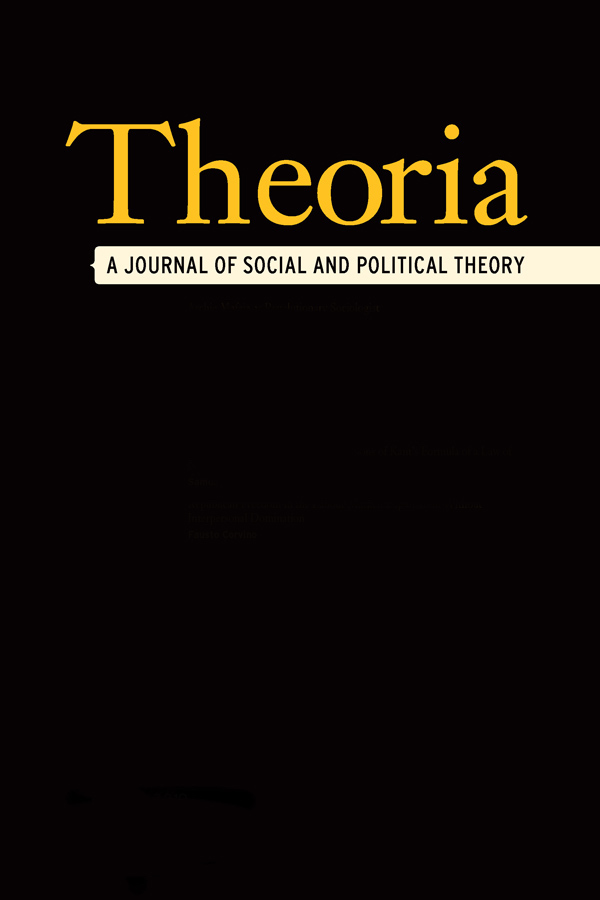
Theoria
A Journal of Social and Political Theory
ISSN: 0040-5817 (print) • ISSN: 1558-5816 (online) • 4 issues per year
Volume 48 Issue 98
Editorial
Lawrence Freedman has suggested that the Third World War is now under way.1 Whether or not one agrees with his diagnosis, it is clear that the events of 11 September and the responses that they have occasioned are of world-historic importance. No aspect of our globalised economy will be left unaffected, no region will escape the impact of the conflict. From Indonesia and Malaysia to Nigeria and Paraguay, domestic political stability has been rendered more precarious. The order of war itself has been inverted; civilians, and the very fabric of civil society itself, were the first targets of attacks launched with essentially civilian instruments. The iconic impact has been no less extraordinary: arguably the two most potent symbols of capitalist modernity and its awesome technological capacities – the skyscraper and the jet airplane – were destroyed, intentionally, in a brilliantly orchestrated, chillingly effective media event. The ramifications need little spelling out: the very self-confidence and normative underpinnings of western civilisation have been shaken and questioned through the terrorists’ unprecedentedly potent “propaganda of the deed”. The political capacity and will, as well as the unity, of the West are being tested as perhaps never before. The juggernaut of technological progress and economic growth appears, at least momentarily, to have been halted in its tracks, as the global economy slides into recession. The erstwhile unchallenged power of the most technologically advanced society in history has been brought into question by an atavistic, theocratic ideology joined to the will of agents working, without the aid of hyper-modern technology and with relatively small financial resources, from the very margins of the global political and economic system.
The Cultural Effects of Globalisation
Editorial
Economic imperialism and the imperialism of economics which characterise ultramodernity in its current phase, are destroying the planet. This can be observed by looking at everyday life, providing that one does not suffer from the short sightedness of the ultra-liberal “Stalinists” from the Bretton-Woods institutions, who are playing at being sorcerer’s apprentices … Economising has reduced culture to folklore and relegated it to museums. By liquidating different cultures, globalisation gives birth to “tribes”, withdrawal, and ethnicity, rather than co-existence and dialogue. The rise of mimetic violence, with its backdrop of the victimising of the scapegoats, is the corollary to homogeneity and false hybridisation. These phenomena have been amplified by the media and have provoked such repugnance, undoubtedly legitimate, that we have reached the stage of exalting unconditional, selfsatisfied universalism, which is exclusively western in essence, along with the repeated chanting of meaningless slogans.
Globalisation, Technopolitics and Revolution
As the third millennium unfolds, one of the most dramatic technological and economic revolutions in history is advancing a set of processes that are changing everything from the ways in which people work to the ways that they communicate with each other and spend their leisure time. The technological revolution centres on computer, information, communication, and multimedia technologies. These are key aspects of the production of a new economy, described as postindustrial, post-Fordist, and postmodern, accompanied by a networked society and cyberspace, and the juggernaut of globalisation. There are, of course, furious debates about how to describe the Great Transformation of the contemporary epoch, whether it is positive and negative, and what the political prospects for democratisation and radical social transformation are.
Scientific Realism
An Elaboration and a Defence
My aim in this paper is to present the basic elements of scientific realism and the major lines of argument in support of the position. So as not to define scientific realism by contrast with any specific opposing position, I will state the position and the arguments for it in as general a manner as possible. There is a broad range of positions opposed to scientific realism. The opposition is not limited to any specific aspect of realism. Nor is it limited to any one single line of anti-realist argument. The main point I wish to make is that there are a number of different arguments which work together to support scientific realism. Realists often speak as if there is one argument, the so-called success or “no miracles” argument, which is the argument for scientific realism. While this argument no doubt plays a central role in the argument for scientific realism, it is only one of a battery of arguments which make up the case for scientific realism.
Realism, Humanism and the Politics of Nature
All of those working in the broad field of environmental studies (and I here include, among others, philosophers, geographers, political ecologists, sociologists, cultural historians and critics) are likely to agree to two points. First, the term “nature” which has been so central to our various debates, has lost its all-purpose conceptual status and can no longer be bandied around as it once was. This does not mean that we have ceased to use it. Indeed, it still regularly recurs in ecological laments and admonitions (it is “nature”, after all, that we are being told is being lost, damaged, polluted and eroded; and it is nature that we are enjoined to respect, protect and conserve). But we readily acknowledge now that this is no more than a kind of shorthand: a convenient, but fairly gestural, concept of eco-political argument whose meaning is increasingly contested. This bears on the second point of presumed agreement, namely, that we can, broadly speaking, discern two main parties to this contest over the nature of nature: the realists on the one hand, and the contructivists on the other. Since this distinction will be familiar to readers in its general outline, I shall not here elaborate in any detail upon it. But a few specifications might be added at this point.
Critical Studies of Whiteness, USA
Origins and Arguments
The call-in show on Wisconsin Public Radio in 1995 began with the host skilfully introducing me as an historian who tried to explain how a white identity had come to seem so important to so many working people in the United States. We talked about efforts to understand why such significant numbers of people came to see themselves not as workers, but as white workers; not as women but as white women, and so on. And then to the phones and eager callers: Why do African countries make so little progress? Aren’t African Americans racist too? Isn’t their “reverse racism” the biggest problem? Hasn’t the welfare system enlarged a parasitic, amoral nonwhite underclass? The barrage of such questions, on public radio in a quite liberal city, took virtually the whole hour. The last caller, an African American worker at the University of Wisconsin, initially offered no question but a comment. All of the prior questions, she observed, focused on people of colour. Despite the subject of my work, she continued, and despite the moderator’s unambiguous introduction, no caller had deigned to discuss whiteness at all. If I were an expert on race, the white callers had been certain that my role was to contest or to endorse accusations and generalisations concerning those who were not white. Why was it so hard to discuss whiteness?
Book Reviews
The Adorno Reader, edited by Brian O’Connor. Oxford: Blackwell, 2000. Reviewed by Ben Parker
Writings on Psychoanalysis: Freud and Lacan, by Louis Althusser; edited by Olivier Corpet and François Matheron. Columbia University Press, 1996. Reviewed by Clayton Crockett
On the Pragmatics of Social Interaction: Preliminary Studies in the Theory of Communicative Action, by Jürgen Habermas; translated by Barbara Fultner. Cambridge, Massachusetts: MIT Press, 2001. Reviewed by Iain MacKenzie
Senses of Culture: South African Culture Studies, edited by Sarah Nuttall and Cheryl-Ann Michael. Oxford: Oxford University Press, 2000. Reviewed by Arnold Shepperson
Rethinking Multiculturalism: Cultural Diversity and Political Theory, by Bhikhu Parekh. Basingstoke & London: Macmillan, 2000. Reviewed by Laurence Piper
Heidegger and Derrida on Philosophy and Metaphor: Imperfect Thought, by Guiseppe Stellardi. Humanity Books: New York, 2000. Reviewed by Patrick Lenta
Did Somebody Say Totalitarianism? Five Interventions on the (Mis)use of a Notion, by Slavoj Zizek. New York: Verso, 2001. Reviewed by Kevin A. Morrison
Contributors
Notes on the Contributors