 Get New Issue Alerts
Browse Archive
- Vol 73 Issue 187
- Vol 73 Issue 186
- Vol 72 Issue 185
- Vol 72 Issue 184
- Vol 72 Issue 183
- Vol 72 Issue 182
- Vol 71 Issue 181
- Vol 71 Issue 180
- Vol 71 Issue 179
- Vol 71 Issue 178
- Vol 70 Issue 177
- Vol 70 Issue 176
- Vol 70 Issue 175
- Vol 70 Issue 174
- Vol 69 Issue 173
- Vol 69 Issue 172
- Vol 69 Issue 171
- Vol 69 Issue 170
- Vol 68 Issue 169
- Vol 68 Issue 168
- Vol 68 Issue 167
- Vol 68 Issue 166
- Vol 67 Issue 165
- Vol 67 Issue 164
- Vol 67 Issue 163
- Vol 67 Issue 162
- Vol 66 Issue 161
- Vol 66 Issue 160
- Vol 66 Issue 159
- Vol 66 Issue 158
- Vol 65 Issue 157
- Vol 65 Issue 156
- Vol 65 Issue 155
- Vol 65 Issue 154
- Vol 64 Issue 153
- Vol 64 Issue 152
- Vol 64 Issue 151
- Vol 64 Issue 150
- Vol 63 Issue 149
- Vol 63 Issue 148
- Vol 63 Issue 147
- Vol 63 Issue 146
- Vol 62 Issue 145
- Vol 62 Issue 144
- Vol 62 Issue 143
- Vol 62 Issue 142
- Vol 61 Issue 141
- Vol 61 Issue 140
- Vol 61 Issue 139
- Vol 61 Issue 138
- Vol 60 Issue 137
- Vol 60 Issue 136
- Vol 60 Issue 135
- Vol 60 Issue 134
- Vol 59 Issue 133
- Vol 59 Issue 132
- Vol 59 Issue 131
- Vol 59 Issue 130
- Vol 58 Issue 129
- Vol 58 Issue 128
- Vol 58 Issue 127
- Vol 58 Issue 126
- Vol 57 Issue 125
- Vol 57 Issue 124
- Vol 57 Issue 123
- Vol 57 Issue 122
- Vol 56 Issue 121
- Vol 56 Issue 120
- Vol 56 Issue 119
- Vol 56 Issue 118
- Vol 55 Issue 117
- Vol 55 Issue 116
- Vol 55 Issue 115
- Vol 54 Issue 114
- Vol 54 Issue 113
- Vol 54 Issue 112
- Vol 53 Issue 111
- Vol 53 Issue 110
- Vol 53 Issue 109
- Vol 52 Issue 108
- Vol 52 Issue 107
- Vol 52 Issue 106
- Vol 51 Issue 105
- Vol 51 Issue 104
- Vol 51 Issue 103
- Vol 50 Issue 102
- Vol 50 Issue 101
- Vol 49 Issue 99
- Vol 49 Issue 100
- Vol 48 Issue 98
- Vol 48 Issue 97
- Vol 47 Issue 96
- Vol 46 Issue 94
- Vol 46 Issue 93
- Vol 45 Issue 92
- Vol 45 Issue 91
- Vol 44 Issue 90
- Vol 44 Issue 89
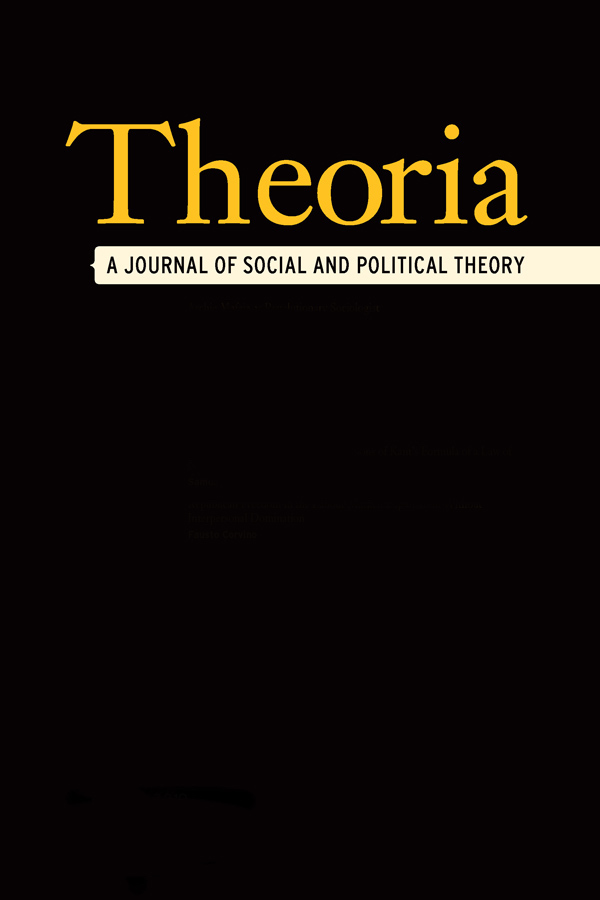
Theoria
A Journal of Social and Political Theory
ISSN: 0040-5817 (print) • ISSN: 1558-5816 (online) • 4 issues per year
Volume 51 Issue 105
Editorial
This issue of Theoria marks a decade of democracy in South Africa. Invited to reflect on the process and challenge of building a modern liberal democracy and on progress towards social justice since 1994, the contributors have responded with detailed and in-depth analyses of a range of pertinent issues, from public institutions, national reform strategies, popular perceptions and moral responsibility to philosophical ideals, educational reforms, political participation and unrepudiated injustices. Beyond apartheid, beyond the Truth and Reconciliation Commission, and beyond party politics, greater and more inclusive social justice, if not immediately within reach, is certainly attainable: through the equalization and redistribution of access to resources, through reparations for injustices, through respect for rights and recognition of obligations, through compromise, sympathy, socialization and debate, and through making sense of change, both symbolically and practically. Most of all, justice will be served, and democracy advanced, by promoting, widening and multiplying spaces and opportunities for people to conceptualize and act upon social transformation in new and different ways.
Beyond Party Politics
Unexpected Democracydeepening Consequences of One-party Dominance in South Africa
It might be claimed that something approaching a broad consensus has emerged in political science that democracy, in any operationally viable form, entails a multi-party system. However, in recent times the notion that this view is fully captured by a narrowly instrumentalist party-political model has been challenged. It is argued that while parties are widely accepted as a democratic compromise—a necessary mechanism for representation in contemporary democracies— insufficient consideration is given to the possibility that parties may also serve to compromise democracy by alienating citizens from government.
Forget Forgiveness
On the Benefits of Sympathy for Political Reconciliation
The work of South Africa’s Truth and Reconciliation Commission has generated a great deal of interest in the role of forgiveness in politics. More specifically, it has raised the question of whether forgiveness should be a constitutive part of reconciliation processes between groups. In this paper, I argue that it should not, and that it might be both more useful and more realistic to consider something like Adam Smith’s notion of ‘sympathy’ instead. The first part examines the arguments for and against policies promoting political forgiveness. The second part suggests sympathy as an alternative. The third part considers and rejects some objections to the employment of sympathy in this context.
The Ant and the Grasshopper
Rationalising Exclusion and Inequality in the Post-apartheid City
As with many other genres of storytelling, fables are as much about the socialisation of political values as they are about the amusement of children. Although their timeless appearance presents their truths as absolute, the meanings of fables change as they are reinterpreted through time by particular ideologies. Thus we find that The Ant and the Grasshopper, a children’s favourite about the need for hard work and careful saving, has recently been commandeered by conservative adults who are searching for ever more coded ways of communicating in today’s anti-racist contexts. This story is attributed to Æsop, a mythical sixth century B.C. slave and storyteller (Adrados 1999). During the renaissance, Europe’s fascination with antiquity prompted renewed interest in Æsop’s fables as vehicles of commentary on the politics of the time (Hanazaki 1993-1994 & Patterson 1991). Their popularity accelerated with the industrial revolution since some of the fables, such as The Tortoise and the Hare and The Ant and the Grasshopper, were particularly suited to the socialisation of selfrestraint and a strong work ethic. The Ant and the Grasshopper tells the story of the ant that worked hard collecting food during summer, while the carefree grasshopper did not. During winter, the ant survived while the grasshopper starved. This story conveyed to children that the threat of lean times was ever present but that hard work would stave off starvation.
Symbolic Representations of the Post-apartheid University
Narratology is the study of the ways in which narrative organises perception and experience. Narratologists understand narrative as a ‘meta-code, a human universal’ (White 1987), which is instrumental in enabling the re-organisation of time, space, character and event in the construction of meaning in texts. Narratologists draw on different epistemological traditions, and develop different approaches and practices. These approaches can be roughly categorised as belonging to textual, inter-textual, and extra-textual traditions. The textual approach is exemplified by the work of Vladimir Propp (1928/1968), Claude Levi-Strauss (1958/1963), Roland Barthes (1966/1977), Algirdas Greimas (1966/1983), Paul Ricoeur (1985), and Tzvetan Todorov (1990). Narratologists in this structuralist tradition categorize and taxonomize narrative form. Propp identified 31 ‘narratemes’ (the smallest narrative units, equivalent to morphemes at the sentence level), which occur in all narratives in unvarying sequence; Greimas developed a typology of narrative ‘actants’; and Ricoeur investigated connections between time and narrative to typify ‘configurational activities’ in narrative plots and sequences. These, and other, textual approaches to narrative, show how texts selectively draw on narrative resources (emplotment, ways of representing character, hermeneutic and proairetic codes) in the construction of narrative meaning.
The Justice of Crime Prevention
The Case of South Africa
The Kantian principle that persons must be treated with respect is the most widely accepted normative foundation of a constitutional democracy. Because the state must treat citizens as free and equal persons or in a way consistent with their dignity, it is obligated to abide by majority rule but to ensure that a constitution prevents a majority from violating minority rights to civil liberty and due process. My broad purpose in this article is to explore the implications of the principle of respect for criminal justice in South Africa.
Righting the Wrongs of Apartheid Justice for Victims and Unjust Profiteers
In trying to come to grips with what is involved in righting the wrongs of apartheid, we begin by pointing out unique challenges posed by societies in transition. It is our position that the pursuit of justice is not the same in transitional contexts as it is in stable democracies. As we shall see, the transitional domain throws up several non-standard obstacles in the way of fulfilling the imperatives of justice. After this introduction to justice in transitions we will look more closely at the relationship between justice and law in the context of political transformation generally, and the specific relationship between justice and international human rights law in this transformative process. Thereafter we will address the pursuit of justice in respect of both apartheid’s perpetrators as well as its victims—the discussion will, however, be limited to the liability of those who fall outside the scope of the Truth and Reconciliation Commission’s (TRC) mandate. In that regard, we will deal with violations of rights not specifically covered by the TRC: odious apartheid debt owed to international legal entities; other debt incurred by the apartheid state to private money-lending institutions; the violation of international labour standards in the apartheid state; and the unjust enrichment of foreign corporations at the expense of black South Africans.
Book Reviews
Decline of the Public: The Hollowing-out of Citizenship, by David Marquand. Malden, MA: Polity Press, 2004. ISBN: 0745629105. Reviewed by Steven Michels
How to be Alone, by Jonathan Franzen. London & New York: Picador, 2004. ISBN: 0312422164. Reviewed by Derek Hook
Contributors
Notes on the Contributors