 Get New Issue Alerts
Browse Archive
- Vol 41 Issue 1
- Vol 40 Issue 3
- Vol 40 Issue 2
- Vol 40 Issue 1
- Vol 39 Issue 3
- Vol 39 Issue 2
- Vol 39 Issue 1
- Vol 38 Issue 3
- Vol 38 Issue 2
- Vol 38 Issue 1
- Vol 37 Issue 3
- Vol 37 Issue 2
- Vol 37 Issue 1
- Vol 36 Issue 3
- Vol 36 Issue 2
- Vol 36 Issue 1
- Vol 35 Issue 3
- Vol 35 Issue 2
- Vol 35 Issue 1
- Vol 34 Issue 3
- Vol 34 Issue 2
- Vol 34 Issue 1
- Vol 33 Issue 3
- Vol 33 Issue 2
- Vol 33 Issue 1
- Vol 32 Issue 2
- Vol 32 Issue 1
- Vol 31 Issue 2
- Vol 31 Issue 1
- Vol 30 Issue 2
- Vol 30 Issue 1
- Vol 29 Issue 2
- Vol 29 Issue 1
- Vol 28 Issue 2
- Vol 28 Issue 1
- Vol 27 Issue 2
- Vol 27 Issue 1
- Vol 26 Issue 2
- Vol 26 Issue 1
- Vol 25 Issue 2
- Vol 25 Issue 1
- Vol 24 Issue 2
- Vol 24 Issue 1
- Vol 23 Issue 2
- Vol 23 Issue 1
- Vol 22 Issue 2
- Vol 22 Issue 1
- Vol 21 Issue 2
- Vol 21 Issue 1
- Vol 20 Issue 2
- Vol 20 Issue 1
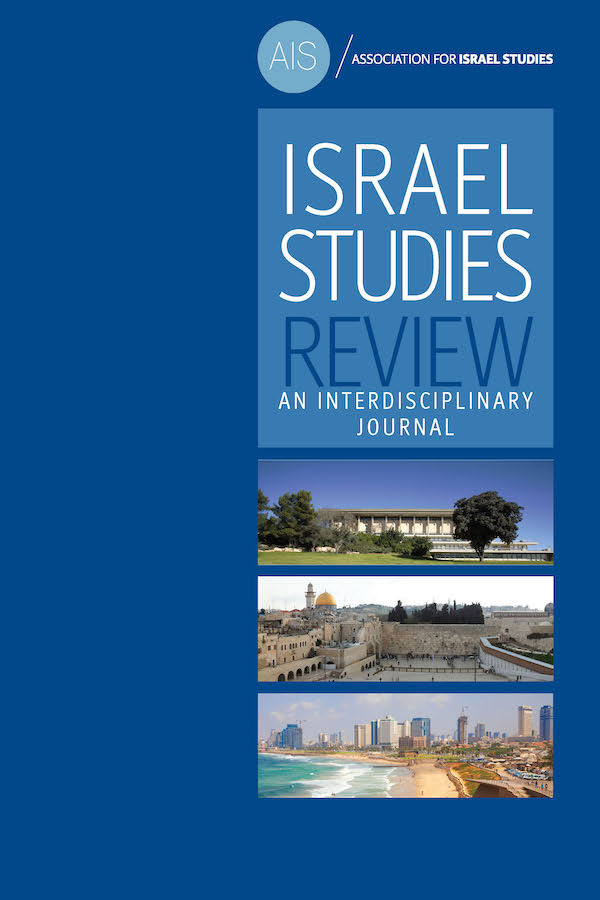
Israel Studies Review
An Interdisciplinary Journal
ISSN: 2159-0370 (print) • ISSN: 2159-0389 (online) • 3 issues per year
Volume 36 Issue 2
Editors' Note
In the spring of 2011, the two of us took over the editorship of the newly renamed, and somewhat reshaped, official journal of the Association for Israel Studies. The former
Israel as a Case Study in Processes of Nation-Building
The process of nation- and state-building in Israel could be viewed as unique because of its pace and intensive character. This is evident in much that is related to immigration, forging cultural coherence, the establishment of institutions, and the like. However, the extreme characteristics of its development also make Israel a valuable case study for a theoretical or comparative discussion because those conditions allow for a clear view of various social, cultural, and political aspects of nation-building. Therefore, using Israel as a case study can corroborate, refute, or challenge assumptions, patterns of analysis, or conceptions and terminologies in theories and models used in the humanities or the social sciences for understanding processes of nation-building.
Beyond Comparativism
Israel's Welfare History in a Non-European Comparative Perspective
This article critiques Esping-Andersen's class-based theory of welfare regimes, demonstrating that the theory's scope conditions are not fulfilled by the Israeli case during the country's first three decades. It traces the transition of Israel's welfare regime and the consolidation of its welfare state in the 1970s. Based on historical analysis, the article points out two incongruities between Esping-Andersen's theory scope conditions and the case of Israel. Further, it argues that the transformation of Israel's welfare regime can be better explained by institutional historical theories that highlight the impact of the production regime on welfare and the significance of conflicts between high-skilled and low-skilled workers.
One Hand Giveth, the Other Taketh Away
A Feminist Perspective on Polity, Religion, and Gender in the Pre-state Period
This article presents a feminist perspective on polity, religion, and gender in the Yishuv. It analyzes how each of these three categories is shaped by its intersection with the others while simultaneously constituting the whole. Two major decisions that were enacted in the 1920s—women's right to vote and the institutionalization of the Chief Rabbinate—serve as case studies of the formation of these categories, as well as of the creation of social boundaries, the politics of inclusion and exclusion, and the culture of political arrangements in the Jewish state-in-the-making. Women were both the focus of and significant actors in these multi-dimensional conflicts. They won their rights for equal citizenship in terms of suffrage, but lost their personal status rights as a result of the institutionalization of the Chief Rabbinate.
The Jewish Centrality of Israel
The 1958 ‘Who Is a Jew?’ Affair as a Case Study
This article examines reactions in the Jewish Diaspora to the ways the Diaspora is viewed in Israel, especially with regard to the Israeli self-perception of Israel as the ultimate spiritual and religious center for its Diaspora. These ideas are explored using as a case study the 1958 ‘Who is a Jew?’ controversy and David Ben-Gurion's famous correspondence with 51 ‘Jewish sages’ on the question of how to classify on an Israeli identity card a child born in Israel to a non-Jewish mother. Focusing on the responses of the Orthodox Jewish sages, I suggest that this correspondence may be understood as a reflection of different, sometimes conflicting understandings of the nature and meaning of Israel's centrality for Jews and Judaism.
The Third Angle in Israel Studies
Boundaries between Government and Non-governmental Entities in Early Israel
Relying on theoretical foundations and conceptualizations in the literature on government–Third Sector relations, this article examines the motives and outcomes that impacted the relations between voluntary non-governmental entities and government organs after the State of Israel was established. Using the typology primarily of Jennifer Coston, in addition to those of Dennis Young and Adil Nagam, the article concentrates on three case studies reflecting those relations: disabled veterans and demobilized soldiers, immigrant associations, and the Israel Education Fund. All three cases show that additional actors lay claim to matters undisputedly under the state's responsibility. The relationships between these parties, we maintain, provide another angle to an understanding of
Israeli Militarism Reconsidered
Reframing the Independence Day Parade
This article seeks to challenge conventional arguments about Israel's ‘cultural militarism’ through a comparative analysis of Independence Day parades of the 1950s. Using media reports, newsreels, and archival documentation, it examines the parades and compares them to other cases from around the world. The discussion focuses on three features of the Israeli parades: the widespread civil criticism of the place of the military in Independence Day celebrations; the role of the crowds and their proximity to the marchers; and the partly militaristic character of the parades themselves. While the article does not deny the obvious militaristic connotations of soldiers marching in the streets, it stresses the unique relationship between the armed forces and society in Israel and argues that militarism alone is not a sufficient analytic framework for analyzing Israeli society.
The Road Not Taken
Menachem Begin's Position on the Formation of a Democratic Regime for Israel
This article explores the position taken by the Herut party and its leader, Menachem Begin, on fundamental issues of democracy and regime type. It analyzes the democratic model that Begin and Herut sought to promote during Israel's formative years: a presidential democracy with a clearly defined separation of powers preserved in a rigorous formal constitution that includes both judicial supremacy and a mechanism for judicial review. The article illuminates an important and unexplored chapter in Israeli historiography—the right wing's position on the formation of Israel's democratic regime—and addresses the ideological roots and foundations of the Likud movement in the spheres of government and law.
The Pedagogy of Song
Teaching Israel through Music
Drawing upon the author's “Settlement in Israeli History” course, this essay argues that song can play a valuable and pedagogically economical role in Israel Studies and general humanities teaching, in both conveying meaning and initiating students in the art of close textual analysis. In particular, it showcases how the Israeli classics “Anu banu artzah” (We have come to the land), “The Ballad of Yoel Moshe Salomon,” and “Shir ha-‘emek” (Song of the Valley) can be deployed to stimulate vibrant and critical class discussions. In doing so, it also offers detailed readings of these songs and their place in Israeli culture.