 Get New Issue Alerts
Browse Archive
- Vol 41 Issue 1
- Vol 40 Issue 3
- Vol 40 Issue 2
- Vol 40 Issue 1
- Vol 39 Issue 3
- Vol 39 Issue 2
- Vol 39 Issue 1
- Vol 38 Issue 3
- Vol 38 Issue 2
- Vol 38 Issue 1
- Vol 37 Issue 3
- Vol 37 Issue 2
- Vol 37 Issue 1
- Vol 36 Issue 3
- Vol 36 Issue 2
- Vol 36 Issue 1
- Vol 35 Issue 3
- Vol 35 Issue 2
- Vol 35 Issue 1
- Vol 34 Issue 3
- Vol 34 Issue 2
- Vol 34 Issue 1
- Vol 33 Issue 3
- Vol 33 Issue 2
- Vol 33 Issue 1
- Vol 32 Issue 2
- Vol 32 Issue 1
- Vol 31 Issue 2
- Vol 31 Issue 1
- Vol 30 Issue 2
- Vol 30 Issue 1
- Vol 29 Issue 2
- Vol 29 Issue 1
- Vol 28 Issue 2
- Vol 28 Issue 1
- Vol 27 Issue 2
- Vol 27 Issue 1
- Vol 26 Issue 2
- Vol 26 Issue 1
- Vol 25 Issue 2
- Vol 25 Issue 1
- Vol 24 Issue 2
- Vol 24 Issue 1
- Vol 23 Issue 2
- Vol 23 Issue 1
- Vol 22 Issue 2
- Vol 22 Issue 1
- Vol 21 Issue 2
- Vol 21 Issue 1
- Vol 20 Issue 2
- Vol 20 Issue 1
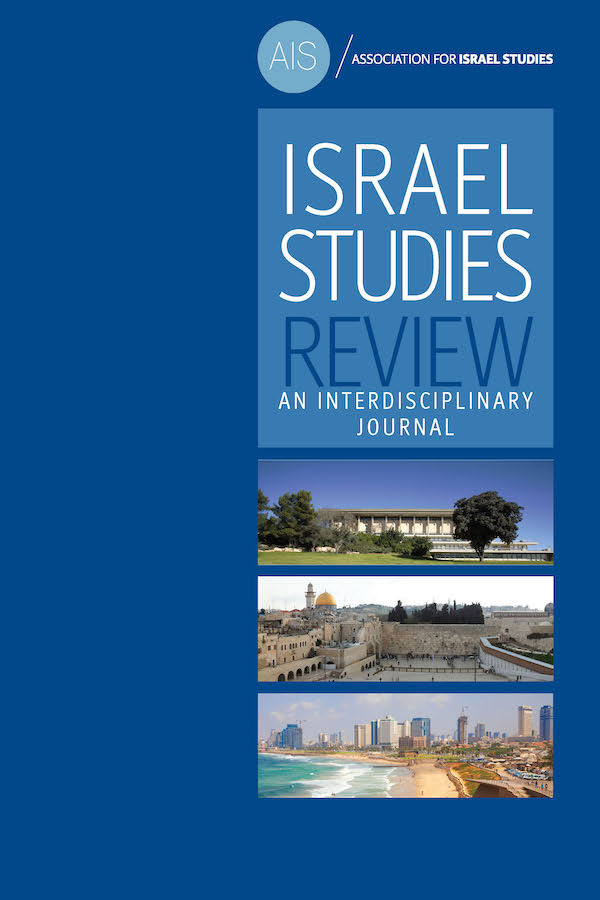
Israel Studies Review
An Interdisciplinary Journal
ISSN: 2159-0370 (print) • ISSN: 2159-0389 (online) • 3 issues per year
Volume 23 Issue 1
Israel's Future: The Time Factor
A Debate between Efraim Inbar and Ian S. Lustick
Time is on Israel's Side Efraim Inbar
From a realpolitik perspective, the balance of power between Israel and its neighbors is the critical variable in the quest for survival in a bad neighborhood. If Israel’s position is improving over time and the power differential between the Jewish State and its foes is growing, then its capacity to overcome regional security challenges is assured. Moreover, under such circumstances there is less need to make concessions to weaker parties that are in no position to exact a high price from Israel for holding on to important security and national assets such as the Golan Heights, the settlement blocs close to the “Green Line,” the Jordan Rift, and particularly Jerusalem.
With a Bang or a Whimper, Time Is Running Out Ian S. Lustick
Israel’s existence in the Middle East is fundamentally precarious. Twentieth- century Zionism and Israeli statehood is but a brief moment in Jewish history. There is nothing more regular in Jewish history and myth than Jews “returning” to the Land of Israel to build a collective life—nothing more regular, that is, except, for Jews leaving the country and abandoning the project. Abraham came from Mesopotamia, then left for Egypt. Jacob left for Hauran, then returned, then left with his sons for Egypt. The Israelites subsequently left Egypt with Moses and Joshua, and “returned” to the Land. Upper class Jews who did not leave with the Assyrians left with Jeremiah for Babylon, then returned with Ezra and Nehemiah.
Zionism between Raw Force and Eros: Berdichevski's Passionate Relation to the Jewish Political Revolution
This article deals with the relation of Micha Yosef Ben Gurion (Berdichevski)—one of the central formulators of the Zionist idea and of modern Hebrew literature—to the Zionist political sphere. As a wordly Jewish intellectual, Berdichevski attempted to establish a kind of Zionism that would allow Jewish individuals to engage in it as an act of their desires. In exploring how his carnal inclinations affected his vision of the political, I argue that Berdichevski's perception fails qualitatively by transposing its guiding sensual approach to the formulation of the new Jewish political sphere. As this article will show, Berdichevski's relation to the Jewish political revolution reveals a sometimes limited perception regarding the possibilities of freedom inherent in political activity and often contradicts his own aspiration to nurture the liberty of Jewish individuals.
Locating the Fragments of the State and Their Limits: Water Policymaking in Israel during the 1950s
Three elements dominated scholarship on Israeli water politics and policymaking in the 1950s: (1) the state is often taken to be a fully established actor since its inception in 1948; (2) Israeli water policymaking was dominated by geopolitical and regional concerns over security and access to shared water resources; (3) water was, and continues to be, a scarce resource. This article argues that these elements result in the depoliticization of Israeli water policies and offers three counterarguments. First, the totality of any state is an ever-illusive construct. Second, Israeli water politics had an internal dimension that has to be investigated in its own right. Third, scarcity did not acquire the status of a "fact" until the mid-1950s. In fact, the struggle over the notions of water abundance and scarcity was an essential part of working through the political conflicts over the meaning of Jewish subjectivity, the boundaries of the state, and its right to intervene in civil society.
How to Be an Alien: Cross-Cultural Transition of Russian-Speaking Youth in Israeli High Schools
This study focuses on adolescents who immigrated to Israel between 2000 and 2002. The aim of the survey on which the article is based was to investigate the determinants of cross-cultural transition, focusing on family problems, identity crises, educational achievements, and language behavior. Since the beginning of the mass immigration from the former Soviet Union, the Israeli educational system has not managed to reorient itself to accommodate the newcomers. Among the main reasons are differences in the Russian and Israeli educational systems and the changing character of the immigration itself. Despite existing problems, the younger generation of these recent immigrants wants to be integrated into Israeli society. It is the task of the formal education system to provide them with support and guide them on a path toward successful adjustment.
The Dramatic Growth of Private Legislation in Israel, 1992-2006
Very little research has been conducted on the functioning of the Israeli Parliament (the Knesset) in general and on private members' legislation in particular. This article contributes to the perception of the role of the legislator as political initiator in modern parliamentarism.
Making Peace with the Duel of Narratives: Dual-Narrative Texts for Teaching the Israeli-Palestinian Conflict
Sami Adwan and Dan Bar-On, eds., Learning the Other’s Historical Narrative: Israelis and Palestinians, Parts One and Two (Beit Jalla: Peace Research Institute in the Middle East, 2003, 2006).
Robert I. Rotberg, ed., Israeli and Palestinian Narratives of Conflict: History’s Double Helix (Bloomington: Indiana University Press, 2006).
Paul Scham, Walid Salem, and Benjamin Pogrund, eds., Shared Histories: A Palestinian-Israeli Dialogue (Walnut Creek, CA: Left Coast Press, 2005).
Book Reviews
Yehuda Bar Shalom, Educating Israel: Educational Entrepreneurship in Israel’s Multicultural Society Review by Yehuda Jacobson and Diana Luzzatto
James Gelvin, The Israel-Palestine Conflict: One Hundred Years of War Review by Ziva Flamhaft
Sharon Lang, Sharaf Politics: Honor and Peacemaking in Israeli-Palestinian Society Review by Madelaine Adelman
Ussama Makdisi and Paul A. Silverstein, eds., Memory and Violence in the Middle East and North Africa Review by Vered Vinitzky-Seroussi
Assaf Meydani and Shlomo Mizrahi, Public Policy between Society and Law: The Supreme Court, Political Participation, and Policy Making Review by Guy Seidman
Ilan Peleg, Democratizing the Hegemonic State: Political Transformation in the Age of Identity Review by William Safran
Alon Tal, Pollution in a Promised Land: An Environmental History of Israel Review by Oren Perez
David A. Wesley, State Practices and Zionist Images: Shaping Economic Development in Arab Towns in Israel Review by Dan Bavly