 Get New Issue Alerts
Browse Archive
- Vol 41 Issue 2
- Vol 41 Issue 1
- Vol 40 Issue 3
- Vol 40 Issue 2
- Vol 40 Issue 1
- Vol 39 Issue 3
- Vol 39 Issue 2
- Vol 39 Issue 1
- Vol 38 Issue 3
- Vol 38 Issue 2
- Vol 38 Issue 1
- Vol 37 Issue 3
- Vol 37 Issue 2
- Vol 37 Issue 1
- Vol 36 Issue 3
- Vol 36 Issue 2
- Vol 36 Issue 1
- Vol 35 Issue 3
- Vol 35 Issue 2
- Vol 35 Issue 1
- Vol 34 Issue 3
- Vol 34 Issue 2
- Vol 34 Issue 1
- Vol 33 Issue 3
- Vol 33 Issue 2
- Vol 33 Issue 1
- Vol 32 Issue 2
- Vol 32 Issue 1
- Vol 31 Issue 2
- Vol 31 Issue 1
- Vol 30 Issue 2
- Vol 30 Issue 1
- Vol 29 Issue 2
- Vol 29 Issue 1
- Vol 28 Issue 2
- Vol 28 Issue 1
- Vol 27 Issue 2
- Vol 27 Issue 1
- Vol 26 Issue 2
- Vol 26 Issue 1
- Vol 25 Issue 2
- Vol 25 Issue 1
- Vol 24 Issue 2
- Vol 24 Issue 1
- Vol 23 Issue 2
- Vol 23 Issue 1
- Vol 22 Issue 2
- Vol 22 Issue 1
- Vol 21 Issue 2
- Vol 21 Issue 1
- Vol 20 Issue 2
- Vol 20 Issue 1
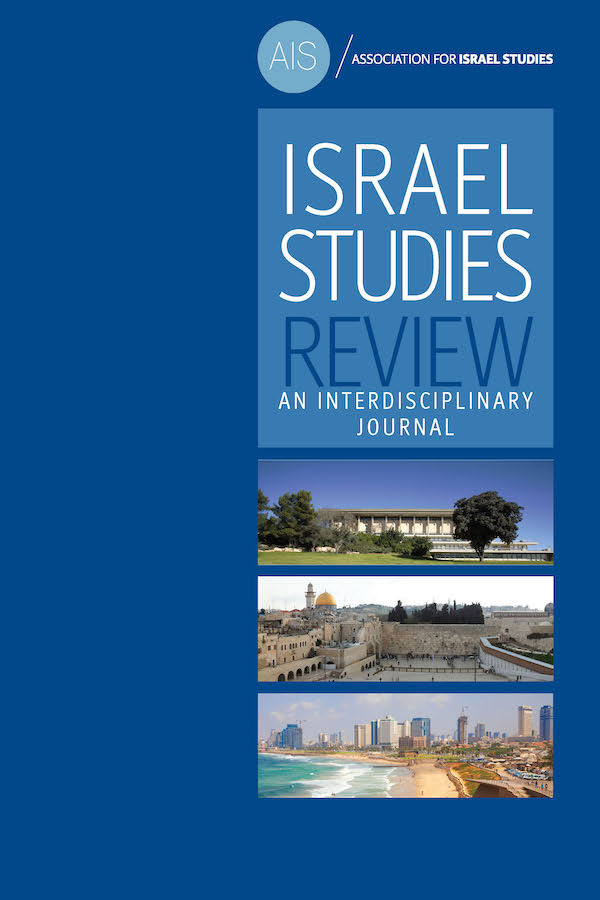
Israel Studies Review
An Interdisciplinary Journal
ISSN: 2159-0370 (print) • ISSN: 2159-0389 (online) • 3 issues per year
Volume 36 Issue 1
Editors' Note and In Memoriam: Rachel Feldhay Brenner
Introduction
When the existence of a European Association of Israel Studies (EAIS) was first publicized a decade ago, many believed that it was merely a front for advocacy and that the discipline was an invented one. The last ten years have borne testimony instead to a profound intellectual endeavor that indicates Israel Studies is an area worthy of academic research. Hundreds of academics from all over Europe—and beyond—now participate in dynamic discourse on a regular basis. Moreover, there has been tremendous support from Israeli academics. Indeed, there is an interesting overlap between Israel Studies in Europe and European Studies in Israel.
Israel and East-Central Europe
Case Studies of Israel's Relations with Poland and Hungary
Israel's policy toward the region of East-Central Europe (ECE) started changing notably from 2004 onward, in response to the European Union (EU) enlargement process. The following years brought a further development of Israel's position toward the region and substantial changes in Israel's European policy. This article aims to track this evolution: not only Israel's position but also the shape as well as the content of bilateral and multilateral relations between Israel and selected ECE states. For the purpose of this analysis, special attention is paid to Israel's relations with Poland and Hungary, with primary focus on Israel's approaches and policy orientations. The article argues that while the ideological changes that occurred almost simultaneously in Poland, Israel, and Hungary at first created favorable conditions for the strengthening of bilateral and multilateral relations between all three countries, they soon became a divisive factor and obstacles to cooperation.
Political Labels and Post-Politics
A Comparative Analysis of the Party Spectrum in Israel, Hungary, and Poland
Debate over the present-day meaning of the traditional political terms ‘left’ and ‘right’ has been ongoing for at least three decades. Many claim that these labels have lost their former relevance. This article offers a comparative analysis of the Israeli, Polish, and Hungarian party systems. Using qualitative content analysis, it examines party platforms and politicians’ speeches in order to assess the significance of political labels both in political narratives and academic debate. Two main research topics concerning political systems of the three countries are explored in the article: the blurring of the traditional left-right divisions and the partial adoption of an anti-establishment agenda by mainstream parties.
The 2014 Israel-Hamas Conflict
Repercussions on French Foreign and Domestic Policy
The eruption of a new military conflict between Israel and Hamas in the summer of 2014 was at first followed by unequivocal French support for Israel's right to defend itself. However, the rising death toll in Gaza and the spread of a pro-Palestinian protest movement on French soil altered this position radically, making way for an assertive French peace initiative. This article adopts a historical perspective and relies on a comprehensive analysis of French public sources to examine the impact exerted by this distant conflict over French foreign and domestic policies throughout the war and its aftermath. Ultimately, it shows that, although France's determination to take action was in part motivated by foreign policy factors, public opinion played an important, if not equivalent, role in the country's diplomatic activism.
Multiculturalism as Reflected in the Linguistic and Semiotic Landscape of Arab Museums in Israel
Multiculturalism is respectful of diversity among individuals and communities in a society, allowing them to retain and express their particular identities and engage in egalitarian dialogue. This article examines how the multiculturalist approach is reflected in the linguistic and semiotic landscape of Arab museums in Israel. It focuses on a case study of the Umm al-Fahm Art Gallery as a window onto the sociocultural realities of Israel. The article's findings are based on an analysis of the linguistic and semiotic landscape elements of the museum space and a semi-structured in-depth interview with its founder. They attest to deficiencies in the process of retaining and designing the particular cultural elements for the Palestinian-Arab population in Israel, affecting the realization of multiculturalism and compromising egalitarian dialogue between the various communities.
Benzion Netanyahu's Formative Years
The Politics of Resentment in Palestine, 1932–1935
Decades before he was known as a historian or as an early neoconservative thinker, let alone as the father of Israeli Prime Minister Benjamin Netanyahu, Benzion Netanyahu was a young student and journalist in British Mandatory Palestine. In this tumultuous period, reaching its peak with the 1933 murder of Haim Arlosoroff, Netanyahu dwelt at the margins of Zionist politics, belonging to a group of well-educated, right-wing, young outsiders—students, poets, journalists, intellectuals, and pseudo-intellectuals—all of whom rebelled against their current and former Hebrew University professors. This study examines the crystallization of Netanyahu's worldview and his Zionist ideology by focusing on three events between 1932 and 1935 that shaped his hostility toward the left and, much later, which became integral components of politics in Israel.
A Leap over History
Vladimir Jabotinsky's Political Paradigms, 1916–1940
This article argues that Vladimir Jabotinsky envisioned ‘leaping over history’ to immediately achieve his goal of creating a Jewish majority in Eretz Israel. On several occasions he tried to break with evolutionary time and make events bend to his will. My arguments show him to be a revolutionary political thinker similar to Lenin, Stalin, or Mussolini, rather than a gradualist and parliamentarian. Looking at his career from this angle permits one to create a different timeline that pits Jabotinsky's feverish activity against the slow progress of the Zionist movement.
No Sabras in the Fields?
Sabra Artists in The Cameri Theatre, 1945–1953
The Cameri Theatre of Tel Aviv has always presented itself as the first repertory theater in the Yishuv that represented the sabras, creating the impression that its actors and artists were themselves mainly sabras and Hebrew their native language. However, this image, based chiefly on the successful performance of the play