 Get New Issue Alerts
Browse Archive
- Vol 59 Issue 2
- Vol 59 Issue 1
- Vol 58 Issue 2
- Vol 58 Issue 1
- Vol 57 Issue 2
- Vol 57 Issue 1
- Vol 56 Issue 2
- Vol 56 Issue 1
- Vol 55 Issue 2
- Vol 55 Issue 1
- Vol 54 Issue 2
- Vol 54 Issue 1
- Vol 53 Issue 2
- Vol 53 Issue 1
- Vol 52 Issue 2
- Vol 52 Issue 1
- Vol 51 Issue 2
- Vol 51 Issue 1
- Vol 50 Issue 2
- Vol 50 Issue 1
- Vol 49 Issue 2
- Vol 49 Issue 1
- Vol 48 Issue 2
- Vol 48 Issue 1
- Vol 47 Issue 2
- Vol 47 Issue 1
- Vol 46 Issue 2
- Vol 46 Issue 1
- Vol 45 Issue 2
- Vol 45 Issue 1
- Vol 44 Issue 2
- Vol 44 Issue 1
- Vol 43 Issue 2
- Vol 43 Issue 1
- Vol 42 Issue 2
- Vol 42 Issue 1
- Vol 41 Issue 2
- Vol 41 Issue 1
- Vol 40 Issue 2
- Vol 40 Issue 1
- Vol 39 Issue 2
- Vol 39 Issue 1
- Vol 38 Issue 2
- Vol 38 Issue 1
- Vol 37 Issue 2
- Vol 37 Issue 1
- Vol 36 Issue 2
- Vol 36 Issue 1
- Vol 35 Issue 2
- Vol 35 Issue 1
- Vol 34 Issue 2
- Vol 34 Issue 1
- Vol 33 Issue 2
- Vol 33 Issue 1
- Vol 32 Issue 2
- Vol 32 Issue 1
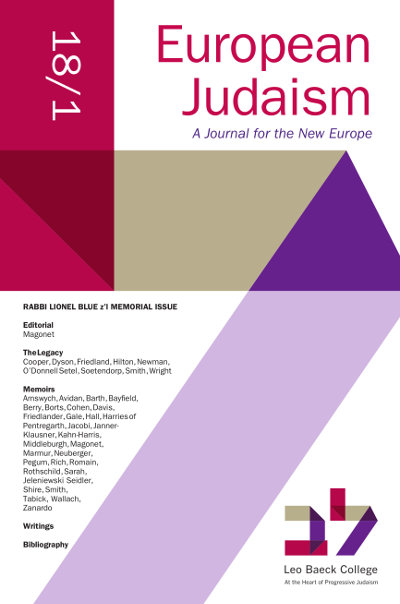
European Judaism
A Journal for the New Europe
ISSN: 0014-3006 (print) • ISSN: 1752-2323 (online) • 2 issues per year
Volume 45 Issue 1
Editorial
Two rabbis played a major role at a key transitional period in the history of the Leo Baeck College. Eight years after its beginning in 1956 under the auspices of the Reform Synagogues of Great Britain (RSGB) (now Movement for Reform Judaism) it was joined as a co-sponsor by the Union of Liberal and Progressive Synagogues (ULPS) (now Liberal Judaism). Two years later Rabbi Dr Werner van der Zyl, the founder and Hon. Director of Studies retired, to be succeeded in the shared leadership by Rabbi Dr. John Rayner (1924-1995), representing the ULPS, as Hon. Director of Studies, and, in the specially created post of Hon. Registrar, by Rabbi Hugo Gryn (1930-1996), representing the RSGB. Together they oversaw the College’s development until the appointment of Rabbi Dr. Albert Friedlander in 1970. In addition to their administrative tasks, both served as teachers, Rabbi Rayner in the field of rabbinics, and Rabbi Gryn in the area of practical rabbinics. Both had refugee backgrounds but made the U.K. their permanent home, serving as the senior rabbis at the two ‘cathedral synagogues’ of their respective movements, Rayner at the Liberal Jewish Synagogue, St. Johns Wood, and Gryn at the West London Synagogue. Very different in temperament and personality, both made an indelible impact on their congregants, their students and the College itself.
An Introduction to 'A Reflection and Celebration of the Life and Work of Rabbi John D. Rayner'
Rabbi John Rayner was born in Berlin on 30 May 1924. He died in London on 19 September 2005, having made a significant contribution to the cause of Liberal Judaism in Great Britain. As Senior Rabbi of the Liberal Jewish Synagogue (LJS) for nearly thirty years, and Emeritus for nearly sixteen years until his death, his influence on the congregation which he served was immeasurable. He was the leading exponent of Liberal Judaism in Great Britain, seeking throughout his life to strengthen and reconstruct the Liberal Jewish movement in Britain that had been founded by Claude Montefiore and Lily Montagu and led by Rabbi Israel Mattuck, the LJS’s first rabbi.
Rabbi John D. Rayner
Liturgist as Correspondent
Rabbi John D. Rayner was prolific not only of learned articles and challenging sermons, but a frequent and engaging correspondent. It is through his multitudinous letters that we gain inestimable insight into the dynamic of his path-breaking liturgy-making, his raising of disciples in England and abroad, and his commitment to critical Jewish scholarship combined with utter religious honesty. His love of the Hebrew language, his devotion to family, and his irrepressible brand of humour, too, shone through his missives, both by airmail and by email.
The Integrity of John Rayner and Inter-Faith Relations
John Rayner had warm memories of the Christians he met when he first came to England and had a positive attitude to Christianity. Nevertheless, he believed that the Christian dispensation in Europe had broken down for good, that there were elements in Christianity unbelievable to modern people and that liberal Judaism could play a key role in building a new moral and spiritual foundation. Dialogue with Christians was an important part of his ministry. This was characterised by his unfailing courtesy and integrity. This integrity enabled him to transcend all personal considerations to focus on the issue in hand and to speak plain truths as he saw them, both to Christians and his fellow Jews.
Rabbi John Rayner, Ethical Zionism and Israel
Rabbi John Rayner was an eminent proponent of ethical Zionism. His views about Israel are related in this article to his views about Judaism and Jewish ethics. The three pillars of Judaism are: truth, justice and peace. Rabbi Rayner personified these values to a remarkable degree. The common thread that runs through his countless sermons and articles was the emphasis on the gentler and more outward-looking values of Judaism. It is by cultivating and exemplifying these values, he believed, that Jews could best help humanity find signposts to justice and peace, not only in the Middle East but everywhere. Ethical Zionism, as understood by Rabbi Rayner, is based on Jewish values. The State of Israel is the main political progeny of the Zionist movement. It follows that the State of Israel ought to reflect Jewish values in its external relations. In the event of a clash between Israeli behaviour and Jewish ethics, Rabbi Rayner invariably came down on the side of Jewish ethics. He consistently placed principle above pragmatism and morality above expediency. He was an honest and courageous man who always spoke truth to power.
'He Did Bestride Our Narrow World Like a Colossus'
The Liberal movement that John Rayner joined in the mid-1950s and speedily came to dominate was small, inward-looking, aimlessly treading water and intellectually undistinguished. But my conviction is that whether in its sister movement in the U.S.A., the two million strong Union of American Hebrew Congregations or in the glory days of nineteenth- century German Reform Judaism, John's powerful intellect, wide Jewish knowledge, conviction of principle, clarity of thought and concision of expression would have brought him to the forefront. When the history of Progressive Judaism comes to be written in a hundred years time, his name will be mentioned in the same breath as luminaries like Abraham Geiger, Kaufmann Kohler, Isaac Mayer Wise, Leo Baeck and Solomon Freehof. He was one of the great ones for his and future generations.
'. . . And a New Spirit I Will Put Within You'
The Contribution of Rabbi John D. Rayner to the Creation of Liberal Prayer Books
'And a new spirit I will put within you' salutes John Rayner's contribution to the Liberal liturgies of the United Kingdom over more than forty years. It explains his ethos as a liturgist and quotes from his writings about liturgy as well as some of his original prayers. This is a heartfelt tribute from a devoted disciple to a master liturgist.
John Rayner as Preacher
The Sermon in Response to Historical Events
John Rayner certainly believed that delivering regularly a carefully prepared sermon was an integral and important component of the rabbi's role. The evidence is in his more than 1,000 sermon texts that serve as an important historical source for Liberal Judaism in the U.K. Rayner helped future scholars by preparing a detailed listing of all his sermons, from 21 June 1953 ('Ordination') to number 1,137, on 5 October 2003 (Kol Nidre: 'The People's Self-Righteousness'), including topical indices at the end. After describing more fully this unique resource, I will focus on some of his topical sermons, especially those not published in A Jewish Understanding of the World. These include thoughtful and courageous analyses of moral issues raised by the British role in the 1956 Suez campaign, near the beginning of his career, and in the Falklands War of spring 1982, and many powerful sermons on Israel in times of crisis. The texts reveal a Jewish leader with prophetic courage — though expressed always with love for the Jewish tradition, the Jewish people and the universalist dimension of Jewish values — combined with profound knowledge and penetrating intellect, expressed with clarity and directness that speaks both to the mind and to the heart.
Rabbi Hugo Gryn as Preacher
Rabbi Hugo Gryn was both the leading rabbinic figure of British Reform Judaism for several decades and one of the best-known and highly admired rabbis in British society. The sermons he delivered regularly throughout the entire period of his leadership as Rabbi of the West London Synagogue show that preaching was a significant component of his rabbinic role. Most of the extant texts of Gryn's sermons are not fully written, but rather detailed outlines on cards. They suggest a communication that reached its final formulation only as the preacher faced his listeners, depending on the delivery for much of its power. Almost all are rooted in the weekly Torah reading, exploring a biblical passage in its own context before applying it to an issue of contemporary significance. Many draw not only from his wide reading but also from his own personal experience, as Holocaust survivor, young rabbi in India, community leader deeply involved in interfaith dialogue. The present article uses the extant texts to recapture something of the impact of the sermons, and concludes with one fully written text given at a public tribute to the memory of Gryn's teacher, Rabbi Leo Baeck.
Jewish Schools and Learning
In the post-war period, numerous Jewish schools and other educational institutions emerged throughout Europe. Some of these were recreated from old institutions of learning while others were brand new, catering for a new population in the post-war era. Each country and city grappled with the provision of Jewish education of its young in its own way. The national governments in Europe have different attitudes to funding and controlling religious education, and this has shaped formal Jewish education. Countries like England have incorporated Jewish day schools into their national schooling system, which require certain conditions on governance and curriculum provision to be met, but thereby provide free, accessible Jewish schools to all. Other countries like France and Germany offer a different model where Jewish religious education is handled outside the core curriculum of state schooling. Other factors that influence the differing models are the availability and training of teachers and madrichim as well as the funding possibilities for new schools, kindergartens and youth programming. Often new educational initiatives were sponsored by a single individual or were nurtured by Israeli or international Jewish organisations such as ORT or the Joint. In this last decade we are beginning now to see more systemised attempts to provide Jewish education, including more centralised training and cooperation.
Challenging the Status Quo
The Story of Jcoss – The Jewish Community Secondary School
As early as the mid-1990s, individuals within the Jewish community in the UK were discussing the potential of setting up a pluralist Jewish secondary school in London. Until 1981, every Jewish school in the UK had operated under Orthodox auspices. By 1999, three pluralist primary schools were thriving, and the political and Jewish communal climate was ready to support the development of a new kind of Jewish secondary school. A feasibility study in 2001 led to the formation of a steering group and the project was born. Nine years later, JCoSS opened its doors in a brand new, state-of-the-art building in North London, and 150 eleven-year-olds began a new kind of Jewish secondary education. This article charts the journey of this project, from idea to reality, navigating political, economic and community challenges, and shows how one group of people changed the landscape of Jewish education in the UK.
Yitzhak-Rabin-Schule
The Re-establishment of a Jewish School in Düsseldorf
The Yitzhak-Rabin-Schule is the Jewish primary school in Düsseldorf. Opened in 1993, it is considered by its sponsor, the Jewish Congregation Düsseldorf, as a successor of the 'Private Jüdische Volksschule' which was forced to close by law in 1942. The primary school started with seventeen pupils in a transitional space and was finally able to move into its own building ten years after its establishment. Currently 150 pupils visit the only Jewish school in Düsseldorf.
Likrat – Leadership and Dialogue
Project for Jewish Teens – Forging Jewish Identity in Switzerland and Germany
This article introduces the Leadership and Dialogue project Likrat as a creative answer to the question of how Jewish adolescents between sixteen and eighteen years-of-age can gain a nuanced understanding of Jewish themes, expand their Jewish knowledge and strengthen their Jewish identity. The genesis of the Likrat project is specifically Swiss, yet the situation of Jewish communities in other European countries, especially those with marginal Jewish populations, is not fundamentally different from that of Switzerland. As a result, Likrat can serve as a model for educating Jewish youth in other European countries.
Implications for Jewish Identity of Teenagers Attending an Integrated Jewish State School
'Det judiska högstadiet' at Vasa Real may be unique in the world. Its existence is important to ensure a dynamic, varied and tolerant Jewish community in Stockholm but also to show that we can integrate in a multicultural environment without losing our identity as Jews. This system started about twenty-five years ago as a trial project and has adapted to the changing demands of pupils' social and educational requirements throughout the years. The uniqueness is the fact that we have a unit within a state school structure. The Jewish classes study homogeneously most subjects; that is, secular subjects as well as Hebrew and Jewish Studies, but are integrated with non-Jewish pupils in mathematics, a third language and science. The concept of streaming in mathematics and integration in science classes was developed to create more natural areas of cooperation between pupils. The major challenge that we face is the governmental stance that religion cannot be enforced on pupils, while we endeavour to educate and provide strong Jewish identities. This article will focus on how much this stance affects the Jewish identity of the youth attending an integrated school environment as well as other factors that influence Jewish identities.
Jewish Schools in a Changing Europe
Old and New Challenges
This paper is based on the outcomes of a think tank on formal Jewish education in Europe, organized by the JDC International Centre for Community Development, in October 2010, Oxford, England and attended by key professionals in the field across Europe. If Jewish education is thriving in the major centers of Jewish life across the continent, there are still a number of issues and dilemmas that remain undiscussed by the professionals and educators working in Europe. Also, this paper stresses the need for Jewish schools to start profiting from, at all levels, an intra- European dialogue.
Poetry
Eve, Long Afterwards (from The Imperfect Paradise, Norton 1988)
Hannah (According to the Talmudic story of Hannah, Antiochus IV, the King of Syria, killed her seven sons sequentially, the eldest down to the youngest, for refusing to bow down to him as if he were a god. He attempted to trick the youngest by throwing something on the floor and urging the child to kneel to pick it up, but the boy refused and was also put to death.)
Crucifixion Nails Unearthed
Uriah
Sunday Immigrant
Der Zeydehs Tallis
Book Reviews
Langham, Raphael, 250 Years of Convention and Contention: a History of the Board of Deputies of British Jews, 1760-2010, London, Vallentine Mitchell, 2010, 320 pp., ISBN 978-0853039822.
Kahn-Harris, Keith and Gidley, Ben, Turbulent Times: the British Jewish community today, London, Continuum, 2011, 248 pp., ISBN 978-1847144768.
Blue, Lionel, The Godseeker’s Guide, London, New York, Continuum, 2010, 186 pp., ISBN 978-1847-06418-9.
Gryn, Naomi (ed.), Three Minutes of Hope. Hugo Gryn on the God Slot, London, New York, Continuum, 2010, 270 pp., ISBN 978-1-4411-4035-7.
Hoelting, Kurt, The Circumference of Home: One Man’s Yearlong Quest for a Radically Local Life, Cambridge MA, Da Capo Press, 2010, 356pp., ISBN 978-1458758880.
Sznaider, Natan, Jewish Memory and the Cosmopolitan Order, Cambridge, Polity Press, 2011, 205 pp., ISBN 978-0-7456-4796-8.
Gigliotti, Simione, The Train Journey, New York and Oxford, Berghahn Books, 2009, 244 pp., ISBN 978-1-57181-268-1.
Jospe, Raphael, Jewish Philosophy in the Middle Ages, Boston, Academic Studies Press, 2009, $65/$33, 620 pp., ISBN 978-1-934843-09-3/978-1-934843-27-7.
Rynhold, Daniel, An Introduction to Medieval Jewish Philosophy, London/ New York, I.B. Tauris, 2009, £49.50/£16.99, 272 pp., ISBN 978-1-845117- 47-4/978-1-845117-48-1.