 Get New Issue Alerts
Browse Archive
- Vol 59 Issue 2
- Vol 59 Issue 1
- Vol 58 Issue 2
- Vol 58 Issue 1
- Vol 57 Issue 2
- Vol 57 Issue 1
- Vol 56 Issue 2
- Vol 56 Issue 1
- Vol 55 Issue 2
- Vol 55 Issue 1
- Vol 54 Issue 2
- Vol 54 Issue 1
- Vol 53 Issue 2
- Vol 53 Issue 1
- Vol 52 Issue 2
- Vol 52 Issue 1
- Vol 51 Issue 2
- Vol 51 Issue 1
- Vol 50 Issue 2
- Vol 50 Issue 1
- Vol 49 Issue 2
- Vol 49 Issue 1
- Vol 48 Issue 2
- Vol 48 Issue 1
- Vol 47 Issue 2
- Vol 47 Issue 1
- Vol 46 Issue 2
- Vol 46 Issue 1
- Vol 45 Issue 2
- Vol 45 Issue 1
- Vol 44 Issue 2
- Vol 44 Issue 1
- Vol 43 Issue 2
- Vol 43 Issue 1
- Vol 42 Issue 2
- Vol 42 Issue 1
- Vol 41 Issue 2
- Vol 41 Issue 1
- Vol 40 Issue 2
- Vol 40 Issue 1
- Vol 39 Issue 2
- Vol 39 Issue 1
- Vol 38 Issue 2
- Vol 38 Issue 1
- Vol 37 Issue 2
- Vol 37 Issue 1
- Vol 36 Issue 2
- Vol 36 Issue 1
- Vol 35 Issue 2
- Vol 35 Issue 1
- Vol 34 Issue 2
- Vol 34 Issue 1
- Vol 33 Issue 2
- Vol 33 Issue 1
- Vol 32 Issue 2
- Vol 32 Issue 1
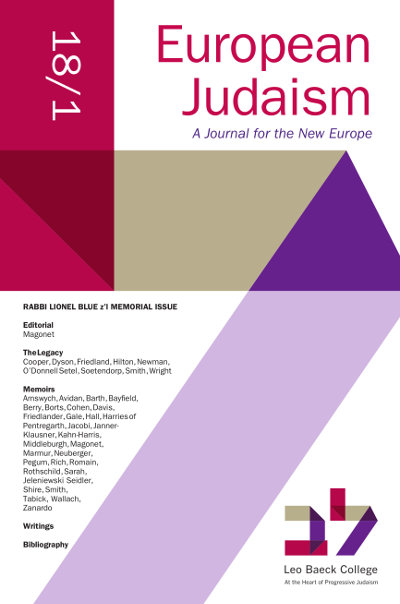
European Judaism
A Journal for the New Europe
ISSN: 0014-3006 (print) • ISSN: 1752-2323 (online) • 2 issues per year
Volume 36 Issue 1
Get 35% discount when you checkout 3 or more PDF articles.
Editorial
Sometimes, we must confess our inadequacies. European Judaism cannot begin to cover all the areas of European Jewish life after the Shoah. So much of what we try to achieve is the task of the remembrancers, and even our collective memories falter. We should have celebrated the centenaries of Karl Popper and Günther Anders in 2002, even if we already have critics muttering that EJ grants too much space to Germany. Of course, both of these giants of European culture can be described as ‘ex-Vienna, almost ex-Jewish’, born there in 1902. Popper’s assimilated parents had converted to Protestantism in 1900; but the Sterns were ultra-Reform.
Religions and Globalisation
The topic I propose to address here is vast, and all I can reasonably do is to present a picture painted with very large brushstrokes. Much of what I will have to say will be based on insights gained from the work of the research centre I direct at Boston University, first of all from the largest project we ever undertook – a ten-country study of globalisation and culture (the major results have been published in a volume I co-edited with Samuel Huntington, Many Globalisations: Cultural Diversity in the Contemporary World, Oxford University Press, 2002). And before I say anything about religion, I must make some general observations about the cultural dimension of globalisation. (Though I will point out right away that in most of the world, as soon as one looks at culture, one is looking at religion.)
The Anguish of Religious Faith in a Time of Globalisation
In the Age of Globalisation, everything is new for us, and everything is old. The religions of the world are once again children who have entered a new world, this time of globalisation. We have eaten the fruit of knowledge and have been expelled from our secure Paradise. Now, we wander about, lonely and afraid in a world we never made. We had little to do with the scientific achievements which fashioned today’s world; indeed, religion often tried to restrain the advance of science. Now, we must learn to live in this brave new world; we must also learn to live with the imperfections of our religions.
Culture and the New International Order
Given the extraordinary circumstances confronting us in a world profoundly unsettled by the advances of globalisation in all walks of life, and by the reactions provoked by this process, it may perhaps not be inappropriate to reflect upon how the growing interdependence among nations will affect cultural life. This interdependence is derived from the internationalisation of communications, the economy, ideas and technologies. A certain degree of perplexity and a number of prejudices surround this question. It may be worthwhile to dispel them.
Wolf Biermann
The Minnesinger-Prophet of Germany
We first met Wolf at the Wissenschaftskolleg in Berlin in 1997, and were surprised: Biermann, the great pop star of East Germany whose protest songs had helped to destroy the ‘Wall’ was a Fellow at this institute? Slowly, we discovered the reasons. Biermann had received the Heine Prize, the Hölderlin Prize, the great Büchner Prize, the National Prize and other honours as one of the great poets of Europe; and he was at the institute to translate Shakespeare sonnets into contemporary German! We became friends, and he sang Evelyn his protest songs as we sailed under the bridges of the Spree (and sent her to Hamburg to his dentist who turned out to be Szpilman, son of the composer/ pianist of Polanski’s new film ‘The Pianist’).
Lessons of 9/11
I am very pleased and honoured to have this opportunity to speak at a gathering of the Muslim delegates in London. For the sake of brevity and clarity, I shall limit my comments in general to the Muslim community in this country, though much of what I say may equally be applied to the Muslims in general. Furthermore, since the Maimonides Foundation is an interfaith organisation and does not comment on political issues, I shall steer clear of politics.
'In The Midst of Many Peoples'
Some Nineteenth-Century Jewish Composers and Their Jewishness
At the start of the nineteenth century there were virtually no Jewish professionals in music and the standard of music in Jewish synagogues was generally appalling. Yet by the end of the same century throughout Europe Jews held leading positions as conductors, soloists, producers, music publishers and patrons of music; a Jew was the most successful opera composer of the century, and the Jews were commonly held, what would have seemed nonsensical a hundred years earlier, to be a ‘musical people’.
The Jewish Intellectual in France
Durkheim and Mauss
Moses Durkheim (1805–1896) was a rabbi in Epinal, Lorraine, and was then appointed Chief Rabbi of the Vosges and of the Haute-Marne regions. His son Emile David (born in Epinal in 1858 and died in Fontainebleau in 1917) left home to prepare his entrance to the Ecole normale supérieure de Paris. He was to become one of the pillars of French and European culture.
'Hear O Israel'
The 'Impossible Profession' of Jewish Faith
In one of his last dense, dark essays (‘Analysis Terminable and Interminable’ (1937)) Freud offered, almost as an aside (a moment of gloom? an old man’s wry self-deprecation?), a remark which has haunted the psychoanalytic community ever since: ‘It almost looks as if analysis were the third of those ‘impossible’ professions in which one can be sure beforehand of achieving unsatisfying results. The other two, which have been known much longer, are education and government.’
The Torturer's Horse
What Kinds of Witness Does Literature Bear?
What follows is a personal exploration of some of the ways in which the language of literature can embody and exploit our complex, ambivalent attitudes to victim, perpetrator and bystander. I want to begin with W.H. Auden’s poem, Musée des Beaux Arts (1938), which is the source of my title.
Reflections on Working with Psychotics
This paper was originally addressed to a convention of independent group members of the British Psychoanalytical Society who had gathered to consider whether common, theoretical and technical issues shape, or contribute to, an independent group identity. I shall be describing some aspects of my understanding of psychotic patients, and some of the techniques I have utilised in working with them.
And Granny Makes Three
I have taken my title from the lines of an old song ‘Just Molly and Me’ and changed the verse to ‘Just baby and me, and Granny makes three, in my Blue Heaven’. In this way, I emphasise the grandmother as the ‘third person’, an important potential position that she has in the ‘blue heaven’ of the emotional life of the family. The grandmother is also involved in the oedipal movement from the two-person relationship, ‘Molly and me’ or ‘baby and me’, to the three-person triangle, ‘and Granny makes three’.
Therapy Is a Process That Reduces Injustice
The aim of this paper is to discuss what I take to be a new and useful concept of injustice. By means of this concept I think that some of the destructiveness of injustice may be lessened.
A Generation Confronting the Loss of Community
It was a hot Saturday night in the summer of 1986. I was alone at home in Bournemouth. My wife, Ruth, and my children, Naomi and Joel, were on a family visit to London. I was sitting in the living room, where my eye caught sight of a book which someone had recently given to me: Memorbook1 and I had not yet had a chance to read; a history of the Dutch Jewish Community, from its beginnings to 1939. Picking it up and starting to read it was like opening a Pandora’s box. Here was an account of the history of the Jewish community into which I had been born, yet a community which was unfamiliar to me.
Poetry
Legacy Almost By Larry Lefkowitz
Old Man Among Old Men Quantum Genesis By Philip Fried
Tell it not in Gath: (from David’s lamentations for the deaths of Saul and Jonathan) On Muranowska Street April 1943: Borszczow By Myra Sklarew
A Man, a Plan, a Canal, Panama Repairing Relations with the Dead Thoughts in Preparation for a Trip Robert Weinberg
Enemies War Poet Dannie Abse
The Immigrants Gerald Zipper
Where the Prath Falls Bernhard Frank
Dust Sheldon Flory
Book Reviews
The Phantom Lane, Lotte Kramer, Rockingham Press, 2000, 80 pp., £6.95, ISBN 1–873468–74–1
Women Pioneers of Jewish Learning: Ruth Liebrecht and her Companions at the ‘Hochschule für die Wissenschaft des Judentums’ in Berlin 1930–1934, Esther Seidel, Berlin, Jüdische Verlagsanstalt, 175 pp., ISBN 3–934658–32–6
L’CHAIM! Prayers and Blessings for the Home, Michael Shire (ed.), illustrated with illuminated manuscripts from the British Library and the Bodleian Library, London, Frances Lincoln, 2000, 77 pp, £12.99, ISBN 0–7112–1602–9
The Language of Silence: West German Literature and the Holocaust, Ernestine Schlant, New York and London, Routledge, 1999, 277 pp., ISBN 0–415–92219–4 Review by Albert H. Friedlander
The Strange Case of Dr Simmonds and Dr Glas, Dannie Abse, London, Robson Books, 2002, 195 pp., £14.95, ISBN 1–86105–504–8
Jewish Religious Law: A Progressive Perspective, Progressive Judaism Today, Volume 3; John D. Rayner, New York & Oxford, Berghahn Books, 1998, ISBN 1–57181–975–4