 Get New Issue Alerts
Browse Archive
- Vol 59 Issue 2
- Vol 59 Issue 1
- Vol 58 Issue 2
- Vol 58 Issue 1
- Vol 57 Issue 2
- Vol 57 Issue 1
- Vol 56 Issue 2
- Vol 56 Issue 1
- Vol 55 Issue 2
- Vol 55 Issue 1
- Vol 54 Issue 2
- Vol 54 Issue 1
- Vol 53 Issue 2
- Vol 53 Issue 1
- Vol 52 Issue 2
- Vol 52 Issue 1
- Vol 51 Issue 2
- Vol 51 Issue 1
- Vol 50 Issue 2
- Vol 50 Issue 1
- Vol 49 Issue 2
- Vol 49 Issue 1
- Vol 48 Issue 2
- Vol 48 Issue 1
- Vol 47 Issue 2
- Vol 47 Issue 1
- Vol 46 Issue 2
- Vol 46 Issue 1
- Vol 45 Issue 2
- Vol 45 Issue 1
- Vol 44 Issue 2
- Vol 44 Issue 1
- Vol 43 Issue 2
- Vol 43 Issue 1
- Vol 42 Issue 2
- Vol 42 Issue 1
- Vol 41 Issue 2
- Vol 41 Issue 1
- Vol 40 Issue 2
- Vol 40 Issue 1
- Vol 39 Issue 2
- Vol 39 Issue 1
- Vol 38 Issue 2
- Vol 38 Issue 1
- Vol 37 Issue 2
- Vol 37 Issue 1
- Vol 36 Issue 2
- Vol 36 Issue 1
- Vol 35 Issue 2
- Vol 35 Issue 1
- Vol 34 Issue 2
- Vol 34 Issue 1
- Vol 33 Issue 2
- Vol 33 Issue 1
- Vol 32 Issue 2
- Vol 32 Issue 1
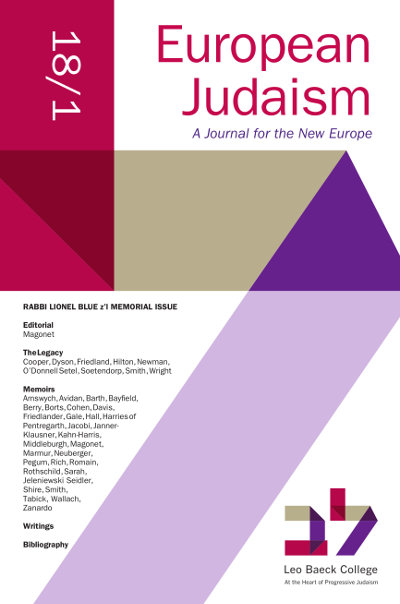
European Judaism
A Journal for the New Europe
ISSN: 0014-3006 (print) • ISSN: 1752-2323 (online) • 2 issues per year
Volume 39 Issue 1
Get 35% discount when you checkout 3 or more PDF articles.
Editorial
This edition celebrates the fiftieth anniversary of the founding of Leo Baeck College-Centre for Jewish Education on 30th September 1956. It is measure of the success of that new enterprise, and the calibre and commitment of its first students and lecturers, that within ten years of its founding teachers and graduates created this journal, the first to explore the newly emerging Jewish life in Europe.
From Artilleriestrasse to Upper Berkeley Street
The Origins of a Rabbinical College
The Leo Baeck College is one of the few institutions to be born out of the German refugee community in Britain, to have preserved the values of its origin, to have made the transition to a new culture and to have won for itself the respect of a new generation and built a new leadership. Its origins lie in the rabbinic seminary that was a quintessential product of pre-war German Jewry, the Hochschule für die Wissenschaft des Judentums. For the first half of its life the College was located at the West London Synagogue in Upper Berkeley Street, before its transfer to its present site at the Sternberg Centre for Judaism in East End Road, Finchley. This is a brief account of some of the stages in that first journey.
Address Given at the West London Synagogue on the Occasion of the Inauguration of the Jewish Theological College of the Association of Synagogues in Great Britain, on 30 September 1956
Mr. Chairman, Members of the Staff, Ladies and Gentlemen, We, plain and simple members of the Anglo-Jewish Community, are gathered here today to congratulate the Association of Synagogues on a signal act of faith. For the opening here and now, in London, in 1956, of a Jewish Theological College, is nothing less than an act of faith, faith in the continuance of Anglo-Jewry, faith in the value of a college, faith in the existence of Jewish Theology. It is to my mind not only a great, but an astonishing, act, and I find it the more astonishing in that it is an act of affirmation; and since the contemporary Jewish scene is in many respects not one of affirmation but of abdication, each element in this triple affirmation invites emphasis.
Fifty Years of Leo Baeck College
An Overview (1956–2006)
Only a few people are aware that the name of the College and that of Leo Baeck, now inseparably intertwined, were not originally linked. The College started its existence under a different title, being launched in September 1956 as the Jewish Theological College. This was in part a descriptive title, and in part a tribute to the Breslau Theological College, which, along with the Berlin Hochschule, had been destroyed during the war, and to both of which the new College saw itself as the successor, attempting to rekindle the light of Jewish learning in Europe.
'To Give You a Future and a Hope' (Jeremiah 29:11)
Leo Baeck College, Centre for Jewish Education through the Retrospectoscope – David Goldstein Memorial Lecture, 16 June 2005
It is a great privilege to have been invited to give this lecture in memory of David Goldstein, zikhrono livrakha. He was one of the great scholars and teachers of our movement and he died tragically young. I recall in particular a series of lectures he gave at the College on the Golden Age of Spain. In one of the earlier ones he noted that while at school he had been taught about the so-called 'dark ages' in Europe when there was little in the way of cultural development. The only exception, he had been taught, was the single shining light provided by the Venerable Bede. It was only in later life that he discovered that at the same time when Christian Europe was 'in the dark', Islamic Spain was going through its 'golden age' with an extraordinary flourishing culture that nourishes us till today. That same kind of cultural narrowness and ignorance seems to be no less a problem today when considering the Muslim presence in Europe, and I am always pleased to use that illustration to challenge people to think more broadly.
Learning, Teaching, Being
The first challenge I encountered at the Leo Baeck College when I came in 1957 was the imperative to learn. The lecturers wanted the students to study so that they would know Judaism. It was torah lishmah. Though the College was a professional school, the teachers seemed determined that, before we learnt to run congregations, we would know how to walk through texts – hence the emphasis on Bible and Talmud.
My Student Years at Leo Baeck College
I entered the Leo Baeck College in October 1959 and completed my studies there in June 1965. In those days the college had few students and was initially housed in the old council room of the West London Synagogue atop the main entrance in Upper Berkeley Street. In 1963 the building on the corner of Upper Berkeley Street and Seymour Place was demolished and in its place was erected a new building for the Leo Baeck College which also doubled as a venue for the West London Synagogue Religion School.
Menschlichkeit Prevailed
All the pent-up emotions of the hidden child struggling to bridge the twenty miles ditch between a torn continent and the British Isles that fortunately had been spared the experience of extermination came to the fore when I presented to Dr van der Zyl the decision of the students of the Leo Baeck College not to attend classes at the outbreak of the – what was later called – Six Day War. It was in fact an ultimatum not open for debate.
Leo Baeck College 1971–1975
When I was a student at the College, I remember thinking that I should write my rabbinic thesis on the frequent changes made to the College timetable. I well remember that for most of my student years, we would receive as many as five draft timetables per term before the matter was finally settled and we could plan our time and our studies. It was not just a case of trying to fit in with the needs of our many part-time lecturers, though that was probably part of the equation; to me it seemed far more to reflect a basic contradiction at the heart of the syllabus: the academic versus the vocational.
Memoir of Leo Baeck College
Memory is a curious thing, as we all know. Revisiting the past even physically, in my case especially physically, can have unexpected results. For me, it has often been a question of 'shrinkage' for want of a better word. Places that seemed in one's youth vast, impressive, overwhelming seem so much smaller. Revisiting Oxford in the 1980s for example, after a period of perhaps fifteen years absence, I was so struck, not only by the 'Disneyland' that the town had become (ten times worse since then), but by how far less physically impressive the vast Shangri-la of my youthful imagination had become to me: beautiful, yes – but no Rome or Versailles. Living in Paris – a majestic city – whatever its other drawbacks and travelling fairly widely in the world had no doubt - unconsciously – put the 'dreaming spires' of my memory into architectural perspective.
Leo Baeck College Memoir
My first few visits to the Leo Baeck College from Cambridge in 1972 were amazing to me because of a totally different, far less dry, approach to texts. I was blessed, then and later, with classes taught by Nelly Littman and Rabbi Dr Louis Jacobs. After three years at Cambridge (this was my fourth year, and I made weekly visits to the College), I was used to people standing and lecturing me even if I was the only person in the class. I was used to discussions of cognate languages, of a form of historical analysis that has stayed with me for the rest of my life but left little room for an emotional bond with a period or a people, and of a deep and loving understanding of the Hebrew language.
My First Day at Leo Baeck College
My first day at Leo Baeck College, I arrived early, dressed soberly but impressively to demonstrate my serious intent. I was shown into a room where I sat with two other students among the drawings and misspelled Hebrew words of a West London Synagogue cheder class. Feeling frightfully shy, I did not introduce myself to my two colleagues, and they, being equally reticent did not introduce themselves to me. So there we sat and waited for some twenty minutes in total silence. Rabbi Albert Friedlander z'l finally came in, blinked, and asked what we were doing.
Memoir of Leo Baeck College
I entered Leo Baeck College in September 1979 as 50 percent of the Class of 1984; my co-student was William Wolff. It would be hard to conceive of two less similar people, yet we hit it off like a house on fire and remained close mates throughout our College years. I came from an academic background; my general Jewish knowledge was almost nil, but I'd already mastered Biblical Hebrew. Willie, a tabloid journalist, was steeped in Yiddishkeit but couldn't differentiate between a sh'va na' and a sh'va nach. Our lecturers that first year must have been in hysterics over us.
A Nun at Leo Baeck College
In 1986, twenty years after my entry into the Anglican contemplative community of the Sisters of the Love of God at Fairacres, Oxford, my monastic life took a radically different turn when I was given permission to devote time to study. This was an exceptional decision, the fruit of a conversation with the then Reverend Mother, Mother Jane, which was subsequently supported by our Warden, Canon Allchin, and the Community Council.
Memoir
The prologue to my study at LBC started in Zurich, where I was asked to become the part-time Chazan at the Progressive shul of Zurich. I had talks with representatives of the congregation, and we decided that I would sing during a special Shabbat. There we met Rabbi Jonathan Magonet, and we started talking about LBC and studying for the rabbinate. The late chair of Zurich actually asked me, why not become a rabbi in Zurich instead of a chazan. I started thinking and discussing matters with my wife Riette. I had found myself in a job as a jurist (I finished my BA and MA in Law at the University of Amsterdam in 1985) where I had hardly any time for my hobbies: chazan, youth leader, and teacher. I missed these aspects of my life.
My Experience as Student and Lecturer at Leo Baeck College
My experience of the College predates my admission to the Rabbinic programme. While I was studying Hebrew at UCL in the late 70s, I was fortunate enough to watch Charles Middleburgh and Jonathan Romain successfully make the transition from undergraduate to postgraduate rabbinic studies and knowing them allowed me access to the hallowed halls of the College at West London Synagogue.
Memoir
In 1998, on Shabbat Lech Lecha, on which each year rabbinic students and Rabbis are asked to heighten congregational awareness of the College.
I Samuel 9:1–14
Saul's Destiny Fulfilled – A Meeting of Parallel Worlds
In B. Berakhot 48b1 the discussion of the gemara turns to ask why, in I Samuel 9:13, the women, who Saul finds drawing water, give such a long answer to his question. There are three possible answers given, which seem to provide lenses through which we are able to read the narrative of I Samuel 9:1-14. The first answer offered is that, 'women are fond of talking'. This appears to be a most basic reading of the narrative, suggesting that within a given text it is possible to identify essential universal characteristics within the figures of the text.
The Transparency of King Saul
While there exist many instances in the Tanakh of characters who are 'fraught with background' and whose internal workings are hidden, Saul could not be described as one of them. It is not just that his thoughts and feelings become public knowledge in the sense that the reader understands them clearly. In addition his internal life seems to be at the mercy of others, beyond his control. Such is his transparency that psychologists have found it easy to analyse his turmoil. Furthermore, there are literary devices that serve to highlight his openness and exposure compared to the opaqueness of other characters, in particular David.
Islamic View on Pluralism
How do people of faith reconcile their own faith path with the reality and validity of pluralism? How to be faithful to one's own tradition and also be open to the faith of the other? What are the enabling or disabling issues that make it easier or more difficult for members of different faiths to work or sometimes even to co-exist together?
John D. Rayner
Hans Sigismund Rahmer (John Desmond Rayner), rabbi: born Berlin 1924; ordained rabbi 1953; Minister, South London Liberal Synagogue 1953–57; Associate Minister, Liberal Jewish Synagogue 1957–61, senior Minister 1961–89 (Minister Emeritus); Lecturer in Liturgy and Rabbinic Literature, Leo Baeck College 1966–2003, Director of Studies 1966–69, Vice-President 1969–2005; Chairman, Council of Reform and Liberal Rabbis 1969–71, 1982–84, 1989–92; President, London Society of Jews and Christians 1990; CBE 1993; Honorary Life President, Union of Liberal and Progressive Synagogues 1994; married 1955 Jane Heilbronn (two sons, one daughter); died London 19 September 2005.
The Latest Liturgy of Liberal Judaism in England
In the history of Progressive Jewish liturgy, Britain’s Liberal movement has, in spite of its relatively small numbers, played a unique role. For one thing, it has taken cognisance of the liturgical traditions of both of the two main centres of Progressive Judaism: Germany and the United States of America. (Britain’s Reform movement, by contrast, has preferred to do ‘its own thing’, with little reference to what has been done elsewhere.) For another thing, its publication in 1967 of Service of the Heart marked the beginning of a new trend, which has since manifested itself throughout the Progressive Jewish world.
Poetry
In the Field of Sacred Apples Bilhah’s Song The Four Sons
Poem
Radio
Instructions
Book Review
Islam and Global Dialogue: Religious Pluralism and the Pursuit of Peace, Roger Boase (ed.), foreword by HRH Prince Hassan bin Talal, Ashgate, London, 2005, £50.00, 330pp., ISBN 0-7546-5307-2.