 Get New Issue Alerts
Browse Archive
 PDF issue available for purchase
 Print issue available for purchase
- Vol 6 Issue 1
- Vol 5 Issue 2
- Vol 5 Issue 1
- Vol 4 Issue 2
- Vol 4 Issue 1
- Vol 3 Issue 2
- Vol 3 Issue 1
- Vol 2 Issue 2
- Vol 2 Issue 1
- Vol 1 Issue 2
- Vol 1 Issue 1
Journal of Bodies, Sexualities, and Masculinities
ISSN: 2688-8149 (print) • ISSN: 2688-8157 (online) • 2 issues per year
Published Open Access as part of the Berghahn Open Society collection.
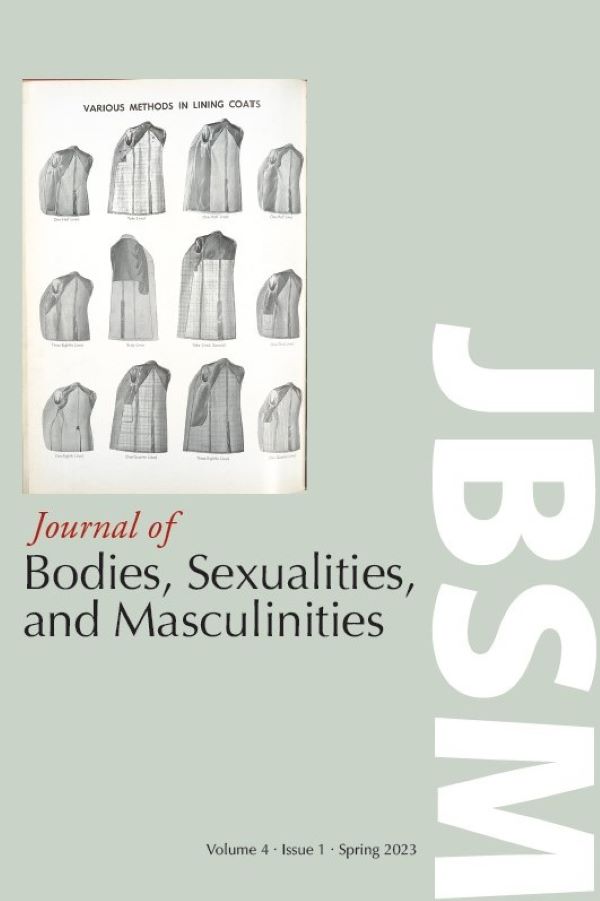
It has only been in the last twenty years that men's fashion has gained attention as a discreet disciplinary area of study across the arts and humanities. Up until as late as 1994, when fashion studies entered the academy, information about men's fashion was not included in studies of masculinities; if anything, a cursory mention was made in an occasional book chapter or academic article. This was because fashion was considered frivolous and narcissistic, and not worthy of any serious scholarly attention, unless you were a woman or queer. Fashion was regulated to the domain of the feminine and the body, as opposed to art and architecture, which were deemed masculine and placed in the sphere of the mind and the psyche. Up until the mid-eighteenth century, men's clothing was made of plush fabrics, constructed silhouettes, and refined forms that signaled wealth and aristocratic status. Influenced by the Enlightenment ideas of reason and rationality, men's clothing became more utilitarian and functional, abandoning wigs, stockings, and high heels in favor of garments such as the suit. Exaggerated forms were left to women's fashion, as men relinquished their claim to adornment and beauty and fashion became associated with femininity and frivolity. It was, as John Flügel claimed, the Great Male Renunciation that was to burden masculinity for the next four hundred years. Since our first Issue, the By examining a cache of mid-nineteenth-century daguerreotypes, it becomes evident that, for the middle-class young men who sat for these portraits, masculine vestimentary self-representation was not a simple task. This article sheds light on the crisis in the regime of masculine domination and white supremacy, twin forces deployed in France with and for the development of the modern capitalist system. Stemming from a perceived physical degeneracy in men's bodies, this feeling of crisis was alleviated by scaffolding these bodies with normative and pseudo-scientific tailoring practices. In these daguerreotypes, the young men photographed used various accessories and embellishments to push against the dark uniformity of men's clothing and demonstrate their own idiosyncratic singularity. By reading this vestimentary play alongside Judith Butler's theory of gender performativity, the true decentering power of fashion accessories, particularly in men's fashion in the nineteenth century, is revealed. The archival-artistic practice of fashion designer and performer Gwen van den Eijnde attends to the bodily feelings prompted by physical engagement with historic costumes and textiles as a source of emotional discovery. Touching and wearing old fabrics of which we have no previous direct sensory knowledge can activate unexpected imaginings of ourselves that would otherwise be foreclosed: by dressing up in baroque costumes we can phenomenologically In analyzing the metrosexual and drawing on the work of Mark Simpson, this article argues that metrosexuality relates to the dressed, not naked, body. It also highlights the history and variations in form and expression of the metrosexual from the post-war period to the present day, illustrating how the metrosexual is a shifting kaleidoscope of relations between masculinity and sexuality, the body and clothing. Particular attention is given to the suit as the dominant form of modern, western men's dress and as a system of bodily adornment that has shifted over time. Underpinning this is a more unilinear development of the mediatization, commodification, feminization, and infantilization of fashionable masculinity. In sum, it is argued that furthering the understanding of the metrosexual and his relationship to masculinity and sexuality requires greater attention to men's clothes, which was otherwise rendered invisible in much of the preceding analysis. Through a close textual analysis of This article introduces the work of Belgian designer Glenn Martens as creative director of the Paris-based brand Y/Project and its “unisex” approach to fashion. Drawing on queer theory and theories of non-binary and genderqueer identities, the proposed investigation addresses the power of fashion in rethinking bodily gender boundaries and in imagining possible escapes from the tyranny of the gender binary in fashion. To do so, I propose a qualitative multidimensional reading of the brand, in which I look at how Martens critically questions normative assumptions about masculinity and the male dressed body. The analysis takes into consideration the Y/Project e-commerce with its structure and positioning in the online retailing system, the design of garments, and the visuality of fashion shows. After his appointment in 2015 as creative director at Gucci, Alessandro Michele broke with the brand's look of sleek sophistication and introduced an eccentric, maximalist, and ultimately queer approach to fashion. Taking the campaign as a case study, the article aims to investigate the shifting norms of masculinities in Michele's designs. Following a visual cultural analysis as proposed by Martin Lister and Liz Wells, this article aims to consider Gucci's Spring/Summer 2016 campaign in a cultural and societal context. Focusing on the transgressive potential of gender-fluid fashion, the article draws on a theoretical framework deriving from queer theory and gender studies. The article interrogates how masculinities are constituted and renegotiated in contemporary Western culture and highlights the relevance of fashion in constituting and tackling issues of masculinity in contemporary times of change. Vicki Karaminas, Adam Geczy, and Pamela Church Gibson (eds.), Volume 4 Issue 1