 Get New Issue Alerts
Browse Archive
- Vol 16 Issue 1
- Vol 15 Issue 1
- Vol 14 Issue 1
- Vol 13 Issue 1
- Vol 12 Issue 1
- Vol 11 Issue 1
- Vol 10 Issue 1
- Vol 9 Issue 1
- Vol 8 Issue 1
- Vol 7 Issue 1
- Vol 6 Issue 1
- Vol 5 Issue 1
- Vol 4 Issue 1
- Vol 3 Issue 1
- Vol 2 Issue 1
- Vol 1 Issue 1
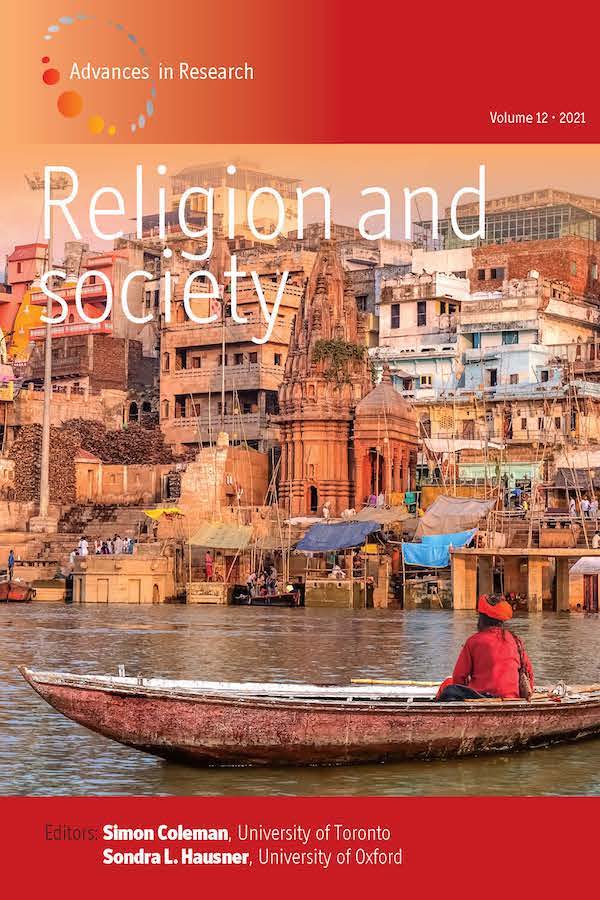
Religion and Society
Advances in Research
ISSN: 2150-9298 (print) • ISSN: 2150-9301 (online) • 1 issues per year
Volume 13 Issue 1
Introduction
On Concepts, Conversations, and (In)Commensurabilities in Studying Religion
Portrait: Michael Lambek
In an article as relevant now as when it was written, There are two possible solutions to the problem, that of the fundamentalist and that of the sage. The fundamentalist overcomes the problem of multiplicity by a return to the One. Truth can be restored only if rivals are eliminated and false pretenders unmasked. Truth and order are founded on the tyranny of the One. The solution of the sage is founded on the metaphysics of absence … Under these conditions, multiplicity cannot be overcome. It has to be endured, tolerated. It is a permanent reminder of the fact that absolute truth is not for this world as we know it. To put it in a paradoxical way: it is the discovery of enlightenment that we are all groping in the dark.
A Thousand Eruptions
Religious Intensification in Melanesia and Beyond
Drawing on ethnographic and historical material from Melanesia and beyond, this article explores movements of religious intensification within Christianity. The morphology of religious intensification is defined by a multiplicity of localized upsurges laterally interconnected by means of decentralized packs of inspired participants. Charismatic intensification is above all an intensification of affect produced through the workings and movements of the Holy Spirit. In contrast to the ‘domesticated affect’ of institutionalized Pentecostalism, religious intensification trades in ‘wild affect’—improvised, loosely structured mobilizations of affective outpouring. These contagious upsurges in spiritualized intensity propel participants toward a new metaphysical horizon, namely, the Parousia or Second Coming. The effusion of apocalyptic affect can in many cases be historically explained in terms of the subsidence of the colonial order; as one cosmological meta-narrative collapses, another rushes into the existential breach. Surging toward a new world here produces an unraveling of existing hegemonic teleology and eschatology that function to fix, dominate, and restrict human bodies.
On
Or, How Not to Write a History
Through a detailed reading of a recent study of medieval Buddhism and politics in Sri Lanka in conjunction with a number of other works, this article explores the troubling legacy of translating the historical questions of subjectivity into the modern language of ‘agency’, ‘autonomy’, ‘innovation’, and ‘creativity’. This legacy cannot easily be separated from the politics of white privilege in post-colonial studies of Buddhism and South Asian religion. The problem with trying to expose creativity, so pervasive in the studies of South Asian religion, is not merely a matter of anachronistic conceptualization of divergent historical forms of religious practice and subjectivity. It is that the very possibility of translating subjectivity into easily digestible aestheticized modes of being (e.g., creativity) is predicated on an uninterrogated assumption about the self-evidence of such concepts independent of temporal forms of power encountered in forms of life.
Around David Henig's
Everyday Islam in Postwar Bosnia and Herzegovina
Around David Henig's
Limits, Genealogies, and Openings
Introductory Remarks on Engaging Religion
This article, which introduces a special collection of articles, is intended to invite scholarly reflection on the study of religion in the present day. We believe that a meaningful conversation about what happens when we engage religion for scholarly purposes forces us to consider the ways in which the very category ‘religion’ shapes our research interests and scholarly communities. A focus on ‘engagements’ is furthermore useful as we seek an open conversation about what is lost and what can be found in the translations and transitions between analytical categories and empirical findings. We contend that much can be learned by exploring what, exactly, is engaging us—and how we engage—in the study of religion. It is therefore the aim of this article and those that follow to participate in joint interdisciplinary thinking about the means, ends, methods, and results of academic analyses that deal with religions and religiosity.
Culture and Religion
Remarks on an Indeterminate Relationship
Religion is often viewed as a subset of ‘culture’, that is, the two terms are often used interchangeably. At the same time, it is possible to view religion and culture as clearly distinct, perhaps even opposed to each other. This article ponders the ways in which what counts as religion in the present day is intertwined with a concept of culture. Each has an essentialist and postmodern variant, and how they are related, whether conflated or separated, carries normative claims about each. Bringing together theoretical insights on these two highly debated concepts, this piece offers an analysis of the nested indeterminacies between both and urges analytical attention toward them in the interplay of essentializing and de-essentializing practices.
Chasing the Secular
Methodological Reflections on How to Make the Secular Tangible
How can we engage the secular in ways that encourage empirical investigations of its specific and embodied expressions? Locating the secular in particular places and situations invites the scholar to recognize it, to say “there it is.” However, the secular seems difficult to pin down precisely: it quickly expands into everything that is not considered religion in a given context, and the distinctively secular seems to evaporate into nothing. This article explores the slipperiness of the secular, not merely as a conceptual obstacle, but as something that emerges from the way the secular is fundamentally constituted upon the absence of religion rather than any specific forms of presence. It probes what kind of spatial, material, and embodied presence such absence of religion might have, and it suggests that an answer to this question may provide us with a methodological way out of the slipperiness.
Analytic Categories and Claims of Special Knowledge
This article examines two categories in which claims of special knowledge are central: Gnosticism and conspiracy theories. In both cases, notions of what counts as ‘religion’ come into play in setting their boundaries, with only certain kinds of religious belief deemed as legitimate. Moreover, the category is privileged over the data. While these cases may be extreme, I contend that they point to a major failure of contemporary social sciences—a commitment to categories about data that leave us upholding the episteme that we should be critiquing.
Contextualizing the Religious Survey
Possibilities and Limitations
Censuses and surveys represent a two-edged sword. They are both a technology of governance for national and former colonial administrations and a tool of recognition for the minoritized. In this article, I discuss the history of censuses and surveys in a Danish context, arguing that the regional and local history of registration is crucial for understanding how and why religious identity becomes visible and important as a measure for the population. Applying the case of a national survey on religiosity in relation to the Danish Evangelical Lutheran Church in 2020, I ask how religion comes alive through the strategic use of artificial ideal types aimed at mapping a religious mainstream. Surveys introduce a distance to messy religious reality, thereby reducing complexity and richness. Yet this distance also allows the researcher to ask new questions that go beyond the immediate religious experience.
Working in Between
Interdisciplinary and Multivalent Approaches to the Study of Religion
Through personal reflections on my work to date, this article explores how scholars of religion creatively define and redefine our subject matter. It emphasizes two main themes: temporality and the category of religion. Regarding time, I discuss how changing personal and political contexts have spurred my experiments with cross-disciplinary methodologies, as well as my reflections on citational politics and the role of citation in interdisciplinary exchanges. Regarding the category of religion, I consider the impact on my recent work of projects to deconstruct religion further by including secularism and non-religion within Religious Studies departments. Throughout, I ponder how scholars speak to one another, particularly in the interdisciplinary environment of religious studies, about the thing we call ‘religion’.
Afterword
The study of religion has come a long way since the bad old days of bold, universalizing theory. The claim that religion can be readily recognized across time and place because it has a sort of ‘essence’ is today viewed as preposterous. What we would much rather insist on is the notion that religion as a category is shifting and complex, with vagueness kept at the center of our analyses. In this article, I play devil's advocate by asking what (more) we can possibly gain by continuing to foreground religion's conceptual shiftiness. Reflecting on this collection, I explore how a focus on genealogies and biographies might offer us new insight on the distinction between religiosity and religion. Defining religiosity as a species of attention that inheres in persons, I suggest that writing about and researching religion engages the religiosity of the author, and that religiosity, in turn, may (or may not) bring about definitions or assemblages we might recognize as ‘religion’.
Introduction
Rethinking an ‘Islamic Utopia’
This article argues for a non-normative and pluralistic approach to the study of utopia among Muslim people. The authors employ the contributions to this special section as a starting point to redress a number of ethnocentric biases clouding the relationship between utopia and Islam. They criticize arguments that deny Muslims the ability to produce ‘genuine’ utopias, highlighting commonalities between a religious culture and the secular culture in the West that has endorsed the notion of utopia. At the same time, the contributors show how in scholarly research a normative and prejudicial concept of ‘Islamic utopia’ has obscured the variety of forms that utopianism assumes among Muslim people, particularly the youth. This article envisages an inductive approach that takes into account both the different positionalities from which the concepts of Islam and utopia are appropriated and the diverse political outcomes that are produced.
Remobilizing Religion in Utopian Studies
A View from a Feminist Literary and Historical Scholar of Utopia
This article explores how factors such as gender and cross-religious communication frame and yield utopian perspectives in Rokeya Sakhawat Hossain's literature and practice as educator and feminist. The article makes the case that Hossain's body of work envisions utopia in complex, many-layered ways. Early in her creative career, as a member of the Muslim youth herself, Hossain created gender-just utopian visions that also embedded cross-religious dialogue and cooperation. She later became an educator, inspiring youth, particularly Muslim girls and young women, with utopian ideas and practices. The article concludes that analyzing Hossain's writing in utopian frames, as well as examining her writing and work through Ruth Levitas's approach to utopia as method, helps to explain Hossain's inclusion of religion and spirituality in her oeuvre.
Waiting for Utopia
Young Tunisians, Salafism, and the Post-revolutionary Transition
In this article I consider the connection between Islam and utopia, using the renewed visibility that Islamic actors and moral economies have gained in the post-revolutionary Tunisian public sphere as a starting point. In particular, based on ethnographic findings from field research in Tunisia, I take into account the interest in Salafism expressed by young Muslims, recently fascinated by the Salafi tradition even if not necessarily joining any formal Salafi organization. The recovery of an original and mythical perfection, rooted in the example of the ancestors (the
A Not-so-Islamic Utopia
The Dialectic between Realism and Messianism among Young Muslims in Rome
Despite the existence of a variegated literary tradition and the almost complete absence of field research on the subject, the notion of utopia in the Muslim world is generally associated with an ‘Islamic utopia’ that aims to reinstate the societal model of early Muslims. Based on ethnographic research among young Italian-Bangladeshis, this article suggests that ‘retro-utopia’ and religious repertoires more generally do not represent the only resources used by young people to imagine social change. The interlocutors put forth a variety of images of an ideal society that is ultimately structured according to a realism-messianism polarity. The youth use these images in an endeavor to make sense of their different positionalities and biographical trajectories, and the power relations experienced by themselves and the religious groups with which they are affiliated.
Reviews
VALERI, Valerio,
VIVEIROS DE CASTRO, Eduardo,
ABRAMSON, Allen, and Martin HOLBRAAD, eds.,
WEIL, Shalva, ed.,
STADLER, Nurit,
RUFFLE, Karen G.,
“MARIA MAGDALENA” EXHIBITION
ASIMOS, Vivian,
MORGAN, David,
POLTORAK, Mike, dir.,
TREMLETT, Paul-François,
KENDALL, Laurel,
LANG, Natalie,
JOHNSON, Andrew Alan,