 Get New Issue Alerts
Browse Archive
- Vol 16 Issue 1
- Vol 15 Issue 1
- Vol 14 Issue 1
- Vol 13 Issue 1
- Vol 12 Issue 1
- Vol 11 Issue 1
- Vol 10 Issue 1
- Vol 9 Issue 1
- Vol 8 Issue 1
- Vol 7 Issue 1
- Vol 6 Issue 1
- Vol 5 Issue 1
- Vol 4 Issue 1
- Vol 3 Issue 1
- Vol 2 Issue 1
- Vol 1 Issue 1
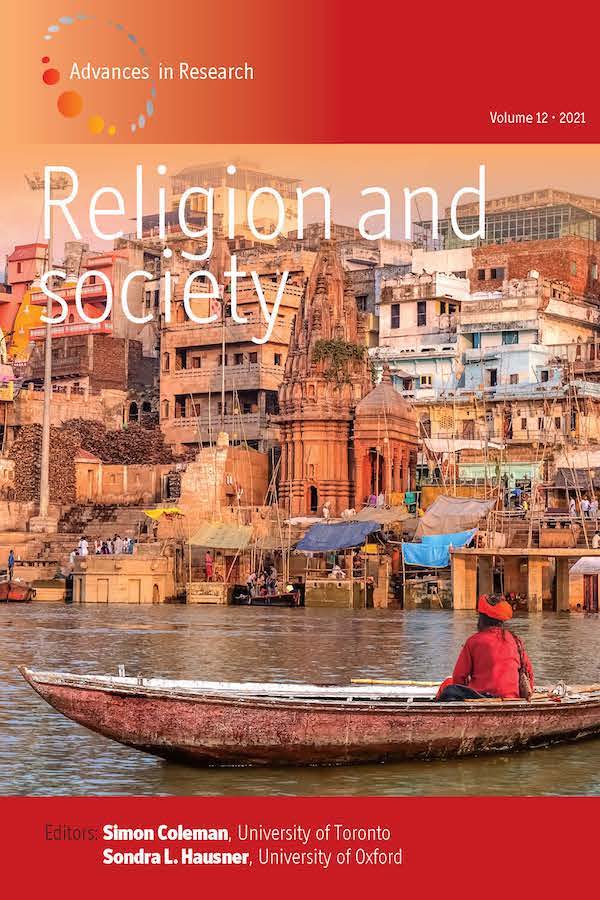
Religion and Society
Advances in Research
ISSN: 2150-9298 (print) • ISSN: 2150-9301 (online) • 1 issues per year
Volume 11 Issue 1
Introduction
The Personal and the Political
The central task of our journal is to present outstanding work on religion. Through our focus on individual scholars in the Portrait section, we are also able to consider how such work is produced, and our hope is to reveal the intellectual, institutional, political, and personal factors behind research that has helped us to revive and reconstruct our field. The subject of this year's Portrait, Talal Asad, has famously addressed questions about the category of religion in unusually productive and provocative ways. Published here for the first time, Asad's autobiographical observations take the reader through some of the key relationships and events of his life, from a remarkable childhood during which he witnessed the violence of Partition first-hand, to what happened in 1950 when he arrived in London from Pakistan and began to discern the problems behind “the local version of modern civilization into which [he] was being unevenly assimilated,” to the process of becoming an anthropologist and an ethnographer.
Portrait
The Preface to the Hebrew Translation of
Affective Futures and Relative Eschatology in American Tibetan Buddhism
Tibetan Buddhist prophecies of decline are largely unattended when it comes to practitioners’ lived experiences. This article considers such narratives through a focus on a community of American Buddhists in California. The relationship between Buddhist narratives of degenerating future and the American landscape is played out through the creation and distribution of sacred objects, which are potent containers for—and portents of—prophetic futures. Ruptures in time and landscape become, through the frame of prophecy, imaginative spaces where the American topography is drawn into Tibetan history and prophetic future. Narratives of decline, this article argues, also find common ground with salient American rhetoric of preparedness and are therefore far from fringe beliefs, but a more widely available way of thinking through quotidian life.
Weapons for Witnessing
American Street Preaching and the Rhythms of War
Drawing on observations of the performances of street preachers in the United States—as well as the texts that inform them—this article explores the concept of rhythm within and beyond the anthropology of religion. More specifically, it develops an expansive concept of rhythm as multiple and interactive, focusing not on a singular rhythm, but on the rhythmic translations that shape the practice of street preaching. First, I argue that the material rhythms of urban infrastructure constrain the narrative rhythms of the street preacher's sermon, producing a distinct homiletics. I then suggest that the ideological rhythms of war animate the narrative rhythms of the street preacher's sermon, linking military strategies with tactics of evangelism. Examining the material, narrative, and ideological rhythms of streets, sermons, and military doctrine, this article advances an analytic framework whereby the intersecting rhythmic tensions that shape performance can be registered.
Cheyenne River Sioux Traditions and Resistance to the Dakota Access Pipeline
The No Dakota Access Pipeline resistance movement provides a poignant example of the way in which cultural, spiritual, and oral traditions remain authoritative in the lives of American Indian peoples, specifically the Lakota people. Confronted with restrictions of their religious freedoms and of access to clean drinking water due to construction of the Dakota Access Pipeline (DAPL), members of Lakota communities engaged with traditions specific to their communities to inform and structure the No DAPL resistance movement. A series of interviews conducted on the Cheyenne River Sioux Nation with tribal members reveal that Lakota spiritual traditions have been integral to every aspect of the movement, including the motivations for, organization of, and understanding of the future of the movement.
Introduction
Elsewhere Affects and the Politics of Engagement across Religious Life-Worlds
Imagine a divided mountain-scape. A line of ceasefire. Fog. Imagine coming to a clearing. In a mist-covered, militarized order of here and t/here, affection makes way where vision or bodies cannot. Mothers call out to daughters; sons identify their mothers’ voices in two-way traffics of sound. So long as the vocal exchange lasts, somewhere along the disputed territory of the Golan Heights, an Elsewhere opens.
Learning the Elsewhere of ‘Inner Space’
The Affective Pedagogy of Post-Secular Sufi Healing in Germany
How is access to the Elsewhere facilitated through affective pedagogy in a contemporary Sufi setting in Germany? This article draws analytical lessons from Inayati healing seminars that took place in the summer of 2013. Participants were instructed to feel the Elsewhere of ‘inner space’ in the material/corporeal realities by attuning to breath, sonic resonance, collective movement, and attentive listening. The affective pedagogy of the teacher extended the spatial-temporal coordinates of the Elsewhere (as framed by Mittermaier) to include ‘fleeting affects’ among its unknown elements. These pedagogic tactics entangled religious and secular life-worlds with aesthetic and therapeutic traditions. Learning to feel the unknown affects emanating from the Elsewhere in this setting aimed to provide existential resources to cope with the everyday struggles of post-secular life.
An Ethics of Response
Protestant Christians’ Relation with God and Elsewheres
How do Protestants engage with Elsewheres, such as God and other parts of the world? While anthropologists of Christianity have focused on the problems of presence and ‘mediating’ God, this article considers instead the concept of ‘responding’ to God/Elsewheres. In examining Lutheran women in early-twentieth-century Norway who held monthly mission meetings, I begin with their decision to remove crafts from their meetings, which created a different blend of sound and silence. I argue that, in their view, quiet listening was the most proper response to calls from Elsewhere and thus allowed them to have the most far-reaching effects. In other words, their right affect would affect Elsewheres. We gain a fuller anthropological description of this complex engagement with God/Elsewheres if we include their understanding of the responsibility to respond.
From the Throes of Anguished Mourning
Shi‘i Ritual Lamentation and the Pious Publics of Lebanon
Drawing on a study of Shi‘i ritual lamentation in Lebanon, this article examines how religious actors and pious publics employ literary, recitational, theatrical, and socio-technological methods to cultivate imaginal engagements with the other-worldly. These methods are analyzed, demonstrating how they locate pious Shi‘is in religious meta-narratives that transcend the linearity of time, taking place simultaneously in the Elsewhere and in the here-and-now. I argue that this produces transposable and lasting dispositions that constitute the Shi‘i self, immerses subjects in this-worldly-oriented modes of religiosity, and bestows upon Shi‘i politics and the imagined community a profound emotional legitimacy. I posit that cultivated engagements with the Elsewhere are constitutive experiences in modes of religiosity that emphasize a symbiosis between human action and metaphysical intervention, thus complicating the question of agency and intentional action.
Dream-Realities
Rematerializing Martyrs and the Missing Soldiers of the Iran-Iraq War
Casting the fallen soldiers of the Iran-Iraq War (1980–1988) as ‘martyrs’ plays a crucial role in the legitimation discourse of the Islamic Republic of Iran. The government has succeeded in integrating many ‘martyr families’ into a state-revering political cult. This ethnographic study draws on theories of affect and atmosphere to investigate how practices around saintly dreams and their materialization in photographs and gravestones of martyrs have challenged the state narratives and discourses. I approach the veneration of martyrs through both affective and narrative sources and explore gravestones as new saintly localities. These localities are spaces of divinely intermediation with intimate connection to the transcendental realm. The multifaceted atmosphere of these sites offers nonconformist and heterogeneous entanglements in which dream-images of martyrs allow for the momentary subversion of the state's political cult.
Politicizing Elsewhere(s)
Negotiating Representations of Neo-Pentecostal Aesthetic Practice in Berlin
Drawing on ethnographic research in a Nigerian-based Pentecostal church in Berlin, this article explores the discussions that emerged when my scholarly representations of the congregants’ aesthetic engagements with the Elsewhere diverged from the church leadership's expectations. More specifically, it interrogates my representational practice in relation to the stakes of the diasporic congregation, which is operating at the political margin of Berlin's widely diverse religious landscape. In exploring the collision of my analytical focus on the affect-charged elements of the believers’ routines of connecting to the Elsewhere with the church's emphasis on affective discipline and moderation, the article demonstrates how aesthetic practices that engage with the Elsewhere not only have a religious but inevitably also a political bearing.
Afterword
The Elsewhere beyond Religious Concerns
We are all connected to multiple Elsewheres: the place(s) where we grew up, the place we would rather be, the places that haunt us, the places where the dead dwell, the sites of empire. Geographical Elsewheres can be a source of fear. In the wake of Europe's so-called migrant crisis and border-crossing pandemic viruses, a moral and racist panic feeds off the supposed collapse of those ‘other places’ into ‘our society’. But other places can also be sites of fascination and longing. Think of the long history of travel accounts, or the long-standing desire to reach beyond the planetary horizon. The dream of a mission to Mars. Anything but the depressing here and now!
Reflections on COVID-19
Book Reviews
Andía, Juan Javier Rivera, ed.,
Cassaniti, J. L.,
Casselberry, Judith, and Elizabeth A. PRITCHARD, eds.,
Elison, William,
Hackman, Melissa,
Leite, Naomi,
Li, Geng,
Lynch, Rebbeca,
Matory, J. Lorand,
Pansters, Wil G., ed.,
Pierini, Emily,
Pitarch, Pedro, and José Antonio KELLY, eds.,
Rambelli, Fabio, ed.,
Richman, Karen E.,
Vitebsky, Piers,