 Get New Issue Alerts
Browse Archive
- Vol 16 Issue 1
- Vol 15 Issue 1
- Vol 14 Issue 1
- Vol 13 Issue 1
- Vol 12 Issue 1
- Vol 11 Issue 1
- Vol 10 Issue 1
- Vol 9 Issue 1
- Vol 8 Issue 1
- Vol 7 Issue 1
- Vol 6 Issue 1
- Vol 5 Issue 1
- Vol 4 Issue 1
- Vol 3 Issue 1
- Vol 2 Issue 1
- Vol 1 Issue 1
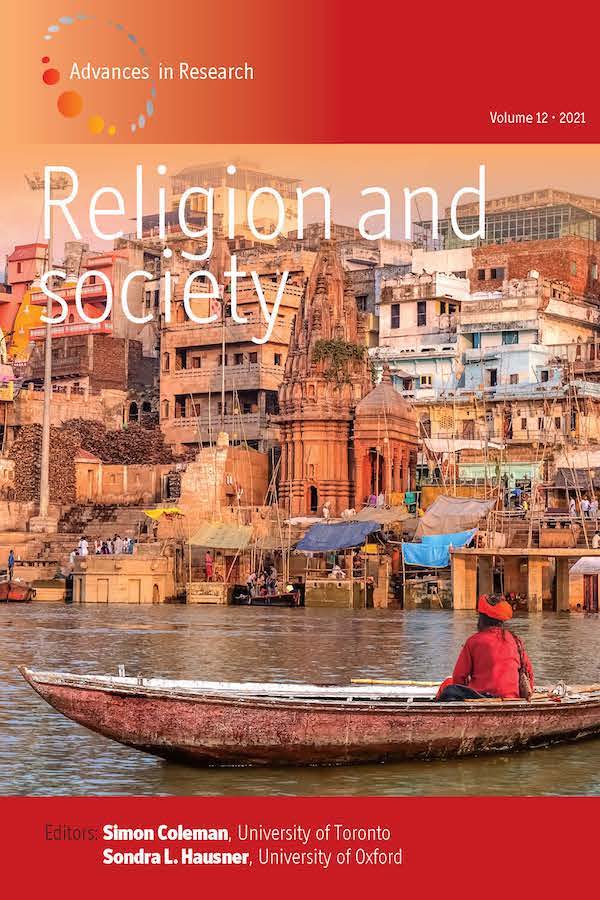
Religion and Society
Advances in Research
ISSN: 2150-9298 (print) • ISSN: 2150-9301 (online) • 1 issues per year
Volume 12 Issue 1
Introduction
Place, Horizon, and Imaginary
Perhaps it is no coincidence that as we approach two years of a COVID-adjusted world, this volume of
Portrait
Diana L. Eck
The study of religion is a challenge. It means trying to understand the energies and visions that have created, undergirded, and sometimes disrupted the great civilizations and cultures of the world. It means studying the history and diversity of the ways people have shaped worlds of meaning in response to or relation to what they may call the ‘transcendent’, or in response to science and technology, or in response to other traditions of meaning. It means studying the many ways people have given an account of the transcendent and the ways some traditions have gotten along quite well without an understanding of the transcendent. It means studying the symbolic, interpretive, scriptural forms over which traditions of faith and practice have argued through the centuries and continue to argue today. It means studying the construction of words like ‘religion’, ‘faith’, ‘tradition’, ‘theology’, and ‘spirituality’.
Beyond the Human Horizon
Amid a moment of crisis, how might the anthropology of religion shift its focus from ethics to politics? This 2021 Rappaport Lecture, delivered at the Society for the Anthropology of Religion (SAR) Biennial Meeting on 15 May 2021, begins by highlighting three ways in which our field has taken on politics in recent years: by troubling the distinction between ethics and politics, by thinking religion together with pressing political issues, and by taking a critical look at our conceptual horizons. Elaborating on this third way, it proposes that the anthropology of religion needs to move beyond the human horizon by ethnographically grappling with something bigger, namely, God. Prompted by a reflection on the phrase
State Legibility and Mind Legibility in the Original Political Society
In one of his last great provocations, Marshall Sahlins describes the ‘original political society’ as a society where supposedly ‘egalitarian’ relations between humans are subordinated to the government of metahuman beings. He argues that this government is ‘a state’, but what kind of state does he mean? Even if metahumans are hierarchically organized and have power over human beings, they lack two capacities commonly attributed to political states: systematic means to make populations legible and coercive means to identity the intentions of others. The nascent forms of state legibility and public mind reading that are present in Sahlins's original political society are not unified and tied to particular agents. A discussion of the limitations of state and mind legibility points to the fundamental correlations between those two forms of legibility and their co-implication in whatever might be called ‘the state’.
Critical Thin
Haunting Sufis and the Also-Here of Migration in Berlin
This article delves into the spectral and affective reserves of
Totemic Outsiders
Ontological Transformation among the Makushi
This article examines how sociological totemism mediates the co-existence of animism and an emerging naturalism among the Makushi in Surama Village (Guyana) within contexts of interactions with outsiders. Since the 1830s, such contexts have varied from missionization to eco-tourism, which Surama developed in the 1990s and which has since significantly increased. Eco-tourism currently facilitates access to employment, goods, outside knowledge, and international allies in Surama. In the present, villagers seek to fête and propitiate the leaders of outside groups and organizations to ensure the continued provision of these desiderata. Such practices are linked to shamanic relations with the ‘masters’ or ‘owners’ of animals, plants, and other aspects of the landscape. This article argues that these notions of mastery and ownership produce totemic homologies when applied to the intra-social relations of outsiders in Surama. The resulting homologies facilitate the emergence of a nascent naturalism that indicates ongoing ontological transformation in Surama.
The Christian Right and Refugee Rights
The Border Politics of Anti-communism and Anti-discrimination in South Korea
This article examines how the language and logics of the Christian Right in South Korea contributed to the propagation of anti-asylum sentiment during the Yemeni refugee crisis in 2018. By analyzing the Christian Right's historical origins in anti-communism and its moral opposition to anti-discrimination law, it shows how the anti-asylum movement owed much of its support to a conservative Protestant view of international refugee rights, seen through the lens of minority rights at home. Ultimately, it argues that overlaps between religious and national ideologies of anti-communism activate conservative Protestant linkages between moral boundaries and border security.
How the Bible Works
Russian Baptist Faith as Text
This article is about Russian Baptists’ perception of their faith as a text. I argue that they practice their lived faith by interiorizing the language of the Russian Synodal Translation of the Bible as their ‘language of reasoning’. I support this claim by analyzing two aspects of faith: as an act of conversion and as a process of living a Christian life. To illustrate the mechanism of sustaining faith, I use the case of a rehabilitation ministry for addicted people to unpack narratives of conversion, gender order, and family life. Biblical literalism is the basis of the Russian Baptist faith narrative, and in this article I scrutinize the mechanism of its construction.
How to Conceptualize an Introductory Course on the Academic Study of Religion
Systematic Reflections and Exemplary Answers
How should instructors conceptualize an introductory course on the academic study of religion? This article combines an abstract and broader review of different conceptualizations of such courses with hands-on discussions of two exemplary teaching models. The ‘case study model’ applies different approaches within the study of religion to a single case study in order to exemplify and compare their potentials and limitations. The ‘monograph model’ illustrates how an ethnography is used as a reference point for a discussion of the history of and current strands within the study of religion. Both models are particularly well suited to facilitate the combination of an overview of key themes, approaches, terms, and scholars with a close study of the intricate and captivating empirical reality of ‘lived religion(s)’.
Introduction
Communities Reimagining Sharedness in Belief and Practice
In this introduction, we bring together diverse anthropological considerations of community, belonging, and belief to argue for a reconsideration of the notion of ‘sharedness’ that often underlies these concepts. Scholars have long critiqued the use of ‘community’ for its broad application and vagueness, and most now recognize communities to be newly emerging rather than pre-existing. Despite this critical approach to scholarly uses of ‘community’, forms of unity often continue to be viewed as undergirded by a seemingly more self-evident idea of sharedness, in practice, belief or purpose. In this special section, we question this self-evidency to focus on how sharedness itself needs to be discursively and semiotically co-constructed and fostered by people who imagine themselves as belonging to communities of apparent mixed beliefs and practices. We propose that a focus on discourse and semiosis can provide insights into the innovative ways in which individuals negotiate, co-construct, and enact sharedness.
Labor and Religious Tolerance in Two Senegalese
How do people create their religious selves and a religious culture through their everyday practices and discourses? This article examines residents of two rural
Speaking in Celestial Signs
The Language of Western Astrology and the (Tenuous) Bonds of Occult Sociality
This article examines the role of language as a key metaphor and medium of occult sociality among contemporary Western astrologers. I argue that the ‘symbolic language’ attributed to celestial objects and patterns informs everyday speech acts and reinforces shared commitments to the authority of astrological tradition, in the relative absence of conventional structures of belief and belonging. At the same time, the flexibility and versatility of horoscopic symbols authorize diverse and idiosyncratic adaptations, creating patterns of discord and fragmentation often framed as characteristic of the astrology community. I argue that the tension between notions of metaphysical community and professionalization, on the one hand, and the virtues of epistemological individualism and eclecticism, on the other, is a constitutive tension at the heart of Western metaphysical practice. This approach complicates straightforward models of community as consensus, and at the same time challenges common stereotypes about the atomizing effects of alternative spiritualities.
Discourses, Bodies, and Questions of Sharedness in Kenya's Wellness Communities
This article contemplates the construction of sharedness that underlies the success of alternative lifestyle communities in Eastern Africa. In Kenya, a new tourism niche market that focuses on yoga, mindfulness, and alternative medicine is flourishing. Tourists travel to East Africa to practice yoga, but also to introduce local communities to ‘alternative lifestyles’. By considering Western and Kenyan practitioners’ discourses about the benefits of alternative healing, mindfulness, and yoga, I explore the significance of sharedness to the emergence of communities that are structured around not just physical practice, but also an envisioned joint purpose. I argue that discursively constructing shared purpose, in the face of seemingly evident differences, is central to Western expats’ validation and commercialization of these initiatives. I also demonstrate that local participants equally, although along different lines, feel compelled to construct a particular kind of sharedness to justify their yoga practice to themselves and their own communities.
Wrestling with Tradition
Reconstructing Jewish Community through Negotiating Shared Purpose
This article analyzes how congregants in a lay-led Reconstructionist synagogue discursively contest and perform sharedness through active engagement, interpretation, and public disagreements about how to create and sustain Jewish community. I argue that such ‘wrestling with tradition’—that is, questioning, negotiating, and (re)creating traditions in the context of countercultural and eclectic Jewish community—is achieved through collaborative and often conflictual discursive engagement with Jewish tradition. ‘Wrestling with tradition’ does not involve shared beliefs, shared Halakhah (Jewish laws and rituals), or even a shared spiritual practice. Instead, it is in the discursive ‘wrestling’—for example, in debating rather than necessarily following Halakhah—that a communal enactment of sharedness persists in affective and intellectual engagement with Jewish tradition.
Sharedness as Belonging
Hospitality, Inclusion, and Equality among the Layene of Senegal
This article draws on in-depth ethnographic research with the Layene (People of God), a little-studied Sufi Muslim community based in Dakar, the present-day Senegalese capital. My analysis of everyday and ritual performances serves as a way to understand what it means to be Layene, a community guided by particular (re)interpretations of equality, community ethics, and religious practice and discourse. I focus primarily on how the Layene reinterpret the Wolof concept of
Afterword
To share/sharing/shared/a share of/to share with. What do we create when we share objects, embodied experiences, languages, or ideas with others? Intimacy? Ties of obligation? A sense of belonging to something despite differences of investments and position? In this special section, Hillewaert and Tetreault experiment with reimagining the notion of ‘sharedness’. They have assembled a set of articles that use the term when describing less hegemonically spiritual and religious communities from a variety of places, traditions, and social formations. Some contributors focus on communities marginalized by more dominantly recognized state or institutional religiosity (Riley, Cochrane, Tetreault). Others ask what constitutes the grounds for defining religious/spiritual communities at all (Hillewaert, Elisha). The majority of the communities discussed probably fit most comfortably in scholarship on new religious movements or New Age scholarship (Elisha). What links these contributions is a focus on processes by which participants’ sharedness is achieved despite their differences of belief, practice, or both, which might seem to threaten their existence as a collectivity. That is, the authors consider how difference rather than sameness becomes the grounds for creating a sense of joint purpose. They also emphasize that sharedness is a jumping-off point, a category for ethnographic investigation specifically through attention to language, materiality, and embodiment. This contrasts to assumptions that community of any sort necessarily relies on or emerges from participants’ sameness.
Reviews
CANTÓN-DELGADO, Manuela, et al.,
COTTER, Christopher R.,
CUNHA, Ana Stela, and Edemar MIQUETA, dirs.,
DAHL, Shayne, and Satoshi WATANABE, dirs.,
FAUSTO, Carlos,
FEDELE, Anna, and Kim E. KNIBBE, eds.,
FERARO, Shai, and Ethan DOYLE WHITE, eds.,
GARZÓN VALLEJO, Iván,
HALPERIN, David J.,
OCHOA, Todd Ramón,
PALMISANO, Stefania, and Nicola PANNOFINO,
ROBBINS, Joel,
SILVIO, Teri,
YELLE, Robert A., and Lorenz TREIN, eds.,