 Get New Issue Alerts
Browse Archive
- Vol 8 Issue 1
- Vol 7 Issue 1
- Vol 6 Issue 1
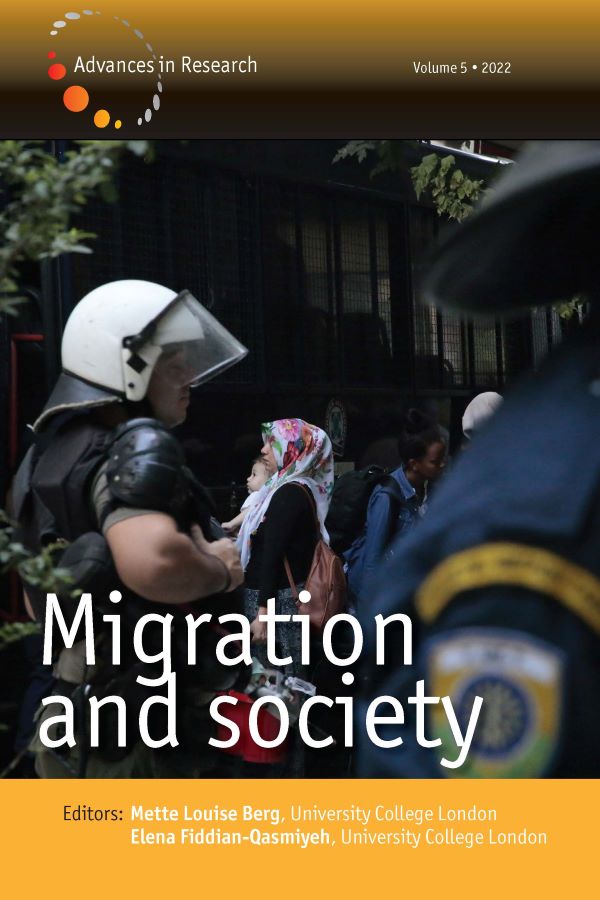
- Vol 5 Issue 1
- Vol 4 Issue 1
- Vol 3 Issue 1
- Vol 2 Issue 1
- Vol 1 Issue 1
Migration and Society
Advances in Research
ISSN: 2574-1306 (print) • ISSN: 2574-1314 (online) • 1 issues per year
Volume 8 Issue 1
Editorial
Vocalizations in the Midst
In a recent speech at a London rally that took place on a warm May Saturday, the director of Makan and chair of British Palestinian Committee, Aimee Shalan, spoke about the “monumental limits of language in this moment”.
Introducing the Anti-Refugee Machine
In their introduction to the special issue, the authors develop the Anti- Refugee Machine (ARM) framework and metaphor to illustrate how interventions intended to address forced migration often reinforce existing power structures. Beginning with an ethnographic case study on Eritrea, the authors draw on Ferguson's
Incubating Futures
Temporal Violence, Durable Solutions, and the Anti-Refugee Machine
Incarnations of humanitarian-development policies linking refugee productivity and self-reliance in the Global South have circulated in the international aid sector for decades, but have reemerged in response to concerns about the refugee “crisis” in the Global North. Proponents have referred to these approaches as “incubation.” Focusing on Jordan, Lebanon, Ethiopia, and Djibouti, we juxtapose the success story told about incubation with the failure of these programs to secure rights and protections. We utilize a temporal analysis to raise questions about whose ends are ultimately achieved through these policies and argue that incubation fails at its stated objectives but succeeds as part of the Anti-Refugee Machine.
Risk, Improvisation, and Emergency Governance on the Mediterranean Sea
While Somali migrants see migration as a response to the deteriorating situation in their country of origin, the European Union (EU) governs irregular migration as an emergency and as a root cause of insecurity. Based on fieldwork among European journalists and staff working with private search and rescue operations, this article explores the human consequences of the Anti-Refugee Machine (ARM) resulting from the emergency discourse of migration governance. The ARM consists of the various ideological and material emergency measures implemented to stem irregular migration, and includes agendas and policies that ignore and obscure the historical context and human aspect of migration. This article explores the different understandings and experiences of irregular migration and contextualizes the fatal encounters between authorities and migrants in Libya and the Mediterranean.
“Integration is a Gift from God”
Blackness, Externalization, and the Figure of the Refugee
Focusing on the case of Italy and border externalization mechanisms in the Horn of Africa, this article argues that refugeehood has become interpellated with Blackness in the Mediterranean world and beyond. Departing from integration discourse and bringing together the Black Mediterranean and Anti-Refugee Machine frameworks, I demonstrate how the move to elide the refugee category with Blackness has attenuated violence, disenfranchisement, and mechanisms of preemptive detention against Black Africans and other racially marked groups. Moreover, externalization policies have fundamentally altered broader institutional policies, making meaningful integration almost impossible to achieve in either the Global North or South. Refugee integration is a “gift from God” insofar as it maintains the categorical exceptionalism that constitutes the category.
Deadly Seascapes
Navigating the Anti-Refugee Machine in the Central Mediterranean
In this article, I bring together the Autonomy of Migration (AOM) approach with the Anti-Refugee Machine (ARM) framework to examine the lived experience of migrants rescued in the Central Mediterranean and disembarked in Lampedusa, an Italian island between Tunisia and Sicily. I contend that the Mediterranean Sea is transformed into a deadly weapon through restrictive immigration policies, militarized policing, and enforcement measures to manage migrant mobilities. However, in this context—where migrants risk death to continue life—I also argue that migrant journeys cannot simply be read through a politics of death. Migrants navigate and challenge their exclusion by activating and utilizing the complex rescue and reception apparatus managed by Italy and the EU, and sometimes effectively steer the ARM for their own benefit.
Not a Semester Hero
Dumped Returnees in The Gambia
Deportation and “voluntary return” are controversial issues in the European Union (EU) and The Gambia. Based on ethnographic analysis of the social realities of Gambians “voluntarily” returned from EU member states, this article emphasizes returnees’ emic understanding of return as the production of “human trash.” Following their administrative sorting and their subsequent return, Gambian migrants experience stigmatization and exclusion in The Gambia while also trying to hide their “failure” as irregular migrants. The claim of “reintegration,” according to the EU's perspective, presumes that Gambians are “economic migrants” (i.e., non-refugees). Nevertheless, they are “cared for” through “humanitarian assistance.” Through these mechanisms, the Anti-Refugee Machine makes productive use of those it spat out.
Restricted access: The Reflexive Subaltern History of Central America–US Informal Migration
Contemporary discourse on the part of the US State Department and immigration authorities represents informal migration from Central America as a transgression of dubious and potentially criminal subjects who assail the United States. Such a representation relies on a memory that draws a purposeful blind eye to the history of colonial extraction and post-colonial “development” that has marginalized and brutalized Central America's indigenous populations and working poor, as well as US involvement in sustaining and enhancing the root causes of informal migration. This article asks how we can narrate the history of informal migration's root causes in Central America, and how such a narrative illuminates the operations of the Anti-Refugee Machine in this part of the world.
“That Machine Does Not Want Us”
CBP One™ and Migrant Im/mobility in the Extended Mexico-US Borderlands
This article demonstrates how the implementation of punitive asylum policies and digital technologies such as the CBP One™ Mobile Application have affected the experiences of waiting and violence for asylum-seeking migrants along the extended Mexico–US borderlands. It situates CBP One™ within the “Anti-Refugee Machine” by theorizing the production of automated border inspections and digital migration deterrence. These external bordering tactics differentially immobilize migrant bodies while their identities flow unfettered across the same borders and data infrastructures facilitate their subsequent in/exclusion. During ethnographic fieldwork, however, migrants hacked CBP One™ through techno-disobedience and critiqued the imposition of border technologies.
“!” Overdocumentation and the Anti-Refugee Machine in Russia
This article examines policing and “overdocumentation” in the everyday life of migrants in Russia and within Russian post-Soviet migration regimes. Overdocumentation produces precarity for migrants, while allowing police and authorities who work within the Foucauldian apparatus to capitalize on migrant precarity. Foucauldian apparatus or machines as in Anti-Refugee Machine (ARM) in this special issue, encompasses a multitude of both state and non-state actors, diverse discourses and ideologies, methodologies and principles influenced by Soviet-style control regimes, as well as institutions, concepts, and ideas. The production of vulnerability and dehumanization through the policing of internal and international migrants, stateless people, non-citizens, and citizens without
The Scales of Translocal Solidarity
Accompaniment, Mutuality, and Flourishing, Here and There
This article discusses migrant solidarity projects across the Mexico–US border, considering community organizations and shelters that practice forms of accompaniment, mutuality, and flourishing that seek to transform structural conditions across different struggles that implicate both migrants and the communities that they join. Through interviews, participant observation, and a research practice informed by principles of solidarity and mutual aid learned in the process, this article examines the translocal scales that connect these strategies and principles across three different sites in the two countries: La 72 migrant home-shelter in Tenosique, Tabasco; La Morada mutual aid in The Bronx, New York; and Otros Dreams en Acción (ODA) in Mexico City. How and where is transformative solidarity put in practice within and across these local sites? Through the perspectives of activists and organizers within these spaces, the article examines different everyday practices through which they challenge the border regime and prefigure alternative ways of living.
Disciplining Asylum Seekers through Infrastructure
Everyday-Power Effects Of Enforced Paralysation and Activation in Switzerland
Based on ethnographic research, this article offers a study of how asylum seekers are governed throughout their stay in asylum camps in Switzerland. It uses street-level narratives to first answer the question of how they are disciplined and why, revealing categories of exclusion, embedded in discriminatory structures. Second, it shows how the highly paradoxical regime of asylum reception has created an architecture of mundane, but no less global and significant violence. Deeply embedded in and facilitated by the material and spatio-temporal infrastructure of arrival, it regulates, orders, controls, disciplines, and seeks to educate individuals “in waiting”, placed in a state of forced paralysis of indeterminate duration, while setting high neoliberal expectations for productivity and integration. Finally, it traces the street-level workers’ perception of the migrant to notice potential changes throughout the procedure. This reveals how social categories are created and structural inequalities reflected in the biopolitical regulation applied.
“I Want You to Tell Me about Yourself.” Epistemic Simplification in Asylum Decision-Making in Finland
The article examines epistemic simplification in asylum decision-making. By drawing on literature on epistemic violence and injustice, and on cultural misunderstandings in asylum decision-making, the article provides novel insights by focusing on how the cultural notions of family and violence, as well as intersectionality, travel between asylum documents. The article analyzes absence and abstraction of social events as well as exclusion and generality of social actors in asylum interview records and negative decisions made by the Finnish Immigration Service in the years 2016–2017. Through examining how epistemic simplifications are produced, the article shows how cultural misunderstandings do not simply happen but are produced as part of asylum decision-making, and how epistemic violence and injustice are therefore ingrained in different kinds of asylum cases.
Soft Infrastructures
Mediating Labor Mobilities Across and Between Secondary Cities in West Africa
How are mobilities mediated in contexts where the movement of people has a long and central history, and how do we account for their gendered, generational, and classed differentiation? Through the concept of soft infrastructures, we suggest that the facilitation of regional labor mobilities in West Africa rely to a considerable extent not only on personal social networks, but on broadly shared cultural notions of friendship, solidarity, and occupational specialization. We further emphasize the centrality of smaller urban centers as nodes in regional mobility regimes, and offer empirical illustrations of the ways in which migrants make use of, and are restricted by, the sociocultural mediation of mobilities.
Caring Masculinities Among Refugee Men
During and After Migration Along the Central Mediterranean Route
The complex intersection of displacement, insecurity, family relations, and gender is a growing field of study. Currently missing is a thorough exploration of single refugee men's conceptualization of their family relationships and the underlying dynamics of masculinity. Based on three in-depth interviews with single men who traveled the Central Mediterranean Route, this article explores how the men discuss their relations with their transnational family during and after their journeys. While initially their journeys were structured by the two themes of worry and safety, after arrival, the four themes of longing and belonging, protection, respect, and money emerged. Furthermore, the article asks how notions of care offer explanatory power for masculinity in this interpretive analysis.
Mobilizing the Suffering of the Body
Live-In Migrant Domestic Workers in Spain During the Covid Lockdown
Live-in care work has been historically an exploitative labour niche for migrant women in Spain. Drawing on interviews with domestic care workers in Spain during 2020, we document how the Covid crisis exacerbated existing patterns of labour extraction. The home lockdown amplified time, space and task fuzziness that characterize live-in care work. These workers’ bodies buffered the negative impacts of the crisis at a cost to their own wellbeing. We use a relational understanding of the body, as mindbody, that brings together physical and psycho-emotional experiences, dispositions, availabilities and skills to show how the embodied experiences of live-in domestic workers during lockdown relate to a labor extraction pattern that seeks to enhance the production of domestic workers’ availability. This accumulation strategy stems from a somatic hierarchization that classifies bodies according to class, gender and origin. Domestic migrant women also mobilized the suffering of their bodies to demand less exploitative labor conditions.
Transversal Community-Building
Fostering Women's Collaboration and Solidarity Across Differences in Cyprus
This article addresses the transversal dimensions of community-building in the European migration context that are responses to refugees’ inadequate access to rights and resources. The main argument is that women-led community-building underlines how women refugees and women volunteers supporting refugees engage their agency to foster dialogue, collaboration, and solidarity across power imbalances and social differences. We refer to these processes as “transversal community-building.” The article analyzes two empirical examples of this form of community-building in Paphos, Cyprus: Learning Refuge and Women's Arabic Culture Club. It emphasizes how women refugees and volunteers enact solidarity across different legal statuses and different class, ethnic, and national backgrounds and within and beyond the boundaries of civil society organizations. The article contributes to the conceptual understanding of the term community-building from the lens of transversalism and offers an empirically grounded view of the making of transversal community-building in the migration context of Paphos, Cyprus.
Book Reviews
Developing a Critical Pedagogy of Migration Studies: Ethics, Politics and Practice in the Classroom. Teresa Piacentini. 2024. Bristol: Bristol University Press. 194 pages. ISBN 9781529227130 (hardback).
The Common Camp: Architecture of Power and Resistance in Israel–Palestine. Irit Katz. 2022. Minneapolis: University of Minnesota Press. 376 pages. ISBN 9781452960807 (ebook).
Refugee Governance, State and Politics in the Middle East. Zeynep Şahin Mencütek. 2019. Routledge. 296 pages. ISBN 9781351170369 (ebook).
Latin America and Refugee Protection: Regimes, Logics, and Challenges. Edited by Liliana Lyra Jubilut, Marcia Vera Espinoza, and Gabriela Mezzanotti. 2021. Volume 41 in the Forced Migration series. Berghahn Books. 434 pages. ISBN 9781800731141 (hardback); ISBN 9781805393191 (paperback).
Editorial
Global and Intersecting Solidarities
As witnesses to the ongoing genocidal assault on Palestinians in Gaza and further afield, we will not start this editorial with the horrifying, ever-increasing statistics,1 but instead with the words of two Palestinian writers. In November 2023, Nour al-Din Hajjaj, a 27-year-old Palestinian writer from Gaza, author of two novels and one play, wrote:
A Manifesto for Bread and Roses
In the midst of the mass displacement, dispossession and systematic killing of Palestinians in Gaza, this manifesto for “bread and roses” centralizes not only the rights of Palestinians in Gaza to life, safety, and security but also displaced people's rights to joy, beauty, and happiness. At a time when Palestinians in Gaza are being massacred and openly deprived of aid, it is, precisely, Palestinians’ commitment to joy and beauty being projected and practiced by displaced and dispossessed Palestinians in Gaza, which provides the impetus for this manifesto. Created around and centering the words and lifeworlds of Palestinians in Gaza, this piece is offered as an inevitably partial but needed archive of this more-than-massacre and as an archive that stands for the future. Starting with roses pushes us to reimagine what meaningful responses to displacement could, and should, entail.
Editorial Introduction: Neoliberal Temporalities and Expertise in Migration Governance
This Special Section addresses the political effects of the increasing confluence between humanitarian, securitizing, and neoliberal logics in contemporary migration governance through the themes of temporality and expertise. Urgent temporalities and global expertise work to control migrant mobilities and amplify neoliberal values of efficiency, productivity, and universality while marginalizing alternative and local knowledges. Five interdisciplinary articles focus on the role humanitarian organizations play in migration governance at multiple scales, in different global contexts and through a range of methods. The contributors highlight the entanglement of state and non-state actors in humanitarian settings, and consider how they may perpetuate and/or challenge neoliberal bordering regimes. United by an intersectional feminist approach, a key aim is to interrogate power relations and to explore hopeful avenues for political resistance.
Island Detention and Seeking Asylum in the Asia-Pacific
The Entanglement of Humanitarianism in State Practices of “Grey Sovereignty”
Drawing on Bhasan Char and Manus Island as case studies, this article makes an argument for the concept of “grey sovereignty,” which is understood as the suspension and/or manipulation of established state norms and obligations in order to contain and punish irregular migrants. The operationalization of grey sovereignty is discussed through three paradigms that can help to understand its purpose and practice: As sites of sovereign decline, violence and trauma, and erasure. I argue that the practice of grey sovereignty is enabled by the entanglement of the humanitarian apparatus and/or discourses in these practices of the state. Further, such practices use dubious means to “shrink asylum” (through temporality, precarity, power inequities) and undermine the ideals of both sovereignty and humanitarianism.
Mediating Mundane Life
Military-Humanitarian Temporalities as Mechanisms of Migration Governance in Brazil
The recent and ongoing exodus of Venezuelans to the surrounding Latin American region has sparked international humanitarian intervention. Drawing on research conducted in Brazil in late 2019, this article focuses on the state-led humanitarian response to Venezuelan migration and its collaborative efforts with the military and leading organizations. Looking at two sites of institutional care, I argue that temporal structures created by military-humanitarian agencies work to govern the everyday mobilities of urban migrants living without shelter, who are often framed as criminals or threats within neoliberal securitization narratives. This article further reveals conflicting temporalities with regard to the practice of waiting, whereby the act is viewed as risky when visible in urban public spaces but favored in institutional settings where it can be closely monitored.
Refugee Registration Schemes in Malaysia
Governing Refugees by Maintaining the Status Quo and Reinforcing Borders
Despite hosting hundreds of thousands of refugees, Malaysia does not legally recognize them. Instead, the United Nations High Commissioner for Refugees (UNHCR) conducts the refugee status determination process, and Malaysia expects them to take care of refugees, although community-based and nongovernmental organizations do most of this work. The Malaysian government, concerned by the increasing number of foreigners registered by the UNHCR, introduced the Tracking Refugee Information System scheme to form a national database for “security reasons.” Contracted to a private company, this yearly registration scheme with high fees provides no rights to cardholders. This article highlights the role of the Malaysian government, the UNHCR, community organizations, and a private company to make sense of the variable refugee registration regimes that increasingly use technological tools to collect refugee biodata to police refugees without increasing refugee protection.
Apolitical Humanitarianism?
Neoliberal Governance and Bordering in a Transnational Interfaith Organization
In humanitarian organizations, neoliberal mechanisms of power exist in tension with the humanitarian desire to do good. Drawing upon digital ethnographic fieldwork, I explore how PeaceUnite, an international interfaith organization, navigates the challenges, obstacles, and contradictions posed by neoliberal entanglements. PeaceUnite navigates geopolitical and humanitarian borders through transnational peacebuilding efforts, and their responsibilization discourses emphasize local expertise while undermining local agency through their auditing and managerial frameworks of centralizing power. Despite the deeply political environment in which they work, PeaceUnite claims to be apolitical, a stance that conceals internal and external contradictions. I argue that these neoliberal discourses create an environment where state power is strengthened, and national borders reinforced, restricting PeaceUnite's organizational mission and reducing their impact.
Civil Society Silos
Racialized Neoliberal Logics and Subversive Expertise in the Movement against Australia's Operation Sovereign Borders
Operation Sovereign Borders imposes protracted precarity on people seeking asylum stuck in Australia on restrictive visas. Civil society actors form a movement offering them crucial support, filling a vacuum amplified by neoliberalized welfare. Drawing on fieldwork in Naarm (Melbourne), I provide an intersectional and ethnographic exploration of power dynamics within movements by examining the creation of “civil society silos” based on diverging claims to expertise. I identify and critically analyze five forms of movement expertise—professional, lived, societal, relational, and Indigenous—alongside my own production of research expertise. These forms encompass both an encroachment of racialized neoliberal logics into movement spaces and a channel to subvert bordering regimes. The findings in this article contribute to scholarship on the political potential of civil society movements in neoliberalized migration settings, and to widening definitions of expertise to include marginalized knowledges.
Editorial Introduction: Colonialism, Postcoloniality, and the Study of Forced Migration
This Special Section explores the continuities, ruptures, genealogies, and contingent parallels that can be traced between twenty-first-century forms of subjectification, governance, and control within the management of mobilities, and older, imperial politics on slavery and colonialism. Drawing on postcolonial and decolonial approaches that emphasize the continuity of colonial thinking embedded within current systems of power, it critically examines the impact of colonial empires on migration control in the present day, as manifested by a variety of state and non-state actors across diverse temporal and geographic contexts. In doing so, it pays careful attention to the lived experiences and resistance practices of those subjected to colonial power matrixes past and present, and to strategies of countering researcher complicity in knowledge extractivism.
Model Settlers, Model Laborers, and the Limits of the Anti-Slavery Colonial Imagination
Reflections on British Management of the First Africans Rescued from the Atlantic Slave Trade in the Post-1807 Caribbean
After the passage of the British law abolishing the slave trade in 1807, Great Britain devoted 60 years to attempting to suppress slave trading from the African continent. One major consequence of this campaign against the slave trade was the rescue of over 500,000 Africans from illegally operating slave ships. During the first two decades after 1807, Great Britain brought approximately five thousand such Africans into British Caribbean colonies. This article explores the earliest British policies related to this population, in conversation with more recent discussions of refugee management, and the impact of European colonial histories on professedly humanitarian projects.
(De)coloniality of “Tethered Mobilities” in Freetown, Sierra Leone and Nyarugusu Refugee Camp, Tanzania
Drawing from historical case studies from Sierra Leone and Tanzania, this article fundamentally asks, what constitutes decoloniality? Before answering, we analyze the enduring coloniality of national borders, internal boundaries and identities, and manipulation and coercive imposition of (im)mobility. These colonial logics create “tethered mobilities” moving internal and external migrants in and out of approved spaces to facilitate extraction and racialized categorizations. We explore the impact of these aspects of coloniality on rural-urban migration and law in Sierra Leone and forced migration and containment of citizens and refugees in Tanzania. Conversing with critical migration and abolition literatures, we argue that despite no explicit revolutionary intent, migrants create their own tethered mobilities through everyday life-making in prohibited spaces as “rehearsal” for decolonial futures and mobility justice.
The Gendered Necropolitics of Migration Control in a French Postcolonial Periphery
This article examines the postcolonial politics of migration control in Mayotte, an overseas French department, and argues that these bear necropolitical consequences. It sheds light on the gendered dimension of this necropolitical power by focusing on the life and border-crossing experiences of undocumented Comorian women. Entrenched barriers to the regularization of their administrative status endanger their access to healthcare and degrade the conditions for life long-term. The constant risk of arrest and massive forced removals furthermore engender dangerous border crossings, each instance exposing the passengers to the risk of death. The article also foregrounds that these necropolitics are exacerbated as a result of the postcolonial conundrum in which Mahoran elites find themselves, with the increasing support of Black and Muslim elites for the French far-right political party.
Linking Land and Sea
Intersections between Indigenous Peoples’ Dispossession and Asylum Seekers’ Containment by Australia
Australia's harsh policy response to asylum seekers appears to be an extreme measure for a country that thinks of itself as a liberal democracy. Confining analyses of this regime to refugee law and policy overlooks the ways that Australia's colonial history, Indigenous dispossession, and contemporary race relations interact with one another. This article argues that these historical dynamics are essential to understanding the Australian government's response to asylum seekers in the present day, with asylum-seekers and Indigenous peoples in Australia both being utilized as tools of modern statecraft to shore up the legitimacy of the Australian state. Attention is drawn to parallels between the treatment of both Indigenous peoples and asylum seekers by the Australian government, with the increasingly harsh response to asylum seekers in Australian politics coinciding with the expansion of land rights for Indigenous Australians.
“The Story's in the Telling”
Using Narrative Genre as a Lens to Explore the Well-Being and Life Projects of Unaccompanied Young Migrants and Refugees
This article develops the narratological approach to well-being research through the novel use of literary theory. It is the first article to explore the role of narrative genre in how unaccompanied refugee and migrant youth expressed their life projects and experiences of confronting the challenges and opportunities of the migration and asylum regime. It argues that narrative is important to understanding their life projects and well-being needs, as well as to how they understand themselves in relation to society and how likely they are to interact (or not) with support structures. Five main narrative genres are discussed that were encountered in mixed-methods ethnographic fieldwork with over 100 individuals in England and Italy: (1) tragedy, (2) comedy, (3) epic, (4) confession, and (5) fantasy. The article interrogates the value of “truth” in these narratives and concludes that storytelling is fundamentally linked to the sense of ontological security, which is vital to the youths’ subjective well-being.
Rescaling Food Insecurity
On Eating and Feeding in Migrant Shelters
Food provisioning represents a major everyday challenge for migrant shelter administrators, workers, and volunteers, yet very little is known about the specific conditions and challenges faced by these spaces. While there is a small body of scholarly work about food in shelters from the perspective of people on the move, most of this literature is based on state-run shelters in the Global North, and there is little understanding of the challenges and conditions faced by non-state shelters in general, and by shelters in the Global South in particular. This article represents an opening for exploring these issues. Drawing on a day-long workshop conducted between a team of researchers and representatives of five migrant shelters in the Mexico City metropolitan area, the article discusses the theoretical and practical stakes of ensuring food security for migrant populations and suggests that we rescale food security to address these spaces and their struggles.
Foreclosure, Disclosure, and Political Engagement
A Collaborative Reflection on Scholar-Activism in the Neoliberal University
Considering the increased institutionalization of scholar-activist research across many university contexts, this reflection critically engages the assumed harmony between scholarship and activism in migration research. Collaboratively authored by eight academics at various disciplinary, geographic, gendered/racialized, and career-level junctures, the article examines the commitments, aspirations, anxieties, and contradictions of activist scholarship. The reflection elaborates on concepts such as accompaniment, reciprocity, foreclosure, disclosure, and impact, putting a finer point on what responsible, ethical, and political research means in the neoliberal university today. The discussion develops insights from a 2023 workshop, convened by Noor Amr and Katharyne Mitchell, at the Max Planck Institute for the Study of Religious and Ethnic Diversity in Göttingen, Germany.
Interview with Jonathan Darling, author of (2022)
This conversation between Jonathan Darling and Sarah M. Hughes focuses on Darling's recently published book
Persistence on Living, Resistance for the Living
It is through writing that times and spaces are made, ones that stand tall in the face of this world's incessant catastrophes. In this issue's Creative Encounters section, “The Radiator” by Ngoi Hui Chien tenderly questions both difference around us and us as difference, and how subjectivities that are arguably concerned with the homely can also be entry points to strangerhood in new settings. In the following collaborative work, Hanno Brankamp and Kodi Arnu Ngutulu view poetry from the optics of knowledge production whereby writing transcends writing-as-an- expression-of-suffering, instead offering the reader varied poetic voices from Kakuma refugee camp in Kenya, including Joh Magok Kuerang (“Unrelenting Pursuit”), Chol Reech (“Planted Thorns”), Atem D. Alaak (“Away from Home”), Mary Aluel (“Empty Pockets”), and Mamer Amou (“Escaping My Identity”). Articulating a diversity of human conditions, spanning containment, fleeing, belonging, and strandedness, the poems’ intricate imaginings not only express such conditions but also reinscribe them as individual journeys that are worthy of narration.
The Radiator
As a Chinese born and raised in tropical Malaysia, I had never seen a radiator before studying in the United Kingdom. Therefore, when I first arrived in the UK in the autumn, I embarrassingly mistook the panel radiator in my room for the place to hang my towel. To capture the experience, I wrote my poem in the shape of a panel radiator, a rectangle with two stands on the sides. Written vertically from right to left, the poem's form resembles the ancient Chinese texts. I chose this form because the UK's autumn reminded me of literary works from China about autumn. Both locales are “the North” for me: while the UK is in the Global North, China is in the North for Malaysians.
Poetry On the Run
Poetry On the Run is an ongoing collaborative project that seeks to traverse the confines of research on displacement through poetic encounters, renderings, imaginations, and experimentation. This contribution is based on a creative writing workshop with young poets in Kakuma refugee camp in northwestern Kenya. The workshop explored how the concept of “fugitivity” may resonate with more contemporary experiences of forced migration, while also furthering the use of poetry as a literary research method and source of theoretical knowledge in the study of refugeehood today. This lyrical (re)searching is framed as part of what we refer to as the “geopoetics of migration.”
A Welcome from the New Book Reviews Editors
We have recently taken over as Book Reviews editors for Migration and Society and wanted to use this opportunity to introduce ourselves, as well as the rich selection of books reviewed in this current issue. As the co-editors of this section, we will prioritize book reviews that are critical in their approach and aligned with the ethos of the journal. We seek to represent diversity in our field and encourage readers, publishers, and authors to share with us books that straddle multiple disciplines, epistemologies, and methodological approaches that can provide our readers with a range of critical perspectives to understand migration and the societies we live in.
Book Reviews
Domicide: Architecture, War and Destruction of Home in Syria. Ammar Azzouz. 2023. London: Bloomsbury Visual Arts. 176 pages. ISBN 9781350248106 (hardback); ISBN 9781350248113 (ebook).
Tahriib – Journeys into the Unknown. An Ethnography of Uncertainty in Migration. Anja Simonsen. 2023. Cham: Palgrave Macmillan. 228 pages. ISSN 2662-2602
Border Nation: A Story of Migration. Leah Cowan, 2021. London: Pluto Press. 167 pages. ISBN 9780745341071 paperback, ISBN 9781786807038 (ebook)
The Refugee System: A Sociological Approach. Rawan Arar and David Scott FitzGerald. 2023. Cambridge: Polity Press. 316 pages. ISBN 9781509542796
Continental Encampment: Genealogies of Humanitarian Containment in the Middle East and Europe. Are John Knudsen and Kjersti G. Berg, eds.2023. Berghahn Books. 332 pages. ISBN 9781800738454 (ebook)
We Thought It Would Be Heaven: Refugees in an Unequal America. Blair Sackett and Annette Lareau. 2023. Berkeley: University of California Press. 291 pages. ISBN 9780520976504
Editorial
In, and For, Hope and Solidarity
We write this editorial in mid-February 2023 as the first anniversary of Russia's invasion of Ukraine fast approaches. The war has so far led to over eight million people fleeing Ukraine to seek refuge across neighboring countries,1 an unprecedented situation in Europe since the end of WWII. While the hospitality and solidarity extended to Ukrainian refugees was widely commended from the onset, commentators, including the UN Special Rapporteur on contemporary forms of racism, Tendayi Achiume, have widely denounced and critiqued the racist and orientalist double standards and “racial tiering” inherent in popular and political responses to displacement from Ukraine (OHCHR 2022; Bayoumi 2022; Jackson Sow 2022; Ray 2022). Ukrainian refugees were welcomed with open borders and “open arms” while racialized third nationals fleeing from the same conflict, including 76,000 students from diverse African countries studying in Ukraine, were forcibly prevented from crossing the same borders, as an extension of institutionalized discriminatory policies which continue to frame migrants and refugees from Africa and the Middle East through the lens of hostility and suspicion (Zaru 2022; Banerjee 2023). Indeed, while Ukrainians have been welcomed across Europe, often explicitly because they have been racialized as white and Christian, people fleeing other conflicts, including wars in which European governments have played an active part, notably Afghanistan, have been met with soldiers and push-backs, in violation of international and regional rights frameworks, including the European Convention on Human Rights, in some cases at the very same borders, notably those of Poland, Latvia, and Lithuania (see
Introduction
Transnational Street Business: Migrants in the Informal Urban Economy
This special issue sheds light on transnational migrants’ engagement with informal urban economies worldwide. Building on anthropological literature on migration and economy, it proposes “transnational street business” as a new concept for grasping transnational dynamics in the informal urban economy. Through ethnographic case studies from different regions, the special issue illuminates how the concept of “transnational street business” serves to analytically capture the urban street's multitude of economically entangled and interdependent transnational social alliances, hierarchies, friendships, and networks. The concept encompasses the materiality of the street and the goods that are exchanged and transacted in trade relations. It also highlights the skills for competition that are needed for orientation in legal and political landscapes that cut across the formal and informal divides that migrants are faced with when setting out to create a livelihood abroad.
The “Transnational Business of Death” Among Somali Migrants in the Streets of Athens
Migrants risk their lives when venturing out on hazardous journeys to escape unbearable situations in their countries of origin. Some, unfortunately, lose their lives en route. When such tragedies happen, a border-crossing social network of brokers, fellow travelers, family members, and friends of the deceased engage in a “transnational business of death” involving exchanges of money, things, information, and rumors. Based on ethnographic fieldwork among Somali women and men from 2013 to 2016, this article explores how the death of one Somali woman was dealt with on a particular street in Athens, Greece. The article argues that an informal economy arises as a reaction to the lack of legal, formal support from the Greek nation-state when it comes to dealing with the deaths of loved ones among undocumented migrants.
Channeled into a Transnational Street Vending Hub
Senegalese Street Hawkers in Buenos Aires
Building on ethnographic fieldwork in Buenos Aires, this article explores the social infrastructure created by Senegalese migrants, which channels newcomers into the cities’ prolific economy of street vending. The article focuses on the often invisible social infrastructure that emerges when people either do not have access to, or are excluded from, formal infrastructures created by the state, city governments, or NGOs. The article highlights how established migrants shape newly arrived migrants’ navigation and access to opportunities in the city to help reproduce life along a migration trajectory that fulfils social expectations in Senegal. However, this process also involves friction and new social alliances, especially when certain roles and expectations become contested.
Making Life Liveable in an Informal Market
Infrastructures of Friendship amongst Migrant Street Traders in Durban, South Africa
African migrants working in street trading business in Durban, South Africa often face xenophobia and must navigate policies regulating the informal economy. However, they sustain livelihoods in urban markets through building friendships while maintaining transnational connections back home. Based on qualitative research conducted in 2019 and 2021 with thirty street traders from Senegal, The Gambia, Nigeria, and Malawi at the Workshop Flea Market in Durban, the article interrogates the way in which friendship and conviviality emerge in informal market spaces. Building on AbdouMaliq Simone's concept of “people as infrastructure,” we show how migrant street traders in the Workshop Market invest in the urban collective, while locally and transnationally connected through economic and affective exchanges.
Reading Desires
Romanian Pimps Striving for Success in the Transnational Street Economy
Based on fieldwork among pimps and sex workers in Eastern Romania, this article explores the personal skills that pimps deem necessary in order to be successful in the transnational street business of pimping in other EU countries. The article introduces the concepts of “reading desires” and “instillation of love,” which enable the pimps to “access” the desires of others. Through these concepts, I argue that the pimps have increased social capacities in distinct social arenas. These skills are not necessarily useful in other arenas of their lives, but in their preparation for entering the transnational street economy abroad, these skills are crucial.
Enacting “Bottom-up” Solidarity in Labor Market Integration for Refugees in England
This article examines the role that third sector organizations (TSOs) play in supporting refugees’ access to the labor market in England. TSO practices are conceptualized through the notion of “bottom-up” solidarity. Data gathered through interviews with refugees and representatives from charities, social enterprises, and public authorities are used to identify how TSO actors enact bottom-up solidarity and, in turn, facilitate integration of refugees into the labor market. The findings show how labor market transition is built on the transformation of the wider circumstances faced by refugees. Data also demonstrates how the creation of direct employment opportunities, coupled with intermediation and trust brokerage, and alongside episodic and extended coaching, is key to enacting “bottom-up” solidarity.
“OutLaw Yard”
Reading Traces of Displacement as Testimonial Inscription
Media coverage of migrant and refugee camps often concerns not everyday life in camps, but violence or a camp's outright destruction. These portrayals risk inscribing camps into public memory as sites of danger and criminality, or of vulnerability without agency. What methods of engaging with a camp's aftermath and its representation might enable more complex understandings of the reality of life in camps? We engage the camp as a site of inscription to reconsider the role of objects, structures, and writing left behind when a camp is destroyed or evacuated. Our proposed methodology of reading traces recognizes these objects and representations as testimonial inscriptions that counter erasure and that record frictions of (in)visibility and space, attesting to the camp as a site not of abjection, but of negotiation.
Migrant Visibility, Agency, and Identity Work in Hospitality Enterprises
This article examines how migrants create value through food- and hospitality-related enterprises, focusing on the ways in which they exercise their agency in mobilizing various cultural resources and on how their organizational practices intersect with identity work. Drawing on empirical research conducted in São Paulo, Brazil, it explores how specific dishes, knowledge of food, recipes, craft skills, and migration histories are transformed into valued cultural resources in these kinds of enterprises. The article explores three themes: first, how foods become “pliable heritage” through migrants’ identity work; second, how migrants’ ongoing identity work shapes their activities and experiences in food and hospitality businesses; and third, how migrants’ individual identity work is entangled in collective interests and the activities of a wider set of (migrant) stakeholders.
Immobile subjectivities
Navigating (Im)mobility in Migrants’ Career and Life Journeys
This article puts forward the concept of
Using Photovoice to Explore Migrant Women's Sociospatial Engagement in Diverse Local Urban Areas of Santiago, Chile
Framed in a project on conviviality and migration-led diversity in Santiago, Chile, this article presents visual narratives of neighborhood participation. Accounts of migrants’ public lives have turned to underlining mundane forms of conviviality and place-making. This visual essay shows how such dynamics can comprise a fertile terrain for public engagement in contexts of “crisis.” The account is based on a photovoice exercise developed by three long-established migrant women of different occupations, age, and nationalities during the COVID-19 pandemic, a crisis that shaped the personal/public interface of their lives. I propose that photovoice, by endowing agency and producing situated knowledge, can illuminate migrants’ local engagement, making visible (creatively, descriptively, and symbolically) the connection between the personal and the public while counteracting dominant problem-based representations of migrants.
Global Social Inequalities and the Coloniality of Citizenship, Past and Present
A Conversation Between Manuela Boatcă and Michaela Benson
This conversation between Michaela Benson and Manuela Boatcă focuses on the coloniality of citizenship. Where dominant understandings of citizenship link this to the emergence of the nation and its national political community, this conversation considers what we can learn about present-day global social inequalities from examining the development of citizenship through a close consideration of Manuela's work on this topic. It takes as its starting point those excluded from the rights of political membership through the development of national communities, to make visible how citizenship and the alleged equality achieved through citizenship rights were acquired at the expense of gendered and racialized “Others.” As the conversation unfolds, the enduring colonial entanglements in the present-day global migration and citizenship regime—the coloniality of citizenship—are revealed, and alongside these, new insights into the citizenship and border struggles within and between nation states.
Writing as Living On
This selection features five poems from Jessica Mookherjee's latest collection,
Book Reviews
BECOMING MIDDLE CLASS: Young People's Migration between Urban Centers in Ethiopia Markus Roos Breines. 2022. Singapore: Palgrave Macmillan. 213 pages. ISBN: 978-981-16-3536-6 (hardback); ISBN: 978-981-16-3539-7 (paperback).
HYBRID POLITICAL ORDER AND THE POLITICS OF UNCERTAINTY: Refugee Governance in Lebanon Nora Stel. 2020. London: Routledge. 264 pages. ISBN 9781138352544 (hardback); ISBN 9780367518615 (paperback).
DEVELOPMENT, (DUAL) CITIZENSHIP AND ITS DISCONTENTS IN AFRICA: The Political Economy of Belonging to Liberia Robtel Neajai Pailey. 2021. Cambridge: Cambridge University Press. 276 pages. ISBN 9781108836548 (hardback); ISBN 9781108873871 (online).
MATERIAL CULTURE AND (FORCED) MIGRATION: Materializing the Transient Friedemann Yi-Neumann, Andrea Lauser, Antonie Fuhse, and Peter J. Bräunlein, eds. 2022. London: UCL Press. 367 pages. ISBN 9781800081628 (hardback); ISBN 9781800081611 (paperback).
POSTCOLONIALITY AND FORCED MIGRATION: Mobility, Control, Agency Martin Lemberg-Pedersen, Sharla M. Fett, Lucy Mayblin, Nina Sahraoui, and Eva Magdalena Stambøl, eds. 2022. Bristol, UK: Bristol University Press. 246 pages. ISBN 978-1529218190 (hardback).
THE PRECARIOUS LIVES OF SYRIANS: Migration, Citizenship, and Temporary Protection in Turkey Feyzi Baban, Suzan Ilcan, Kim Rygiel. 2021. Montreal: McGill–Queen's University Press. 296 pages. ISBN 9780228008033 (hardback); ISBN 9780228008040 (paperback)
THE MIGRANT'S PARADOX: Street Livelihoods and Marginal Citizenship in Britain Suzanne M. Hall. 2021. Minneapolis, MN: University of Minnesota Press. 232 pages. ISBN 9781517910495 (hardback); ISBN 9781517910501 (paperback).
Editorial
Since the publication of our last issue, which included special sections on
Editorial Introduction
The Role of “Voluntariness” in the Governance of Migration
This article introduces the theme and scope of this Special Themed Section on the role of ‘voluntariness’ in the governance of migration. It provides an overarching framework for defining and operationalising the notion of voluntariness in the field of migration studies; and for investigating how voluntariness works across different sites, situations and in distinct national contexts. We understand voluntariness as a general principle and instrument that (re)produces the active participation of different actors across society in the (state-driven) management of migration. This focus leads us to explore key dimensions in the shifting (neo-liberal) governmentality of migration in contemporary societies. The introduction makes the case for bringing together seemingly disparate examples and case studies in order to shed new light on how certain ascribed meanings and understandings of voluntariness can shape the actions of very different subjects involved in contemporary bordering processes.
Forced-Voluntary Return
An Intersectional Approach to Exploring “Voluntary” Return in Toronto, Canada
During the near decade of Conservative rule in Canada from 2006 to 2015, anti-refugee and anti-migrant discourse was continuously circulated by government officials. Social, economic, and physical restrictions were implemented based on the dichotomy of “deserving” versus “undeserving” migrants, and borders were created within communities. This article takes an intersectional approach to explore the reasons that some migrants chose to leave Canada “voluntarily” during that time, and the factors that forced them to do so. I offer the concept of forced-voluntary return to capture some of the tensions and messiness within migrant experiences that are neither completely voluntary nor forced. These tensions affirm the emerging calls in research to conceptualize migration on a spectrum from forced to voluntary, and contribute to understandings of migration management, the production of deportability, and the “voluntary” mobility of migrants by highlighting some of the ways in which intersecting identities impact migrants’ decisions about return.
“Voluntary Return” without Civil Society?
How the Exclusion of Nongovernment Actors from the Austrian and British Return Regimes Affects the Quality of Voluntariness
This article looks at the implementation of so-called “assisted voluntary return” policies in Austria and Britain, where state agencies have recently replaced nongovernmental organizations as providers of return counseling. To better understand how such a shift affects the in/voluntariness of return, I identify three dimensions along which the “quality” of voluntariness can be assessed and relate them to concrete aspects of return counseling practice: absence of coercion; availability of acceptable alternatives; and access to adequate and trusted information. Based on original qualitative data, I show that even within an overall restrictive and oppressive regime, return counselors can make room for voluntariness by upholding ethical and procedural standards—if they retain substantial independence from the government.
The Institutionalization of “Voluntary” Returns in Turkey
The increasing salience and variations of “voluntary” return techniques have not yet been thoroughly investigated in the context of Global South countries, which host the majority of displaced people. As the largest refugee host and transit country, the case of Turkey provides important insights on the role that these instruments and the very notion of “voluntariness” play for migration governance. This article specifically looks at how Turkey develops and implements its own “voluntary return” instruments. The analysis illustrates different ways in which “voluntary” returns are being institutionalized at central state and substate levels across the country. It shows how these national mechanisms are imposed at multiple sites, while also being diffused as practices in everyday interactions with refugees across the country. The arguments I put forward arise from qualitative research that combined mapping of policy papers, national legislation, and interviews with returnees and other relevant stakeholders.
From Vulnerability to Trust
Personal Encounters and Bordering Processes in the British Refugees Welcome Movement
This article examines the complex and ambivalent nature of the encounters between British volunteers and refugees within the 2015 Refugees Welcome movement. The 72 interviews we conducted with volunteers active in different charities and informal networks reveal the significance of the logic of trust in these encounters. We show that although participants often base their engagement on claims that disrupt dominant narratives about border controls, they also tend to endorse and reproduce bordering processes based on the perceived trustworthiness of refugees and, sometimes, exclude some groups from their support. Taking insights from the literature on encounters and critical humanitarianism, our article highlights from a theoretical and empirical perspective how “ordinary participants” in the refugee support sector can subvert humanitarian borders, but also participate in the construction of new types of borders based on domopolitics. More generally, the article aims to highlight civil society's voluntary participation in the governance of migration.
Welcoming Acts
Temporality and Affect among Volunteer Humanitarians in the UK and USA
This article compares local volunteer mobilizations offering welcome to forced migrants in the USA (Oregon) and UK (Yorkshire). We contribute to literature on volunteer-based humanitarianism by attending to the importance of affect and temporality in the politics of welcoming acts, presenting the notion of “affective arcs.” While extant literature argues that volunteers become increasingly contestational, we identify a countertendency as volunteers move from outrage toward pragmatism. Through long-term ethnographic engagement, we argue that affective arcs reveal a particular understanding of “the political” and an underlying belief in a fair nation state that has not reckoned with colonial legacies in migration governance. By carefully tracing affective arcs of volunteer humanitarian acts, this article offers original insights into the constrained political possibilities of these local forms of welcome.
A Conversation with Phevos Simeonidis (Disinfaux Collective), 21 July 2021
In this interview with Nerina Boursinou and Pierre Monforte, Phevos Simeonidis—cofounder of the Disinfaux Collective—reflects on the role of civil society organizations in the field of refugee support in Greece, in particular through the focus on their relations with public authorities. The interview provides an account of the changing environment in the field of migration and the diversity of the organizations working to support refugees in Greece, while it highlights such organizations’ ambivalent relations with public authorities. Moreover, the interview discusses the impact of the measures taken by the Greek government(s) to control or repress the activities of civil society organizations in recent years, including their criminalization. Finally, it makes reference to the complex ethics that accompany migration research and support practices, especially in relation to the collective's operation and decision-making processes.
UK University Initiatives Supporting Forced Migrants
Acts of Resistance or the Reproduction of Structural Inequalities?
This article reports on a decade (2008–2018) of university-led “sanctuary scholarships,” which mitigate the challenges encountered by forced migrants with unsettled immigration status in accessing university: primarily financial barriers imposed by their categorization as international students and ineligibility for student funding. Secondary and primary empirical data was analyzed to i) map a decade of sanctuary scholarships delivered across the UK; ii) extend the debate from access to HE to interrogate the efficacy of sanctuary scholarships as a solution; and iii) assess the extent to which sanctuary scholarships challenge the structural exclusion of forced migrants from UK HE across three indices: growth and development, HEI investment, and student success. The findings reveal the extent to which neoliberal and administrative immigration logics are manifest in bordering practices specific to universities, and the interaction of the higher education border with university-led initiatives shaped by hospitality, in the context of anti-migrant hostility.
Adapting to Crisis
Migration Research During the COVID-19 Pandemic
This article draws on our experiences of carrying out PhD research on migration during the COVID-19 pandemic. We are all involved with the University College London Migration Research Unit (MRU), and our PhD research explores the lived experiences of migrants and people affected by migration. This is the first of two articles in this issue of
Reflecting on Crisis
Ethics of Dis/Engagement in Migration Research
This article offers a collective “gaze from within” the process of migration research, on the effects the pandemic has had on our interlocutors, our research fields, and our positionalities as researchers. Drawing from our experiences of researching a field in increasing crisis, and following the methodological reflections of the article written by our colleagues in this issue, we discuss a number of dilemmas and repositionings stemming from—and extending beyond—the effects of the COVID-19 pandemic. Focusing on issues of positionality, ethics of (dis)engaging from the research field, and the underlying extractivist nature of Global North academia, we propose our own vision of more egalitarian and engaged research ethics and qualitative methodologies in the post-pandemic world.
What has Dheisheh to do with Doncaster?
My visit to the
The Powerful (Vagueness of) Numbers?
(Non)Knowledge Production about Refugee Accommodation Quantifications in UNHCR's Global Trends Reports
The Global Trends Reports represent UNHCR's key tool to share information about annual developments in relation to displacement, primarily through numbers. Among the many subjects covered, they often also address different forms of accommodation. But how do such quantifications produce (non)knowledge and link with the humanitarian landscape? This article explores accommodation categories, quantifications, and local categorizations as presented in the Global Trends Reports published from about 2003 to 2020. While the numbers appear to display precise knowledge on refugees’ whereabouts, gaps prevail in the reports: accommodation categories remain undefined, calculations are partly unclear, and local recategorizations occur suddenly without explanation. This article argues that these issues produce nonknowledge, and that the reports’ continuous attention to accommodation data simulates refugees’ controllability and governability.
The Crack Invites
Returning to the refugee camp, “The Crack Invites” revisits what it means to invite and be invited to a camp. This invitation remains suspended, unanswered, and perhaps unanswerable to this day.
Book Reviews
ADVENTURE CAPITAL: Migration and the Making of an African Hub in Paris Julie Kleinman. 2019. Oakland, CA: University of California Press. 224 pages. ISBN 9780520304406 (hardback); ISBN 9780520304413 (paperback).
PAPER TRAILS: Migrants, Documents, and Legal Insecurity Sarah B. Horton and Josiah Heyman, eds. 2020. Durham, NC: Duke University Press. 264 pages. ISBN 9781478008453 (paperback).
ARC OF THE JOURNEYMAN: Afghan Migrants in England Nichola Khan. 2020. Minneapolis, MN: University of Minnesota Press. 288 pages. ISBN 9781517909628 (hardback).
EU MIGRATION AGENCIES: The Operation and Cooperation of FRONTEX, EASO, and EUROPOL David Fernández-Rojo. 2021. Cheltenham: Edward Elgar. 272 pages. ISBN 9781839109331.
Queer Migration and Asylum in Europe ed. Richard C. M. Mole. 2021. London: UCL Press. 262 pages. ISBN 9781787355811.
FINDING WAYS THROUGH EUROSPACE: West African Movers Re-Viewing Europe from the Inside Joris Schapendonk. 2020. New York: Berghahn. 230 pages. ISBN 9781789206807 (hardback).
ILLEGAL: How America's Lawless Immigration Regime Threatens Us All Elizabeth F. Cohen. 2020. New York: Basic Books. 272 pages. ISBN-13 9781541699847 (hardback).
THE OUTSIDE: Migration as Life in Morocco Alice Elliot. 2021. Bloomington, IN: Indiana University Press. 204 pages. ISBN 9780253054739 (hardback).
WASTELANDS: Recycled Commodities and the Perpetual Displacement of Ashkali and Romani Scavengers Eirik Saethre. 2020. Oakland, CA: University of California Press. 252 pages. ISBN 9780520368491.