 Get New Issue Alerts
Browse Archive
- Vol 8 Issue 1
- Vol 7 Issue 1
- Vol 6 Issue 1
- Vol 5 Issue 1
- Vol 4 Issue 1
- Vol 3 Issue 1
- Vol 2 Issue 1
- Vol 1 Issue 1
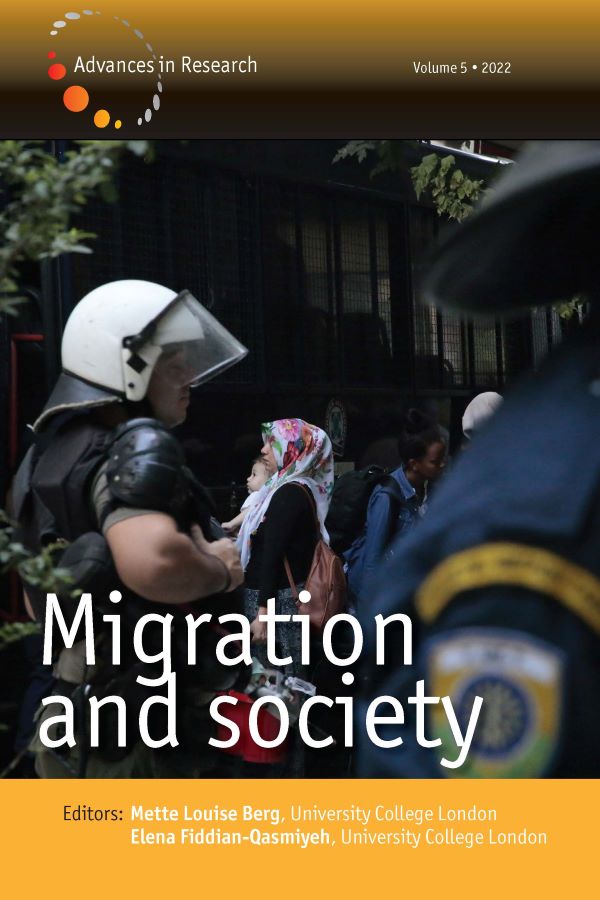
Migration and Society
Advances in Research
ISSN: 2574-1306 (print) • ISSN: 2574-1314 (online) • 1 issues per year
Published Open Access as part of the Berghahn Open Anthro collection.
This second volume of This contribution introduces the collection of texts in this special section of How to write about survival? How to tell survival? By exploring manifold reasons to withhold a story, I shed light on the limits of ethnographic knowledge production and the politics of storytelling that mobilize one story and silence another. Through engaging with the fragmented narrative of a Moroccan survivor of a shipwreck in Spanish waters in 2003, I reconceptualize the movement called “migration as survival” by theorizing it as an ethnographic concept. I explore the different temporalities of survival as The article argues for an intersubjective understanding of mobility among aspirant migrants in the Gambia. Among other factors, Gambian young men's desire to reach Europe and other destinations may stem from an experience of dispersal and abandonment in migrant households. Emigration becomes a way of restoring the viability of relationships, in a socioeconomic sense of regenerating ties and flows between migrants and nonmigrants, as well as in an existential-kinetic sense of experiencing others as moving closer to oneself. By highlighting intersubjective mobility, the article contributes to widening the scope of an existential take on movement and stasis. It further revises popular and scholarly views on the role of families and migrants in shaping aspirations to emigrate. This article examines how “irregular” migrants from West and Central Africa make sense of their trapped mobility in Morocco: for many, crossing into Europe has become almost impossible, returning to home countries “empty-handed” a shameful option, and staying very difficult in the face of repeated infringement of their rights. I explore the limits of contemporary depictions of a “migration crisis” that portray migrants south of the Mediterranean Sea as simply en route to Europe and fail to engage with (post)colonial entanglements. The article recalibrates the examination of migrants’ lived experiences of stasis and mobility by exploring the emic notion of “adventure” among migrants “looking for their lives.” A focus on how migrants articulate their own (im)mobility further exposes and defies the pitfalls of abstract concepts such as “transit migration,” which is misleading in its implication of a fixed destination. This article discusses the challenge of returning home after years abroad from the perspective of Ghanaian labor migrants in northern Italy. It seeks to explore how Ghanaian migrants after years of hard work still find themselves fundamentally estranged from Italy and constantly must navigate day-to-day experiences of bigotry and discrimination in the workplace. Yet the migrants realize that returning home to Ghana is not as straightforward as they might have imagined when they set out, and how to protect advances upon returning to a home country that has changed rapidly during their years in Italy is a recurring subject of concern. Based on ethnographic vignettes, the article will explore West African migrants’ everyday struggles in Italy's segregated and crisis-hit labor market. This article explores the ways people targeted by restrictive migration and mobility policies in Algeria experience, interpret, and contest them. It focuses on the perspective of The Windrush scandal belongs to a much longer arc of Caribbean-British transmigration, forced and free. The genesis of the scandal can be found in the post–World War II period, when Caribbean migration was at first strongly encouraged and then increasingly harshly constrained. This reflection traces the effects of these changes as they were experienced in the lives of individuals and families. In the Caribbean this recent scandal is understood as extending the longer history of colonial relations between Britain and the Caribbean and as a further reason to demand reparations for slavery. Experiences of the Windrush generation recall the limbo dance of the middle passage; the dancer moves under a bar that is gradually lowered until a mere slit remains. Across Northern European states, we can observe a proliferation of “hostile environments” targeting racialized groups. This article zooms in on Denmark and discusses recent policy initiatives that are explicitly aimed at excluding, criminalizing, and inflicting harm on migrants and internal “others” by making their lives “intolerable.” We use the example of Danish deportation centers to illustrate how structural racism is institutionalized and implemented, and then discuss the centers in relation to other recent policy initiatives targeting racialized groups. We propose that these policies must be analyzed as complementary bordering practices: externally, as exemplified by deportation centers, and internally, as reflected in the development of parallel legal regimes for racialized groups. We argue that, taken together, they enact and sustain a system of apartheid. This article argues that Northern responses to, and recognition of, LGBTQ refugees bind queer organizations in Lebanon and Turkey, which support such refugees, in a state of contradiction. This contradiction is defined both by the failure of Northern LGBTQ rights discourses to account for Southern ways of being queer, but also by the categorical imperative of hospitality, which asks that the “right” refugee appears in line with the moral, political, raced, and gendered assumptions of Northern host states. In recognizing this imperative, this article observes how queer organizations in Lebanon and Turkey navigate this contradiction by simultaneously “coaching” their beneficiaries on how to appear “credible” in line with Northern assumptions about sexual difference, while working to accommodate the alterity of those they support. “Epitaphic” features two poems that were written to speak to the poet's interest in commemorating or capturing past moments, events, or persons. “Topographies” is concerned with the interplay between transience and permanence—the passing of time, changing relationships, but also the altering of emotional and physical landscapes. The poem largely speaks to a process of loss and memory, both on a macrocosmic or geographical level, and on a smaller, intimate level. Similarly, “Thanatos” connects with the broad theme of loss, particularly humanity's inability to recognize, appease, or ameliorate the suffering of the animal Other.Volume 2 Issue 1