Home eBooks Open Access Journals
Home
Subscribe: Members Articles RSS Feed Get New Issue Alerts
Browse Archive

PDF icon PDF issue available for purchase
PoD icon Print issue available for purchase


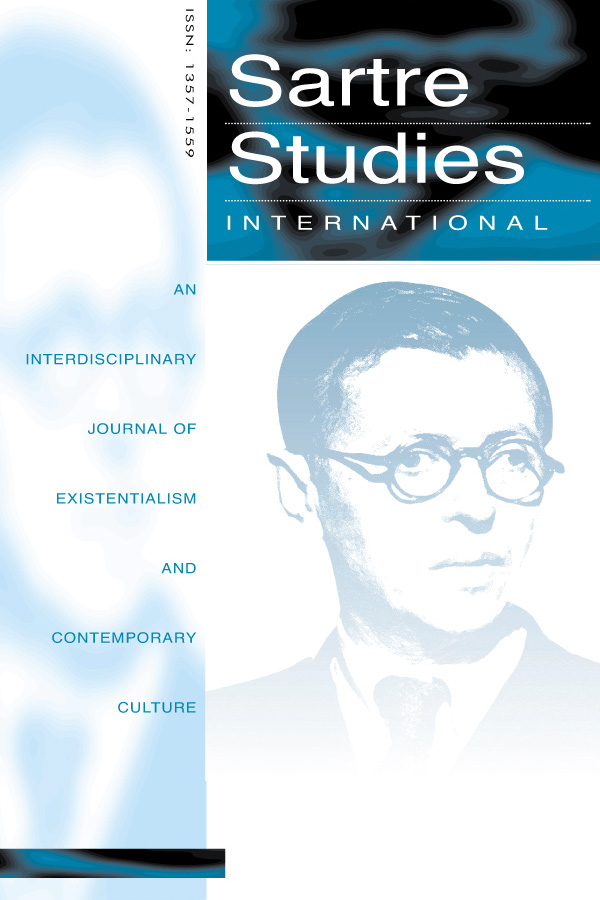
Sartre Studies International

An Interdisciplinary Journal of Existentialism and Contemporary Culture

ISSN: 1357-1559 (print) • ISSN: 1558-5476 (online) • 2 issues per year

View Cart

Volume 32 Issue 1

Get 35% discount when you checkout 3 or more PDF articles.

Editorial

Our first article explores a familiar Sartrean theme from an unfamiliar perspective. Chara Kokkiou's contribution, ‘Shame in Sartre and Plato's Shame-Infused Elenchus’, will be of interest both to Sartre scholars and to Plato scholars. She explores Plato's dialogue Lysis through the lens of Sartre's theory of the emotions, with the aim of illuminating the role of shame in Lysis. She argues that Plato, at least for the most part, and arguably by contrast with Sartre, ‘presents shame as a catalyst for self-examination and growth—an affective disruption that, when intertwined with eros and enacted through the elenchus, propels the soul towards moral transformation and truth.’

(PDF)

Shame in Sartre and Plato's Shame-Infused Elenchus

Chara Kokkiou Abstract

This article argues that Sartre's phenomenological account of emotions – particularly his analysis of shame – offers a novel framework for understanding how shame functions within the Socratic elenchus. It begins by outlining the key features of Sartre's model and then uses Plato's Lysis as a case study, focusing on the dialogue's engagement with the theme of eros. As developed in Sketch for a Theory of the Emotions and Being and Nothingness, Sartre's account raises questions about whether shame is ultimately liberating or constraining. In contrast, Plato, though not without exceptions, presents shame as a catalyst for self-examination and growth – an affective disruption that, when intertwined with eros and enacted through the elenchus, propels the soul towards moral transformation and truth.

(PDF)

Sartre's Overlooking the Importance of Shyness in Madame Bovary

Darren Gillies Abstract

This article challenges Sartre's interpretation of the morning after Charles and Emma Bovary's wedding in Gustave Flaubert's novel Madame Bovary. His position is that Charles stands in a relation of ‘romantic masochistic devotion’ to Emma, which qualifies Charles apprehending Emma in ‘pure adoration’, and this is what makes Charles superior to Emma, and she superior to all her lovers besides Charles. My challenge to this position ultimately shows that it is instead shyness that is the mark of ‘pure adoration’, rather than ‘romantic masochistic devotion’, and subsequently gives support to Mary L. Edwards's position that Sartre lacked objectivity in his pursuit of his overall Flaubert project, while making original contributions to shyness scholarship.

(PDF)

Limits to Freedom and of Freedom

A Sartrean Approach to Fatigue

Rikus van Eeden Abstract

This article investigates Sartre's phenomenological analysis of fatigue in the context of his conceptualisation of situated freedom. Sartre analyses fatigue to establish the possibility of a self-limitation of freedom that does not fall into bad faith. I situate this analysis against the backdrop of contemporary problematisations of fatigue – in discussions of burnout, for example – as a characteristic negative experience of the subject under contemporary capitalism governed by norms of unlimited self-optimisation rather than prohibition. This historical setting compels a re-reading of Sartre's conception of freedom with an emphasis on the theme of self-limitation. I also engage with Jean-Louis Chrétien's critique of Sartre to argue that while Sartre usefully situates his investigation of fatigue in the broader context of a discussion of freedom, his phenomenology of fatigue is limited by the ontological commitments of his project which leads to a too-stringent dualism between activity and passivity.

(PDF)

The Words and the Problem of Salvation Through Literature

Ciro Adinolfi Abstract

In this article, I intend to explore the problem of salvation in Sartre's The Words, in the light of the text entitled Writing for One's Age. First, I will describe the motivations and foundations of Sartrean autobiography in order to highlight the limits of the problem of salvation in this text. Then, I will analyse the 1940s essay and its importance for the definition of the concept of salvation, which was intended as what could emerge in the relationship between author and reader. My argument is that, for Sartre, autobiographical writing transcends its fictional or critical dimension in the direction of a total personal engagement; therefore, as I examine in the final part of this article, this notion of salvation via autobiography opens the way for an ethical consideration.

(PDF)

Book Reviews

Nik Farrell FoxJohn Gillespie

Edwards, Mary, L., Sartre's Existential Psychoanalysis: Knowing Others (London: Bloomsbury, 2023), hardback, ISBN 978-1-3501-7347-7

Sinclair, Mark and Daniel Whistler, eds., The Oxford Handbook of Modern French Philosophy (Oxford: Oxford University Press, 2024), hardback, ISBN 978-0-19-884186-9

Badiou, Alain and Pascale Fautrier, La Question Sartre: Changer de monde (Paris: Presses Universitaires de France, 2025), paperback, ISBN 978-2-13-083416-8

(PDF)