 Get New Issue Alerts
Browse Archive
 PDF issue available for purchase
 Print issue available for purchase
- Vol 18 Issue 2
- Vol 18 Issue 1
- Vol 17 Issue 2
- Vol 17 Issue 1
- Vol 16 Issue 2
- Vol 16 Issue 1
- Vol 15 Issue 1-2
- Vol 14 Issue 2
- Vol 14 Issue 1
- Vol 13 Issue 2
- Vol 13 Issue 1
- Vol 12 Issue 2
- Vol 12 Issue 1
- Vol 11 Issue 2
- Vol 11 Issue 1
- Vol 10 Issue 2
- Vol 10 Issue 1
- Vol 9 Issue 2
- Vol 9 Issue 1
- Vol 8 Issue 2
- Vol 8 Issue 1
- Vol 7 Issue 2
- Vol 7 Issue 1
- Vol 6 Issue 2
- Vol 6 Issue 1
- Vol 5 Issue 2
- Vol 5 Issue 1
- Vol 4 Issue 2
- Vol 4 Issue 1
- Vol 3 Issue 2
- Vol 3 Issue 1
- Vol 2 Issue 2
- Vol 2 Issue 1
- Vol 1 Issue 2
- Vol 1 Issue 1
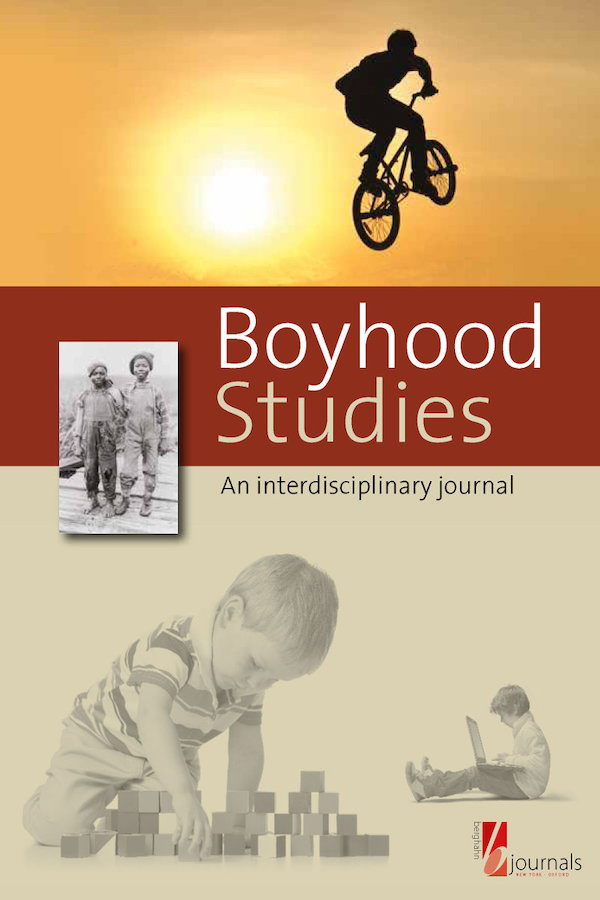
Boyhood Studies
An Interdisciplinary Journal
ISSN: 2375-9240 (print) • ISSN: 2375-9267 (online) • 2 issues per year
Volume 13 Issue 1
Get 35% discount when you checkout 3 or more PDF articles.
Editorial
“Why Do We Ask Them About Their Gender, If We Then Go on to Do Nothing with It?”
Constructions of Masculinity in Youth Justice in England and Wales
Boys and young men continue to make up 81 percent of the Youth Justice System (YJS) in England and Wales, yet dominant discourses on young people who have been identified as having offended largely neglect to examine the potential role of masculinity in offending and interventions. This article aims to fill the gap of research in this area by exploring the role masculinity may play as understood by practitioners. It concludes that practitioners closely link “localized forms of hegemonic masculinity” to offending behavior of boys and young men.
Negotiating Identities
Being “Boy,” Being “Filipino,” Being “Other”
In this article I explore the nuanced performances of masculinity enacted by a 14-year-old boy named “Tom.” Tom, a boy of Filipino descent, complicated much of what was the case with other (non-Filipino) young male participants in my study when it came to masculinity. Rather than simply (re)producing hegemonic masculinity, I show in this article how Tom played with his masculinity and countered potential accusations of homosexuality through acts of self-exoticization and self-feminization (removing others’ power to do so). I explore the role that Tom's Filipino heritage and London background plays in his performance of masculinity, arguing that in the overwhelmingly white context of Norfolk (UK), it serves to anchor his hegemonic masculinity through connotations of “toughness” and “urbanness.” It is therefore in Tom's emphasis of his diasporic “Otherness” that his gender transgressions can be consolidated.
A New Kind of Monster, Cowboy, and Crusader?
Gender Hegemony and Flows of Masculinities in Pixar Animated Films
Representations of boys and men in Disney films often escape notice due to presumed gender neutrality. Considering this omission, we explore masculinities in films from Disney's lucrative subsidiary Pixar to determine how masculinities are represented and have and/or have not disrupted dominant gender norms as constructed for young boys’ viewership. Using Raewyn Connell's theory of gender hegemony and related critiques, we suggest that while Pixar films strive to provide their male characters with a feminist spin, they also continue to reify hegemonic masculinities through sharp contrasts to femininities and by privileging heterosexuality. Using a feminist textual analysis that includes the
Constructing Pathways to Responsible Manhood
Controlling Images and Meaning Making Through the Use of Counter-narratives
Recent studies have focused on challenging deficit narratives and discourses perpetuating the criminalization of Latino men and boys. But even with this emerging literature, mainstream counter-narratives of young Latino boys and their attitudes towards manhood and masculinity stand in stark contrast to the dangerous and animalistic portrayals of Latino boys and men in the media and society. Utilizing a mixed-methods approach, the authors draw on the notion of
James Joyce's “The Sisters”
Implied Pederasty and Interpreting the Inexpressible
The topic of pederasty in “The Sisters” has attracted extensive commentary. In this discussion, the boy's confusion, growing up at the crux of two views of masculinity, has not been explored. Moreover, Father Flynn's nostalgic view of boyhood, and his dependency on the company of the boy, also warrants exploration. Furthermore, little has been made of the boy's antagonistic relationship with Father Flynn's sisters, as there is evidence in the story that the boy is considered corruptive. It is my contention that pederasty is not the larger issue, as in another context, this could be contested. Rather, the boundary between the boy and adults is constructed across two opposing ideals of masculinity, obliterating any possibility of contestation. Subsequently, sentient and reflexive aspects of the boy's characterization deviate from how children are viewed by adult characters in
Conditional Freedom
A Portrait of Young Men's Sense of Belonging to the Street in Maputo, Mozambique
Drawing on extensive fieldwork, this article explores how a group of young men construct their sense of belonging to a public space, namely, a market in the capital city of Mozambique, Maputo. The young men's occupancy of the market was a clever opportunistic move. While life in and around the market provided opportunities and resources that allowed them to “get by,” the way space was lived and experienced in everyday life by these young men made them particularly exposed to punitive systems of social control. Their experience of belonging to the street was ambiguous, as the freedom they searched for became conditional and they recurrently put themselves in a situation in which they became easy targets for police harassment and incarceration in state prisons. The article shows how these young men position themselves and negotiate their masculinities in an urban environment where they are identified as a threat to the social order.
Book Review
Roberts, Steven. 2018.
Reading Raewyn
Reflections on a Lifelong Inspiration
It has been 20 years since Raewyn Connell published