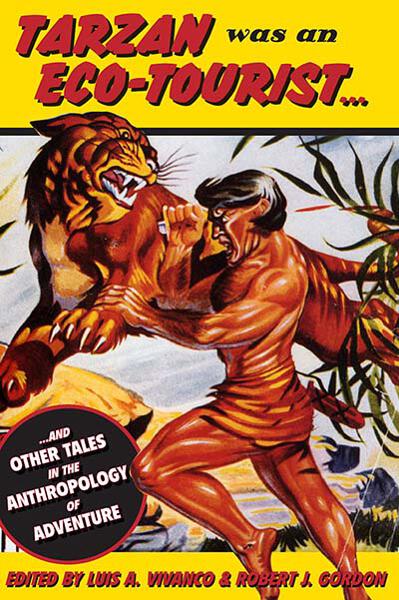
TARZAN WAS AN ECO-TOURIST
…and Other Tales in the Anthropology of Adventure
Edited by Luis A. Vivanco and Robert A. Gordon
| 336 pages, 16 ills, bibliog., index ISBN 978-1-84545-111-0 Pb $29.95/£17.95 Published ( 2006) ISBN 978-1-84545-110-3 Hb $85.00/£53.00 Published (Summer 2006) Buy now and get 15% off listed price |
All chapters available for download - see below.
“The editors and the authors of the essays in this book have made a clear attempt to unravel the complexity of adventure, including a re-affirmation of the importance of Simmel’s seminal essays on adventure and the Alpine journey, and in doing so have offered the reader some fascinating analyses of adventure in contemporary society.” · Environmental Sciences
“An important strength of this collection is the ethnographic grounding of the chapters, which directly engage rich ethnographic understandings with Simmel’s work. This book is a useful addition to the anthropological literature on travel and tourism, and it is a pleasurable adventure to read.” · American Anthropologist
Adventure is currently enjoying enormous interest in public culture. The image of Tarzan provides a rewarding lens through which to explore this phenomenon. In their day, Edgar Rice Burrough’s novels enjoyed great popularity because Tarzan represented the consummate colonial-era adventurer: a white man whose noble civility enabled him to communicate with and control savage peoples and animals. The contemporary Tarzan of movies and cartoons is in many ways just as popular, but carries different connotations. Tarzan is now the consummate “eco-tourist:” a cosmopolitan striving to live in harmony with nature, using appropriate technology, and helpful to the natives who cannot seem to solve their own problems. Tarzan is still an icon of adventure, because like all adventurers, his actions have universal qualities: doing something previously untried, revealing the previously undiscovered, and experiencing the unadulterated. Prominent anthropologists have come together in this volume to reflect on various aspects of this phenomenon and to discuss contemporary forms of adventure.
Luis Vivanco is Assistant Professor of Anthropology at the University of Vermont. His research focuses on the cultural politics of environmentalism and ecotourism in Latin America. He is author of Green Encounters: Shaping and Contesting Environmentalism in Rural Costa Rica (Berghahn Books, 2006).
Robert Gordon is Professor of Anthropology at the University of Vermont. He is author of numerous books and articles, including The Bushman Myth: The Making of a Namibian Underclass and Picturing Bushmen: The Denver African Expedition of 1925.
Download chapters from this title
Table of Contents (Free download)
Introduction
Robert J. Gordon
We live in a post-explorer era in which it is widely considered that the feats of the great adventurers are remnants of history and that the Earth's mysterious places and peoples have long "been discovered." Yet adventure enjoys ubiquitous status in public culture and late capitalism. Adventure television, from the Discovery Channel to the "reality shows," is a major growth area. Best-selling books and magazines increasingly feature "extreme content" and narratives of audaciously successful and famously disastrous expeditions. The best selling SUV (Sport Utility Vehicle) speaks volumes about the current fascination with adventure and the goods deemed necessary for it. Such purchases clearly have major environmental consequences, yet people persist in purchasing them even though they — like most SUVs — will never be used for what they are supposed to be capable of doing. These totems of the desirable bespeak a nostalgia for more heroic days.
Price: $9
Download full chapter (PDF)
Simmel and Frazer
The Adventure and The Adventurer
Aram A. Yengoyan
Adventure, by its various definitions and by what it embraces, comes in many expressions, some might be near as an aspect of quotidian life, others might be far and distant such as dreams and venturing into totally new contexts. Adventure and anthropology are coupled like Siamese twins. The reasons are numerous and they take us in many directions, thus, I will explore what I consider some of the important ones. The best of adventure might tell us something different and new from normal anthropological enquiry and even from abstract theories like structuralism. Anthropology was born out of adventure, and its roots are quite recent in comparison to how the West understood the foundations of adventure and exploration, which were prior to anthropology's nineteenth century foundations. Since anthropology started as an academic discipline, its empirical findings came from adventure and adventurers in the form of colonial officials, explorers, missionaries, administrators, and the intrepid traveler. One can quickly note that, in the broader sense, mutatis mutandis, the necessities of forging anthropology as a science could only have been done by denigrating its roots in adventure. Examination, however, of Georg Simmel's and Sir James Frazer's writings on adventure reveal the basic juxtaposition of adventure and anthropology.
Price: $9
Download full chapter (PDF)
Adventure in the Zeitgeist, Adventures in Reality
Simmel, Tarzan, and Beyond
Daniel Bradburd
As it recounts Tarzan's feelings on his first return to the jungle after he has acquired a veneer of civilization, Edgar Rice Burroughs's Tarzan of the Apes highlights civilization's constraints. Challenged about his knowledge of lions by fellow Europeans, Tarzan accepts a wager to hunt a lion, naked and armed only with a knife and piece of rope.
Tarzan had no sooner entered the jungle than he took to the trees, and it was with a feeling of exultant freedom that he jumped once more through the forest branches.
This was the life! Ah, how he loved it! Civilization held nothing like this in its narrow and circumscribed sphere, hemmed in by restrictions and conventionalities. Even clothes were a hindrance and a nuisance.
At last he was free. He had not realized what a prisoner he had been. How easy it would be to circle back to the coast, and then make toward the south and his own jungle and cabin...
(Burroughs 1983: 244-49)
Price: $9
Download full chapter (PDF)
Tarzan and the Lost Races
Anthropology and Early Science Fiction
Alan Barnard
In the realm of popular literature, the incipient science fiction of the late nineteenth and early twentieth centuries (roughly from 1870 to 1939) is of special interest for anthropology. Unlike the science fiction of more recent times, such early works had terrestrial rather than extraterrestrial settings.1 Three dominant motifs were those of "lost races," "future wars," and "early man," and some writers, notably Edgar Rice Burroughs, combined all three. These motifs have great potential for the revelation of popular attitudes toward the "other" during the period, and indeed since then. Much of the imagery of such literature constitutes a transformation of the "noble savage" idea, seen through the eyes of writers and readers who were conscious of the implications of evolutionary theory. And indeed, anthropological treatments of alien cultures can themselves be seen as analogues of the "lost race" romance.
Price: $9
Download full chapter (PDF)
Avant-garde or Savant-garde
The Eco-Tourist as Tarzan
A. David Napier
The Call of the WildEvery adventure novel at some level owes its successes to our shared perceptions about how the dignified person (as far back as Homer's Odyssey) behaved under trying circumstances in alien places. By the eighteenth century, such trials were socially formalized in what came to be known as the grand tour, an extended journey in which any gentleman of means was meant to show his mettle by carrying his manners to places where they might be unusually tested. Like a controlled experiment in the laboratory of life, such journeys depended upon specific and sometimes extreme conditions.
I don't feel safe in this world no more.
I don't want to die in a nuclear war.
I want to sail away to a distant shore,
And make like an ape man.
The Kinks, "Apeman"
Price: $9
Download full chapter (PDF)
They Sold Adventure
Martin and Osa Johnson in the New Hebrides
Lamont Lindstrom
The twentieth century dawns and the high modernist crash of urbanism, industrialism, bureaucracy, new mass media, and the centralizing state gives young sociologists something to write about. How can society and the individual coexist? In France, Émile Durkheim worries about social stability and community given disparate, often conflicting individual interests. The division of labor, luckily, provides some moral glue. Across the Rhine, Georg Simmel picks up the German end of the stick. He frets that the tightening imperatives of mass society have corroded and subjugated humanity. In response, he produces a series of optimistic portraits of individuals who manage to live in society yet nonetheless retain a golden measure of autonomy and authenticity. Not everyone is a mere cog in the societal works. There are also the Stranger (see Levine 1979), the Renegade, the Noble, the Artist, the Gambler, and the Adventurer.
Price: $9
Download full chapter (PDF)
Jacaré
Cold War Warrior from the Jungles of the Amazon
Neil L. Whitehead
As Rodney Needham (1983) indicated in his inspiring consideration of the literary figure of Tarzan, the realm of the fictive and imagined is a significant site for the appreciation of cultural practice and proclivity. As Needham rightly emphasizes, Tarzan-like constructions may be understood as offering the vision of premodern freedom that liberates the conventional and rule-bound existence of the "civilized." As a result many such fictions pre-date the Tarzan figure: Rousseau's "noble savage," and its variants, the interest in wolf-children, or even the somewhat bourgeois existence of Daniel Defoe's Robinson Crusoe, also speak to this fascination with an escape from the mundane and ordered world of modern society.
Price: $9
Download full chapter (PDF)
The Work of Environmentalism in an Age of Televisual Adventures
Luis A. Vivanco
"DANGER! DANGER! DANGER!"
("Crocodile Hunter" Steve Irwin)
"I'm Jane, he's Tarzan"
(Terri Irwin, referring to herself and husband Steve Irwin; Simpson 2001)
"Somewhere along the way, there was an understanding reached between Tarzan and his followers. Either it was a collaboration — 'don't bother me and I won't bother you' — or it was true conquering that was in some ways permanent. There must have been this understanding or there would not be so many Tarzans today."
(Theroux 1998: 58)
Price: $9
Download full chapter (PDF)
Five Miles Out
Communion and Commodification among the Mountaineers
David L.R. Houston
In the remote Western Karakoram mountain range is the plainly named peak of K2. It is the second-highest mountain on earth, with a reputation as a "killer" mountain. Climbing to an altitude of five miles is not a casual undertaking, but many attempt it. To reach K2 in 1953, climbers walked 150 miles through difficult terrain; today, they can fly almost to Base Camp. Today's expeditions are profoundly different from those of the 1950s, highlighting the contrast between yesterday's pilgrimage and purity versus today's commodification and status. This essay offers a perspective of mountaineering through the narratives heard and life lived with an adventurer, an experience that raises questions about why they climb and exposes differences between new and old-style mountaineering. Today, as an anthropologist, my investigation into this particular type of adventure is significantly challenged: how do I step back from the side effects of living in the shadow of the man and the mountain, escaping the emotional pull of family and self, to develop a critical eye toward the subject? In the larger sense, how do we as anthropologists escape the narcissism of minor differences, denying the similarities between ourselves and what we do and those that we identify as Other? The emotional relationship established between ethnographer and subject is multilayered, containing friendship and intimacy, aversion and hostility. It challenges our ethnographic sensibilities.
Price: $9
Download full chapter (PDF)
Crampons and Cook Pots
The Democratization and Feminizations of Adventure on Aconcagua
Joy Logan
Normal life can be such drudgery; little seems important. But in the mountains, all is different, for the alpine life is a life of consequence.
Gregory Couch
Adventure has the gesture of the conqueror."Aconcagua-toda adrenalina" [Aconcagua: total adrenaline] was the phrase that stopped me dead in my tracks in the middle of a souvenir ship in Mendoza, Argentina.1 How, I wondered, could this T-shirt slogan really be referring to the experience of mountaineering on Aconcagua, at 6,962 meters the highest mountain in the Americas? At altitude a mountaineer's pace is determined, steady, and most often laboriously slow over prolonged periods of time, which belies the heart-stopping kind of exhilaration that the T-shirt suggested. The only way to reconcile these two contradictory images was by imagining that the shirt was marketing Aconcagua to an entrepreneurial, as well as a sports-minded, audience. It seemed much more reasonable to me to attribute Aconcagua's adrenaline factor to the rapid and explosive growth of andinismo in the Aconcagua Provincial Park and to credit the heady experience of an adrenaline rush, not just to high-altitude mountaineers, but to those flatlanders leading the development of the Mendocino adventure tourism industry.
Georg Simmel
Price: $9
Download full chapter (PDF)
The Toughest Job You'll Ever Love
The Peace Corps as Adventure
Michael J. Sheridan and Jason J. Price
"It is in the compelling zest of high adventure and of victory, and in creative action, that man finds his supreme joys."For the modern American in search of a state-sanctioned adventure there is always the Peace Corps: that far-off other world where the privileged and daring set off to do good and find themselves. More than 170,000 Americans have served in the Peace Corps since the program's inception some four decades ago. The authors of this essay rank in those numbers. Sheridan served as a water technician in Kenya from 1988-1990. Price was a secondary school teacher in Malawi from 1999-2001. We both joined, in part, out of a search for adventure. The Peace Corps provided us with the means to balance our personal desires with moral purpose, to experience adventure in the name of both ourselves and the world. This impulse is hardly uncommon, nor is the association between Peace Corps and adventure. This essay, then, explores the notion of Peace Corps service as "adventure" by drawing particularly upon the formal sociology of Georg Simmel.
—Antoine de Saint-Exupéry
Price: $9
Download full chapter (PDF)
Doing Africa
Travelers, Adventurers, and American Conquest of Africa
Kathryn Mathers and Laura Hubbard
In the adventure we forcibly pull the world into ourselves. Adventure has the gesture of the conqueror, the quick seizure of opportunity, regardless of whether the portion we carve out is harmonious or disharmonious with us, with the world, or with the relation between us and the world (Simmel 1971: 193).Adventure, as Simmel suggests, is analogous to a love affair — it requires both an act of conquest and a submission to the conquered. This simultaneous conquest and surrender characterizes contemporary travel by Americans to Africa. We argue that it is precisely the act of submission, the giving in to love, that makes the enacted conquest of adventure palatable to the modern American subject. This not only intimates that travel to Africa actually requires an "adventure," but that the ideal type of the adventurer is critical to the imagined relationship Americans have with the world, one that is often played out against the backdrop of an African scene. The collapsing of histories of representation of Africa as a colonized space of darkness and contemporary images portraying a continent where modernity fails and epidemics run rampant creates an Africa located fully outside of the United States. America's Africa is the definitive site of adventure. An examination of travel to Africa by Americans shows both a frantic yearning for adventure and a frequent reiteration of love and desire for Africa. This hunger for adventure suggests that imperial relationships of the present are negotiated increasingly through modes of action rather than the gaze. This shift from the imperial eye/I to an embodied penetration of Africa by Americans pushes the American adventurer to realize a self more suited to emerging forms of empire. Drawing on ethnographic work with college students and other travelers to southern Africa, literature on African tourism, including sex tourism, as well as the role of Africa in reality television and other fictions, this paper shows how Americans forcibly pull the world into themselves.
Price: $9
Download full chapter (PDF)
"Oh Shucks, Here Comes UNTAG!"
Peacekeeping as Adventure in Namibia
Robert J. Gordon
The ending of conflict is a specific enterprise. It belongs neither to war nor to peace, just as a bridge is different from either bank it connects (Simmel 1955: 110)Rereading Simmel, one is struck by how his view of the Adventure creating an "exclave" is similar to Victor Turner's notions of anti-structure, liminality, and communitas. For Simmel the Adventure is largely experiential fantasy, others and ours, packaged as time away from ordinary life. Most studies of adventure have focused on individual adventures, and this paper suggests that one can extend the notion by incorporating the Turnerian dimension. Transitions, as Turner showed, are situations of uncertainty and danger in which one moves to a new status. Conventional analyses of Adventures see them as entailing a distinctive structural movement, either spatially and/or socially, in which the adventurer has to deal with a challenging element of unpredictability, risk, and danger, all of which combine to create a "Time Out" from the operation of the daily humdrum of society (with the challenging element of danger).
Price: $9
Download full chapter (PDF)
A Head for Adventure
Steven Rubenstein
People typically understand adventures as endeavors that are exciting precisely because they are so risky. This experience is so uncommon that people often must escape, or at least take a break from, their ordinary lives in order to achieve it. Characteristically, though, Georg Simmel reminds us that adventures are successful because they intensify, rather than renounce, the tensions of everyday life. "In the adventure," he observed, "the interweaving of activity and passivity which characterizes our life tightens these elements into a coexistence of conquest, which owes everything only to its own strength and presence of mind, and complete self-abandonment to the powers and accidents of the world, which can delight us, but in the same breath can also destroy us" (1971: 193). Anyone who has been in love or who has conducted ethnographic fieldwork knows these feelings. These experiences are intense not so much because they involve risks, but because of the way they can both require — and lead to — moments that simultaneously involve both conquest and surrender. But Simmel is not merely reflecting on a particular kind of experience. His adventurer is one of a number of social types he analyzed in order to show how people who travel — geographically and emotionally — outside the bounds of society are nevertheless driven by and illuminate social forces. The lovers who surrender themselves to their feelings; the anthropologist who leaves her home to immerse herself in the life of another society — all must recognize, sooner or later, that they are acting out a drama not entirely of their own making.
Price: $9
Download full chapter (PDF)
Riding Herd on the New World Order
Spectacular Adventuring and U.S. Imperialism
Keally McBride
"Adventure has the gesture of the conquerer, the quick seizure of opportunity, regardless of whether the portion we carve out is harmonious or disharmonious with us, with the world, or with the relation between us and the world." (Simmel 1971, 193)It was the photo opportunity that everyone still remembers. President Bush welcomed the aircraft carrier Abraham Lincoln back in port. He personally flew the plane accompaniment, landed in a jet fighter, and strutted in pilot garb under the banner, "Mission Accomplished." Those who did not support the war, or President Bush in general, were outraged. How could he say "Mission Accomplished" when Iraq was obviously a bloody mess? The liberal media spawned a series of commentaries on the event, The Village Voice speculating that the true goal was to present Bush in a uniform that tightly framed his crotch displaying his macho bravado to a nervous public. Harper's Magazine reported on the extra expense incurred for Bush's landing to be staged. The pilot wavered about how long the President actually controlled the plane after it was pointed out that he was not licensed to fly the aircraft. Instead of a substantive debate about U.S. military imperialism by those who were opposed to such activities, we had a scuffle about whether the depiction of President Bush was true to life or a staged hoax. We can lift the curtain to reveal the truth behind the image! Mission accomplished indeed.
Price: $9
Download full chapter (PDF)
Adventure and Regulation in Contemporary Anthropological Fieldwork
David Stoll
To establish ourselves as professionals, anthropologists have long tended to downplay the adversities we encounter — distrust, opposition, calamity, irreducible ambiguity — in order to protect the credibility of our research. Even the rather attractive category of adventure usually finds a place only in our memoirs or popular treatments, not in peer-reviewed articles and books. Candid portrayals of adventures and the complications they leave behind could undermine the air of impartial authority for which most of us strive. Now that cultural anthropology has become absorbed in how our position as observers affects the knowledge we produce, the anthropologist as adventurer becomes pertinent in a new way. But anthropologists who boast of adventures in some contexts will have good reason to deny them in others.
Price: $9
Download full chapter (PDF)
Index (Free download)
Bibliog (Free download)