New Titles Summer/Fall 10
(3.4Mb PDF file)

Anthropology 10/11
(3.3Mb PDF file)

Film and Media Studies 10
(2.5Mb PDF file)

International Studies 10
(3.1Mb PDF file)

History 2010
(2.0Mb PDF file)

Anthropology Texts for Teaching
(5.7Mb PDF file)


advanced search

Browse all titles by:
Author | Title | Series
Celebrating 16 Years of Independent Publishing Last updated: August 19th, 2010


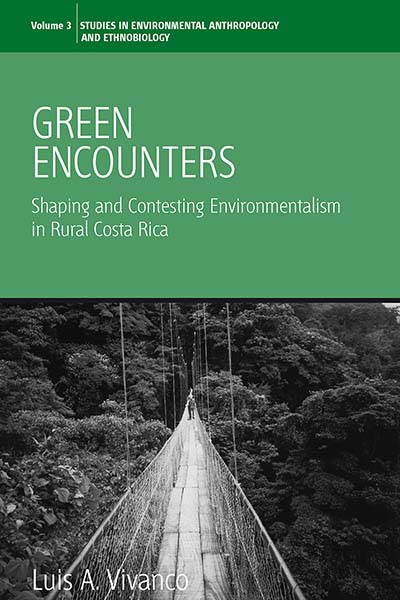
GREEN ENCOUNTERS

Shaping and Contesting Environmentalism in Rural Costa Rica

Luis A. Vivanco


240 pages, 7 ills, 3 maps, bibliog., index
ISBN 978-1-84545-504-0 Pb $27.95/£15.00 Published (Autumn 2007)
ISBN 978-1-84545-168-4 Hb $80.00/£40.00 Published ( 2006)
Buy now and get 15% off listed price
Pb 
Hb 

Download this title All chapters available for download - see below.

(may not yet be available for newest titles)
 Google Book Search

“…a critical and thought-provoking monograph… provides an insightful analysis of how environmentalist discourses shape identities.”  ·  Human Ecology

“Vivanco’s well-written work…clearly raises important questions regarding whether or not ecotourism can overcome the ecological and social equity challenges of sutainable development.”  ·  Choice

“The work excels at showing how environmental conservation oat Monte Verde is and has been the result of a shifting range of social, political, and economic forces, and it also excels at showing the variety of environmentalisms that can be found there.”  ·   JRAI

Since the 1970s and 1980s, Monte Verde, Costa Rica has emerged as one of the most renowned sites of nature conservation and ecotourism in Costa Rica, and some would argue, Latin America. It has received substantial attention in literature and media on tropical conservation, sustainable development, and tourism. Yet most of that analysis has uncritically evaluated the Monte Verde phenomenon, using celebratory language and barely scratching the surface of the many-faceted socio-cultural transformations provoked by and accompanying environmentalism. Because of its stature, Monte Verde represents an ideal case study to examine the socio-cultural and political complexities and dilemmas of practicing environmentalism in rural Costa Rica. Based on many years of close observation, this book offers rich and original material on the ongoing struggles between environmental activists and of collective and oppositional politics to Monte Verde’s new “culture of nature.”

Luis A. Vivanco is Assistant Professor of Anthropology at the University of Vermont (1999-present). He received a Ph.D. in Cultural Anthropology from Princeton University. He is co-editor of Tarzan was an Ecotourist……and Other Tales in the Anthropology of Adventure (Berghahn Books, 2006). He is a co-editor of Talking About People: Readings in Contemporary Cultural Anthropology (McGraw Hill). His research focuses on the culture and politics of nature conservation, ecotourism, and sustainable development in Costa Rica and Oaxaca, Mexico.

Series: Volume 3, Environmental Anthropology and Ethnobiology


Download chapters from this title

Front_Matter (Free download)


Introduction

Encounters in a Tropical Cloud Forest

Several weeks after he began a new job as a maintenance worker at a small cloud forest preserve in Monte Verde, Costa Rica, Manuel Azofeifa invited me to walk with him through the forest.1 During our walk, Manuel explained that as a career cattle rancher and dairy farmer he had paid relatively little attention to the establishment and expansion of forest preserves and the growing numbers of foreign tourists visiting this remote mountainous region in which he and his family have lived and farmed for over fifty years. He decided to work at this preserve not so much because he wanted a midlife change of career or to profit in the tourism economy, but out of a desire to support his son's high school, which had acquired the cloud forest preserve in 1995 to fund its daily operations. We carried machetes and our lunch, typical on long forest walks like this, but Manuel viewed this walk differently from others he had taken, and not simply because he had not been in this forest since it was formally protected in the late 1970s, or that he now worked here as an employee. The shift in Manuel's approach to this walk was reflected in the camera he carried, a small point-and-shoot that he said he rarely uses except for special occasions like parties or family trips. This was the first time he had taken a camera with him into a forest.

Price: $9

Download full chapter (PDF)


Part_1 (Free download)


Monte Verde's Agricultural Environment

Everyone sees forests differently. Some see them as biologists, others as medical doctors. But I see them as a campesino, because that's what I am. And so I see that people need to survive with these forests. We can't not use them. We must use them wisely, though." - Dairy farmer, Santa Elena
In their discussions on biodiversity loss and landscape degradation, environmentalists tend to point to campesinos like José as responsible for a large part of the destruction. They explain that poverty, ignorance, greed, fast population growth, even apparent cultural predisposition are the root causes that drive people like José to rapidly cut rain forests. For example, in her popular book on the global situation of rain forests, In the Rainforest, Caufield has a chapter on the Quakers of Monteverde ("Cattle in the Clouds") in which she complains that the unchecked ambition to destroy rain forests there is the product of "the Iberians' overwhelming atavistic urge to become a caballero" (1984/91: 121), or cattle rancher. So we could add irrational inflexibility and static attachment to tradition to the list of possible root causes.

Price: $9

Download full chapter (PDF)


Uneven Terrain

The Practice and Politics of "Saving" Monte Verde

"So where is this famous tropical deforestation that we hear so much about in the U.S.?"
"Everywhere. This was once a continuous rain forest. The Costa Ricans cut it down to create farmland. That's why they saved the forests in Monte Verde."
- Exchange between a North American tourist and a North American biology student, on the bus to Monte Verde, mid 1990s
Brief as it is, this exchange I overheard on the public bus to Monte Verde illustrates one of the central reasons environmental activists have given for their efforts to formally protect Monte Verde cloud and rain forests. That is, the threat to endangered habitats and species posed by destructive Costa Rican land management practices. Motivating the question is the premise that deforestation has to be happening in order to be fully appreciated, since the tourist would not have asked if he saw it in front of him. It is an attitude at least partially conditioned by North American and European media images in which tropical forests are commonly represented as being cut and burned. This idea is confirmed by what the tourist told me: such media images have always depressed him, so he came to Costa Rica to see what tropical forest loss is like first hand.

Price: $9

Download full chapter (PDF)


Part_2 (Free download)


Testing the Boundaries of Environmentalism in a Participatory Age

Introduction: The Puma in a Tree
Late one afternoon during the mid 1990s, a colleague and I returned from working at the Reserva Santa Elena cloud forest preserve (RSE) as we usually did, walking the six kilometers by dirt road to the village of Santa Elena where we lived. There were no tourists in their rental cars from whom we could hitch a ride — one of the few forms of motorized transportation on what was then a quiet back road (but that is now well-traveled because of the higher number of tourist attractions since the late 1990s) — and we settled into the routine of brisk walk and conversation. Several kilometers ahead we heard the sounds of motorcycles and cars on the road, and our hopes for a ride rose. Within a couple of minutes they sped rapidly by us, heading purposefully in the direction from which we came, toward the RSE. We knew the motorcycle riders, one of whom was a naturalist tour guide and the other a forest guard for the Monteverde Cloud Forest Preserve. Following closely behind them was a Guardia Rural police officer, who sped by in his jeep with a preoccupied look on his face. We wondered where they could be going, especially since the Reserva Santa Elena was closed for the day, and aside from the cloud forest preserve there were only several dairy farms in the area.

Price: $9

Download full chapter (PDF)


Dismembering San Gerardo

A Cautionary Tale of "Sustainable Development"

Before its dissolution in the mid 1990s, the San Gerardo Socio-Biotic Community Project was celebrated as a model integrated conservation and development project based on community participation. Designed and enthusiastically advertised as a joint undertaking between the Monteverde Conservation League and a settlement of cattle ranchers and small-scale farmers living in the Atlantic slope area of San Gerardo Arriba, the project's plan called for community members to develop organic agriculture and livestock production, produce clean power, support selective high-end ecotourism, and construct a biological station (Boll 2000). This would take place in an area of stunning natural beauty and biodiversity that, in spite of over forty years of campesino settlement, still sustained large areas of primary rain forest. According to project descriptions, "The purpose of the San Gerardo Project is to allow these people to live within the protected forest and make a living that is compatible with the rules of the Arenal-Monteverde Protected zone and the philosophy of the League concerning preservation and enhancement of the rain forest." As an MCL worker once earnestly told me: "This has to work, for it has global implications. We are dissolving the boundaries between parks and people."

Price: $9

Download full chapter (PDF)


Contesting "Community" in a Community Conservation Project

The Fight for the Reserva Santa Elena

Introduction: "Pueblo Pequeño, Infierno Grande"
Soon after I arrived in Santa Elena during 1995 for a year and a half of fieldwork, I met with a friend who had been working at the Reserva Santa Elena (RSE), to catch up on what was happening there. He eagerly launched into a long and detailed description of what he called "pueblo pequeño, infierno grande," or "small town, big hell." It is a phrase one often hears in rural Costa Rica to refer to the way in which seemingly slight affronts or tensions can explode into widespread conflicts.

Price: $9

Download full chapter (PDF)


Part_3 (Free download)


Quetzals and Other(ing) Spectacles of Tropical Nature

On the morning back in 1995 when partisans of the Colegio marched on the Reserva Santa Elena, marking a high point in public outrage against the Fundación, it was, to say the least, an interesting day to visit the small cloud forest preserve. It was a colorful and raucous protest march, and people were speaking earnestly out in the open about important issues that bear on nature conservation, tourism, and public responsibility. Even though it was not tourist high season at the time, the RSE could have expected at least twenty visitors that day. But word had gotten out, at least to the naturalist guides and hotel owners, that the protest was going to happen, and only two North American tourists dared show up. Even more striking was the almost total lack of curiosity they showed about what was taking place before them. The naturalist guide who accompanied them, known to virtually everyone at the protest, was eager to usher them into the forest, pausing only to point out a specific plant near the reserve's entrance, barely acknowledging all of us gathered there.

Price: $9

Download full chapter (PDF)


Conclusion

Environmentalism at a Crossroads

One of the easiest and most seductive ways to think about Monte Verde's encounter with environmentalism is in terms of its achievements and successes. They typically include, as Burlingame (2000: 372-3) observes, the sheer amount of formally protected lands (somewhere around twenty-nine thousand hectares in total); the use of local residents as unarmed guards; the creation of windbreaks and biological corridors to support birds and farmers; widespread environmental education for youths; the emergence of local organizations to meet new needs; the substantial contributions that international scientists and fundraisers have made; and the rise of ecotourism as a way to financially support protection efforts. Ecotourism in Monte Verde has thoroughly incorporated these examples into its narratives, so moving through Monte Verde tourist spaces tends to reinforce the idea that effective alliances can be created between local people and international activists to solve problems of environmental degradation. After a few days' visit, enchanted by the rugged beauty of the place, one could easily drive away from it with a sense that Monte Verde justifiably occupies one of the top positions in the pantheon of the world's most eco-friendly places.

Price: $9

Download full chapter (PDF)


Index (Free download)


Bibliography (Free download)


If you have any questions or comments about this site, please email us
All prices listed on this website are subject to change without notice.