Join our Email List
Series
Volume 16
International Studies in Social History
See Related
History JournalsEmail Newsletters
Sign up for our email newsletters to get customized updates on new Berghahn publications.
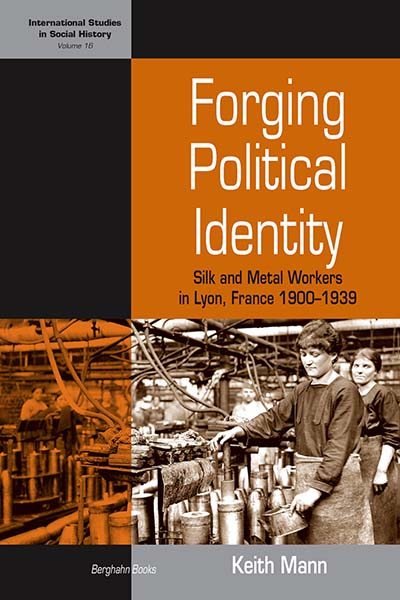
Forging Political Identity
Silk and Metal Workers in Lyon, France 1900-1939
Keith Mann
280 pages, 8 illus., 4 tables bibliog., index
ISBN 978-1-84545-645-0 $135.00/£104.00 / Hb / Published (April 2010)
eISBN 978-1-84545-825-6 eBook
Nominated for the 2012 Distinguished Scholarly Book Award of the ASA Section on Labor and Labor Movements
Reviews
“An exhaustive study [that]…discusses many of the labor issues that would continue to define these relations in the second half of the twentieth century and invites us to reflect on the power of workers whose words and deeds still inform politics in France today.” · French Review
“All in all, this is a brilliant work that combines a depth of sophisticated, nuanced analysis with a clear, crisp writing style. New insights are unearthed from its detailed study of Lyon labour that will increase our understanding of the French working class during the first four decades of the twentieth century. Whether one ultimately agrees with the author’s contentions, one must be impressed by the brilliance of his arguments and the firmness of his evidence.” · European History Quarterly
“Mann does a masterful job analyzing the social basis of working class political identity in Lyon — and beyond — between 1900 and 1935.” · Against the Current
“The approach is a carefully constructed synthesis: on the one hand, it is gendered, open to the insights of poststructuralism and the cultural turn, and rejects base and superstructure; on the other, it embraces the importance of structural patterns of development… Its great methodological virtue is its marriage of the concepts of social movement theory, in particular the political opportunity structure, and the serious archival research that one would expect from labor history.” · American Historical Review
“With this book Keith Mann carries forward a vital tradition of North American labor history inspired by the work of Charles and Louise Tilly. Constructed around the dialectics of skill, technological change, and the organization of the labor process in Lyon’s two key industries, while grounded in the distinctiveness of a particular spatial community shaped dynamically through time, it casts the politics of the Popular Front era in a strikingly original light.” · Geoff Eley, University of Michigan
“This is an important book of exceptionally-high academic quality. With great skill, Mann documents and analyzes the influence of technology and work organization on the character of labor militancy. This book notably advances our understanding of these issues.” · Michael Hanagan, Vassar College
“Keith Mann has written an important book that should be read not only by historians and social scientists but by all interested in movements for social change.” · Gerald Friedman, University of Massachusetts Amherst
Description
Escaping the traditional focus on Paris, the author examines the divergent political identities of two occupational groups in Lyon, metal and silk workers, who, despite having lived and worked in the same city, developed different patterns of political practices and bore distinct political identities. This book also examines in detail the way that gender relations influenced industrial change, skill, and political identity. Combining empirical data collected in French archives with social science theory and methods, this study argues that political identities were shaped by the intersection of the prevailing political climate with the social relations surrounding work in specific industrial settings.
Keith Mann is Associate Professor of Sociology at Cardinal Stritch University in Milwaukee, Wisconsin. He specializes in 19th- and 20th-century French social and labor history. His work has appeared in the International Review of Social History, International Labor and Working Class History, Labor History, and Le mouvement social.
Subject: History (General)History: 20th Century to PresentSociologyPolitical and Economic Anthropology
Area: France
Contents
Of Related Interest

Race in France
Interdisciplinary Perspectives on the Politics of Difference
A Stranger in Paris
Germany's Role in Republican France, 1870-1940

Remaking France
Americanization, Public Diplomacy, and the Marshall Plan