Join our Email List
Series
Volume 9
Berghahn Monographs in French Studies
See Related
History JournalsEmail Newsletters
Sign up for our email newsletters to get customized updates on new Berghahn publications.
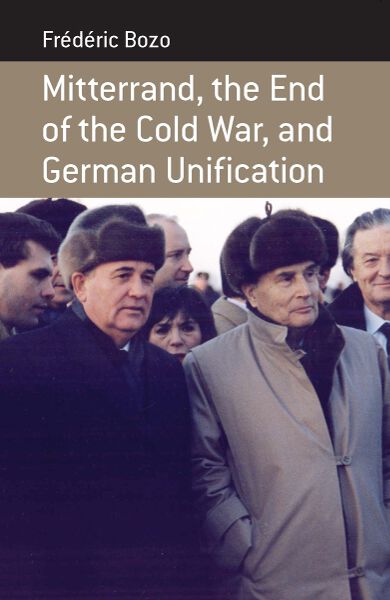
Mitterrand, the End of the Cold War, and German Unification
Frédéric Bozo
Translated from the French by Susan Emanuel
450 pages, bibliog., index
ISBN 978-1-84545-427-2 $150.00/£115.00 / Hb / Published (October 2009)
ISBN 978-1-84545-787-7 $39.95/£31.95 / Pb / Published (February 2010)
Reviews
CHOICE OUTSTANDING ACADEMIC TITLE 2010
“…a superb collection…a unique and valuable contribution to the voluminous literature on the Cold War. Essential.” • Choice
“Bozo undertakes in his meticulously researched and written study the almost herculean task to place French foreign policy between 1988 and 1991 both on the map of international history and in the line of continuity with the policy of Charles de Gaulle…It will be [his] Bozo’s lasting legacy to have written a significant scholarly contribution to stake out France’s important role during these historical processes with all its merits and flaws, twists and turns.” • Central European History
“[This] terrific book…is a significant addition to the literature on the end of the Cold War. It is fortunate that the book is now available in English and thus will reach the wider audience it deserves.” • Journal of Cold War Studies
“Frédéric Bozo’s book on French foreign policy around German unification in 1990 is a superb work of contemporary diplomatic history. Already widely reviewed, it has assumed its rightful place as a must-read to understand the period and the earth-shaking international transformation that followed it. Berghahn Books is to be congratulated for publishing the volume… A landmark which helps us understand the immensity and intricacy of a major turning point in international relations.” • Reviews in History
“Frédéric Bozo succeeds in offering a nuanced and balanced analysis of Mitterrand’s policies towards Germany. But the author is a bit too modest when he claims to concentrate on the president. His book certainly does this, but it also does more: it offers a rich and detailed account of the multilateral diplomacy surrounding German unification which, although stressing the French point of view, takes into account most, if not all, the countries involved.” • International Journal
“Frédéric Bozo… offers a finely nuanced and far more comprehensive interpretation of [Mitterrand’s] GDR visit than any of the other authors, based exclusively on meticulously cross-checked archival sources.” • French Politics, Culture & Society
“... a dense, scholarly, yet readable account.” • Cold War History
“this is a terrific book. Frédéric Bozo is a French professor who teaches at the Sorbonne. Until this book came out, most people believed that Mitterrand, like Thatcher, was completely opposed to German unification. Bozo convinced some of Mitterrand's aides to let him see their papers, and these documents show that Mitterrand played a savvy game. He was initially shocked when the Berlin Wall came down but, unlike Thatcher, he quickly realised that the smart move for France would be to get out in front of the process, support Helmut Kohl, and to see what he could get for France.” • Mary Sarotte, Professor of International Relations at the University of Southern California. Interview with fivebooks.com
“Bozo’s outstanding study thus sheds powerful light on a national policy that ultimately failed (though not for want of trying), and of which some elements, as he shows, may have a role in the future.” • International Affairs
“...telling the story [of German unification] primarily from the French perspective provides a more detached yet highly informed account of the diplomacy.” • Foreign Affairs
“Bozo's masterly book is the definitive study of French President Mitterrand's important, and often denied or dismissed, contribution to German unification and to the reunification of Europe. It is indispensable to anyone interested in these momentous events, in French foreign policy, and -- in the truth.” • Stanley Hoffmann, Harvard University
&;ldquo;This outstanding study... is obligatory reading on the end of the East-West conflict and on German unification. It is exceptionally well researched and based on largely untouched sources.” • Karl Kaiser in Internationale Politik
“Twenty years ago when the Berlin Wall fell, many feared that the reunification of Germany might bring back Europe’s old ghosts, especially the rivalry between France and Germany. This book, written by one of Europe’s outstanding contemporary historians, demonstrates the central role played by French president François Mitterrand in furthering German reunification and forging a new architecture for post Cold War Europe. Based on a rich body of primary source material, Bozo carefully and persuasively challenges prevailing American narratives, and makes a powerful case for the ultimate triumph of Mitterrand’s vision. It is essential reading for scholars hoping to understand the historical background to Europe’s increasing assertiveness and independence from the United States.” • Thomas A. Schwartz, Vanderbilt University
“In his history, Bozo makes excellent use of both documentary sources from the Quai d’Orsay and the Elysee supplemented by extensive interviews with key players in France and elsewhere. It is well footnoted and authoritative and is clearly the best single book on French diplomacy in this period and very good on the broader diplomacy of German unification beyond the French story.” • Stephen Szabo, Executive Director, Transatlantic Academy (TAA)
Description
Twenty years after the fall of the Berlin Wall, this important book explores the role of France in the events leading up to the end of the Cold War and German unification. Most accounts concentrate on the role of the United States and look at these events through the bipolar prism of Soviet-American relations. Yet because of its central position in Europe and of its status as Germany’s foremost European partner, France and its President, François Mitterrand, played a decisive role in these pivotal international events: the peaceful liberation of Eastern Europe from Soviet rule starting in 1988, the fall of the Berlin Wall and Germany’s return to unity and full sovereignty in 1989/90, and the breakup of the USSR in 1991. Based on extensive research and a vast amount of archival sources, this book explores the role played by France in shaping a new European order.
Frédéric Bozo is currently Professor in contemporary history and international relations at the Sorbonne (University of Paris III, Department of European Studies). He was previously professor at the University of Nantes (1998-2005) and associate professor at the University of Marne-la-Valle (1994-1998). Born in 1963, Frédéric Bozo was educated at the Ecole normale supérieure, at the Institut d'études politiques de Paris and at Harvard University. He received his doctorate from the University of Paris X - Nanterre (1993) and his habilitation from the Sorbonne - Paris III (1997). His research field is French foreign and security policy, transatlantic relations and Cold War history.
Subject: History: 20th Century to Present
Area: FranceGermany
Contents
Of Related Interest
Iron-making Societies
Early Industrial Development in Sweden and Russia, 1600-1900
An Outline of European History From 1789 to 1989