Join our Email List
Series
Volume 5
Studies in German History
Email Newsletters
Sign up for our email newsletters to get customized updates on new Berghahn publications.
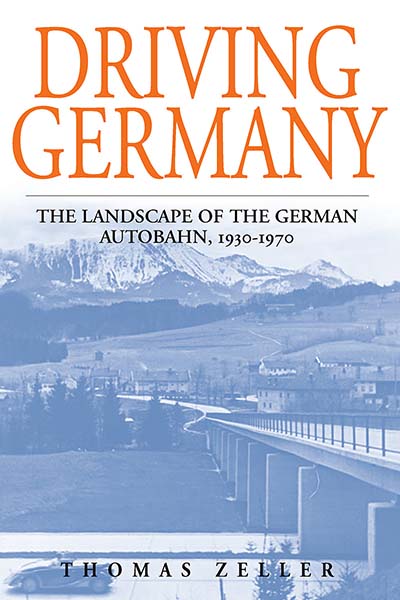
Driving Germany
The Landscape of the German Autobahn, 1930-1970
Thomas Zeller
Translated by Thomas Dunlap
298 pages, 8 illus., bibliog., index
ISBN 978-1-84545-309-1 $135.00/£104.00 / Hb / Published (February 2007)
ISBN 978-1-84545-271-1 $34.95/£27.95 / Pb / Published (October 2010)
eISBN 978-1-80768-684-0 eBook
Reviews
“This is an excellence piece of research that well deserves publication in English. The book is astonishingly well-linked to a wide range of historical scholarship, while at the same time containing very detailed empirical accounts, e.g., in the various media used for autobahn propaganda, the appointment of landscape advocates, and letters from citizens of the Federal Ministry of Transport.” · Technology and Culture
“I urge any reader interested in the role of space on political development, or interested in how space was used in the national development process of Nazi Germany and the Bonn Republic to read this work.” · Geography Online
"a nuanced and convincing interpretation of the autobahn's place under different political regimes... The book enriches the discussion on the early years of the Federal Republic by underscoring how continuities and discontinuities overlapped." · German History
"Zeller offers an exemplary study on the relationship of environmental and traffic history in Germany but, even more, a remarkable in-depth exploration of German cultural history in the 20th century. On both counts this book is to be highly recommended." · Monatshefte
"Thomas Zeller's detailed history of the German autobahn provides an important addition to existing knowledge on the creation of motorways. This well-written book is an important addition to existing knowledge." · Garden History
"Zeller's well-organized book will definitely be viewed as a valuable contribution by everybody interested in the environmental history of Nazism and the ideological background of National Socialist landscaping." · Business History Review
"Zeller successfully merges environmental, technological and cultural history in his linking of the autobahns to differing conceptions of 'the German landscape'... a well-translated and wide-ranging book in which scholars from a range of disciplines will find much to appreciate." · History
"This well-researched and original study shows what can be achieved by integrating the histories of technology, landscape and the environment. Thomas Zeller has new things to say about the ideas and forces that went into making the German autobahn, and along the way he questions recent claims about the "green" Nazis. He also offers an illuminating account of how the autobahn network was recast in the postwar Federal Republic. This book about one of the iconic products of the Third Reich will be of broad interest to students of twentieth-century Germany." · David Blackbourn, Harvard University
Praise for the German edition:
"Behind Zeller's analysis of the changing parameters of highway design is a sophisticated treatment of the relationship between expert knowledge and power, as shifting claims about nature based on climax ecology, racial science, social utility, and mathematics legitimized competing claims to professional authority. ... Zeller thus successfully illustrates the potential for landscape analysis to spur cross-fertilization between environmental and technological history." · Environmental History
"...a very good book... Indeed, Zeller makes many significant contributions - to the history of technology, to environmental history, as well to what might be described as the political history of Landschaft, by which he means countryside, landscape, and scenery. ... Rather, this reviewer wants to close by emphasizing the prodigious research and illuminating analysis of Thomas Zeller's thought-provoking book." · History and Technology
"Arguing that landscape is defined, shaped, and reshaped as much by cultural conceptions and social conflicts as by technological innovation, Zeller describes how the German experience of nature through travel has evolved from prioritizing the panoramic view to emphasizing efficiency and speed at the expense of panorama. ...an interesting and important book..." · H-German
Description
Published in Association with the German Historical Institute, Washington, D.C.
Hitler's autobahn was more than just the pet project of an infrastructure-friendly dictator. It was supposed to revolutionize the transportation sector in Germany, connect the metropoles with the countryside, and encourage motorization. The propaganda machinery of the Third Reich turned the autobahn into a hyped-up icon of the dictatorship. One of the claims was that the roads would reconcile nature and technology. Rather than destroying the environment, they would embellish the landscape. Many historians have taken this claim at face value and concluded that the Nazi regime harbored an inbred love of nature. In this book, the author argues that such conclusions are misleading. Based on rich archival research, the book provides the first scholarly account of the landscape of the autobahn.
Thomas Zeller is an associate professor at the University of Maryland, College Park, where he teaches the history of technology, environmental history, and science and technology studies. He is the author of Strasse, Bahn, Panorama (2002) and has co-edited the volumes How Green Were the Nazis? Nature, Environment, and Nation in the Third Reich (2005), Germany's Nature: Cultural Landscapes and Environmental History (2005), The World Beyond the Windshield: Roads and Landscapes in the United States and Europe (2008) and Rivers in History: Perspectives on Waterways in Europe and North America (2008). His current research project, consuming Landscapes, has been supported by the National Science Foundation, the John W. Kluge Center at the Library of Congress, and the Program in Garden and Landscape Studies at Dumbarton Oaks.
Subject: Transport StudiesHistory: 20th Century to PresentMobility StudiesEnvironmental Studies (General)
Area: Germany
Contents
Of Related Interest

Weimar Publics/Weimar Subjects
Rethinking the Political Culture of Germany in the 1920s
Histories of the Aftermath
The Legacies of the Second World War in Europe

The Economic Diplomacy of Ostpolitik
Origins of NATO's Energy Dilemma