Join our Email List
Email Newsletters
Sign up for our email newsletters to get customized updates on new Berghahn publications.
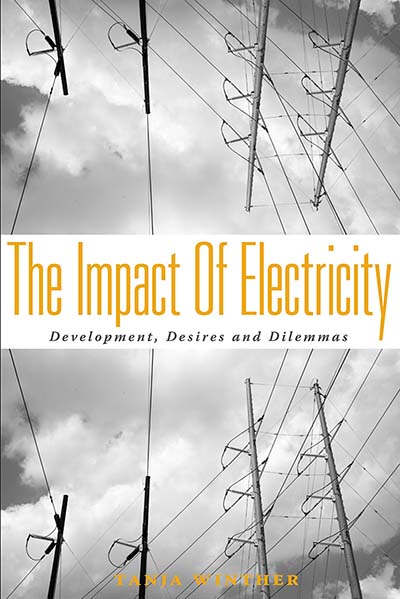
The Impact of Electricity
Development, Desires and Dilemmas
Tanja Winther
274 pages, 16 ills, bibliog., index
ISBN 978-1-84545-495-1 $135.00/£104.00 / Hb / Published (September 2008)
ISBN 978-1-84545-292-6 $34.95/£27.95 / Pb / Published (November 2010)
eISBN 978-1-80758-777-2 eBook
Reviews
“…an excellent book that speaks to readers in different fields including development, anthropology, and technology. The author presents a very readable and enjoyable anthropological analysis of the electrification of the semiautonomous state of Zanzibar within the United Republic of Tanzania…Most importantly, the book presents clear evidence that the implementation of electricity in development processes cannot be simply considered a technological issue that can be addressed by top-down development strategies.” · Regions and Cohesion
"Partly the report of a development project, partly an ethnography, and partly a discourse on development anthropology, [this book] is a fascinating and significant work…an informative and thought-provoking book. Its nuanced discussions of electrification’s effects on Uroans are a valuable empirical contribution to studies of technological change." · American Anthropologist
"Tanja Winther's excellent study clearly shows the insights anthropological analysis brings to understanding development investments, even ones which might be thought to be purely technical in nature. Anyone responsible for designing, implementing or managing rural electrification programs in Africa, is strongly advised to read this book" · Howard White, Executive Director, 3ie
Description
How does everyday life change when electricity becomes available to a group of people for the first time? Why do some groups tend to embrace this icon of development while other groups actively fight against it? This book examines the effects of electricity’s arrival in an African, rural community. Based on ethnographic fieldwork in Zanzibar at different points in time, the author provides a compelling account of the social implications in question. The rhythm of life changes and life is speeding up. Sexuality and marriage patterns are affected. And a range of social relations, e.g. between generations and genders, as well as relations between human beings and spirits, become modified. Despite men and women’s general appreciation of the new services electricity provides, new dilemmas emerge. By using electricity as a guide through the social landscape, the particularities of social and cultural life in this region emerge. Simultaneously, the book invites readers to understand the ways that electricity affects and becomes implicated in our everyday life.
Tanja Winther has a Masters in Power Engineering and a Doctorate in Social Anthropology. She is at the Centre for Development and the Environment (SUM) at the University of Oslo.
Subject: Development StudiesAnthropology (General)Sustainable Development Goals
Area: Africa
Contents
Of Related Interest

Mythology, Spirituality, and History
Experiencing New Worlds
The Last Shaman
Change in an Amazonian Community