Join our Email List
Series
Volume 1
Space and Place
Email Newsletters
Sign up for our email newsletters to get customized updates on new Berghahn publications.
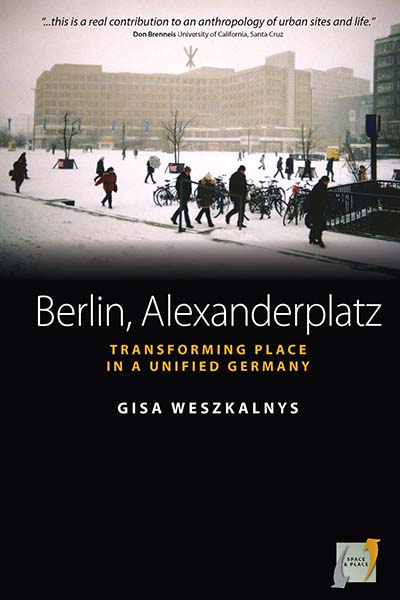
Berlin, Alexanderplatz
Transforming Place in a Unified Germany
Gisa Weszkalnys
226 pages, 17 ills, bibliog., index
ISBN 978-1-84545-723-5 $135.00/£104.00 / Hb / Published (May 2010)
ISBN 978-1-78238-317-8 $34.95/£27.95 / Pb / Published (October 2013)
eISBN 978-1-83695-897-0 eBook
Reviews
“Weszkalnys undertakes a fascinating exploration of the planning process, the intellectual debate and political contest over reconstruction, and the multiple roles of citizenship in the reunified city.” · H-Net Reviews
“This volume contributes significantly to the now well established body of literature analyzing urban places, and it does so by viewing a specific plaza ethnographically… Weszakalnys’ study of a plaza demonstrates the rich potential insights from a careful, nuanced examination of urban institutions, political symbolism, residents, state functionaries, and the places in which they dwell.” · PoLAR
“[This] is a thought provoking analysis of the square’s multifaceted meanings within a theoretical framework drawing on citizenship, Heimat and other concepts of interest to political scientists and anthropologists alike...This monograph does much to link the abstract concept of citizenship to its impact on a specific place. The site is well-chosen as a concrete manifestation, so to speak, of enduring national division, local loyalties and actual citizenship practices. ...this work offers a wilfully fragmentary but nonetheless stimulating view for all that of Alexanderplatz as a place of ‘citizenly entitlement’, political engagement and social construction.” · German Politics
“…a fascinating study of the social and political processes of urban development as well as the inherent complexity surrounding the definition of place…an interesting and sharp ethnography. I can recommend the book to anyone interested in contemporary government, the market and citizen engagement.” · Suomen Antropologi: Journal of the Finnish Anthropologcial Society
“…presents multiple perspectives with a clear focus, enabling the reader to apprehend a complex, consequential, and always transforming site as the nexus of multiple views, values, experiences, and hopes. Smart, deeply researched, interpretively sophisticated without being overburdened by theory, this is a real contribution to an anthropology of urban sites and life.” · Don Brenneis, University of California, Santa Cruz
Description
A benchmark study in the changing field of urban anthropology, Berlin, Alexanderplatz is an ethnographic examination of the rapid transformation of the unified Berlin. Through a captivating account of the controversy around this symbolic public square in East Berlin, the book raises acute questions about expertise, citizenship, government and belonging. Based on ethnographic fieldwork in the city administration bureaus, developers’ offices, citizen groups and in Alexanderplatz itself, the author advances a richly innovative analysis of the multiplicity of place. She reveals how Alexanderplatz is assembled through the encounters between planners, citizen activists, social workers, artists and ordinary Berliners, in processes of popular participation and personal narratives, in plans, timetables, documents and files, and in the distribution of pipes, tram tracks and street lights. Alexanderplatz emerges as a socialist spatial exemplar, a ‘future’ under construction, an object of grievance, and a vision of robust public space. This book is both a critical contribution to the anthropology of contemporary modernity and a radical intervention in current cross-disciplinary debates on the city.
Gisa Weszkalnys studied in Berlin and Cambridge and received her PhD in Social Anthropology from the University of Cambridge. She is a Lecturer in Anthropology at the University of Exeter and is conducting new research on oil developments in West Africa.
Subject: Urban StudiesAnthropology (General)Geography
Area: Germany
Contents
Of Related Interest
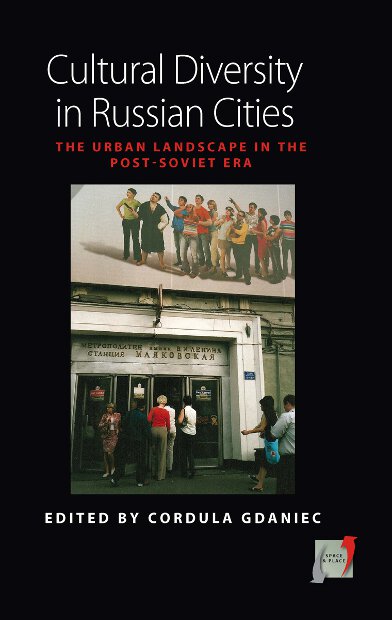
Cultural Diversity in Russian Cities
The Urban Landscape in the post-Soviet Era

Settling for Less
The Planned Resettlement of Israel's Negev Bedouin
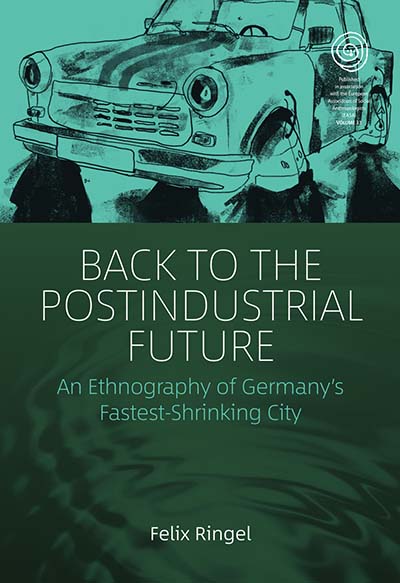
Back to the Postindustrial Future
An Ethnography of Germany's Fastest-Shrinking City