Join our Email List
Series
Volume 14
International Studies in Social History
See Related
History JournalsEmail Newsletters
Sign up for our email newsletters to get customized updates on new Berghahn publications.
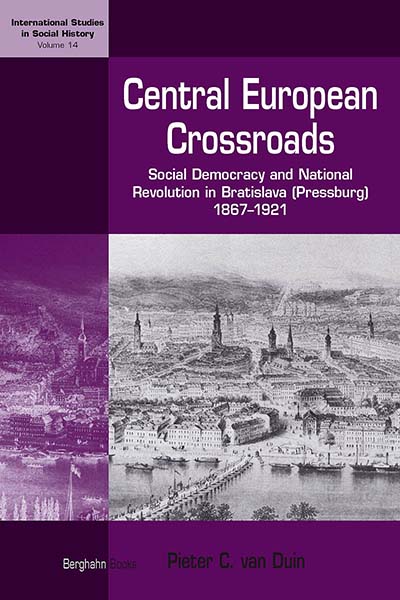
Central European Crossroads
Social Democracy and National Revolution in Bratislava (Pressburg), 1867-1921
Pieter C. van Duin
546 pages, bibliog., index
ISBN 978-1-84545-395-4 $180.00/£138.00 / Hb / Published (May 2009)
eISBN 978-1-84545-918-5 eBook
Reviews
“…the book is an important contribution to labor history, urban history, and social history that provides a new perspective on a time when Central European ‘crossroads’ like Pressburg were being redefined as the capital cities of modern nations.” · American Historical Review
“[The book had] a length that felt long for use in courses, but that reflected breadth and depth, rather than redundancy or poor editing. Stylistically, the book is well written…This book will be of interest and use to scholars of and for upper-level courses on the history of cities, twentieth-century Europe, and ethnonational dimensions of European labor politics. · Habsburg
“Scholars interested in the history of Bratislava during the 1919 transfer of power will find a wealth of detail in Duin’s narrative. The main chapters are exhaustive, balancing a narrative of events, the popular perceptions of various different historical actors, and subsequent historiography. All in all, Duin has written a solid book of considerable interest to specialists. · Austrian History Yearbook
"...brings a polyglot sensibility to the linguistically complex history of the Austro-Hungarian Dual Monarchy, too long the subject of insular national historiographies ... Van Duin possesses the linguistic skills and historical sensibilities to capture the perspectives of all the players. Highly recommended." · Choice
"...an exceptional book about the history of social democracy in Slovakia and, in a broader geographic context, Central Europe...The range of sources and literature used is most impressive...a work about Slovak history that is refreshing in all respects." · Hans Renner, University of Groningen
Description
During the four decades of the communist regime in Czechoslovakia a vast literature on working-class movements has been produced but it has hardly any value for today’s scholarship. This remarkable study reopens the field. Based on Czech, Slovak, German and other sources, it focuses on the history of the multi-ethnic social democratic labor movement in Slovakia’s capital Bratislava during the period 1867-1921, and on the process of national revolution during the years 1918–19 in particular. The study places the historic change of the former Pressburg into the modern Bratislava in the broader context of the development of multinational pre-1918 Hungary, the evolution of social, ethnic, and political relations in multi-ethnic Pressburg (a ‘tri-national’ city of Germans, Magyars, and Slovaks), and the development of the multinational labor movement in Hungary and the Habsburg Empire as a whole.
Pieter C. van Duin studied and worked at the University of Leiden in the 1970s and 1980s. At present he works as an independent historian based in Leiden and Bratislava, Slovakia. His research in social history is mainly concerned with problems of ethnic relations, cultural issues, nationalism, and racism.
Subject: History (General)History: 18th/19th Century
Area: Central/Eastern Europe
Contents
Of Related Interest

Futurism and Politics
Between Anarchist Rebellion and Fascist Reaction, 1909-1944
The Chameleon State
Global Culture and Policy Shifts in Britain and Germany, 1914-1933
Visions of the End of the Cold War in Europe, 1945-1990