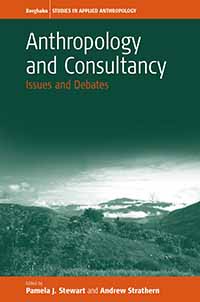
ANTHROPOLOGY AND CONSULTANCYIssues and DebatesEdited by Pamela Stewart and Andrew Strathern
“I do recommend this volume to anthropologists. This collection would be appropriate for training social or cultural anthropologists…Several of these cases are well written, insightful, and instructive.” · Journal of Anthropological Research More and more, anthropologists are recruited as consultants by government departments, companies or as observers of development processes in their field areas generally. Although these roles can be very gratifying, they can create ambiguous situations for the anthropologists who find that new pressures and responsibilities are placed upon them for which their training did not prepare them. This volume explores some of the problems, opportunities, issues, debates, and dilemmas surrounding these roles. The geographic focus of the studies is Papua New Guinea, but the topic and its importance apply widely through the world, for example, Africa, South America, Australia, and the Pacific in general, as well as in relation to indigenous groups in Canada and elsewhere. All the authors have first-hand experience and they address these new pressures and responsibilities of anthropological research. The book's chapters are written in a way that combines scholarship with a style accessible to general readers. Pamela Stewart is Research Associate at the University of Pittsburgh. She works on human identities and life histories, farming practices and national identity, patient/physician communication, religious change and sorcery, forms of violence and its impact. Her areas of interest include the U.S., Europe, and Papua New Guinea. Andrew J. Strathern W. Mellon Professor at the University ofPittsburgh. His interests include the analysis of political and economic systems in small-scale societies, kinship theories, social change, religion,symbolism, ethnicity, legal anthropology, conflict and violence, the anthropology of the body, and the cross-cultural study of medical systems. Stewart and Strathern have co-authored many articles and books, including Empowering the Past: Confronting the Future (Palgrave, 2004), and Witchcraft, Sorcery, Rumors and Gossip (Cambridge University Press, 2004). Recently, they have co-edited, Landscape, Memory, and History (Pluto Press, 2003), and Contesting Rituals (Carolina Academic Press, 2005). Series: Volume 1, Studies in Public and Applied Anthropology Download chapters from this titleTable of Contents (Free download) Preface (Free download) Introduction (Free download) On Knowing the Baining and Other Minor Ethnic Groups of East New BritainMarta A. RohatynskyjThe question that I was asked to investigate by the Tolai-dominated East New Britain Provincial government was very simply if there was a relationship between the relative underdevelopment of the minor ethnic groups of the province, generally defined as all non-Tolai groups, and their culture. This was the germ of the formulation presented to me when I commenced my duties as a research officer in the Department of Planning and Technical Services within the administrative structure of the Department of East New Britain in 1991. The discussions that followed, in order to operationalize the concepts of this original formulation, I remember as intense, theoretically challenging and forcing me to strategize within an applied context that had few precedents and, it seemed to me, contained many potential pitfalls for the consulting anthropologist. Download full chapter (PDF $9.00) From Anthropologist to Government Officer and Back AgainRichard ScaglionIn June 1979, I prepared excitedly to return to Papua New Guinea. I had been hired by the Public Services Commission to direct a Customary Law Development Project for the Law Reform Commission. I had previously conducted anthropological field research in the country, examining customary law and legal change among the Abelam people in what, when I began my work, was the East Sepik District of Australia's Territory of Papua and New Guinea. I remained there from 1974–1976, experiencing the end of the colonial period, which terminated formally on September 16, 1975. I had begun my research in the country as an anthropologist. Now I was to return as a government officer. Download full chapter (PDF $9.00) Environmental Non-governmental Organizations and the Nature of Ethnographic InquiryPaige WestIn this essay I argue that NGO discourses about people, nature, and culture have changed the nature of anthropological and ethnographic inquiry in situations in which we work with and for NGOs, and in situations where we merely work in the same physical spaces as NGOs. My arguments are focused upon environmentally concerned NGOs and discourses about the relationship between culture (the social practices of people) and nature (biological diversity). I agree with Brosius when he argues that environmentally focused discourses come to constitute reality and that they, "in their constitutiveness define various forms of agency, administer certain silences, and prescribe various forms of intervention" (Brosius 1999:277– 278). Download full chapter (PDF $9.00) The Politics of AccountabilityAn Institutional Analysis of the Conservation Movement in Papua New GuineaJohn Richard WagnerThe conservation movement in Papua New Guinea today is dominated by global interests and global agencies. This has especially been the case since the Rio Summit of 1992 and the signing of the UN Convention on Biological Diversity. Shortly after the Summit, the United Nations Environment Programme commissioned the first comprehensive study of biodiversity in Papua New Guinea (PNG), reporting that the country "harbors more than five percent of the world's biodiversity in less than one percent of its land area" (Sekhran and Miller 1994:6). In response to these findings, The PNG Biodiversity Conservation and Resource Management Programme was set up in 1993, with funding provided by the Global Environment Facility. The administrators of this program moved quickly, in the first year of their operation, to set up an integrated conservation and development project in Lak, New Ireland, and in 1995 a second project was set up in the Bismarck- Ramu area. Download full chapter (PDF $9.00) Where Anthropologists Fear to TreadNotes and Queries on Anthropology and Consultancy, Inspired by a Fieldwork ExperienceLorenzo BruttiIn this essay I give an account of my experience of almost a year of survey work as a consultant for a mining company whose presence affected the population I studied as an anthropologist, the Oksapmin of Sandaun Province in Papua New Guinea. I am especially interested in the stage when the researcher switches from the role of the ethnographer, aiming to carry out scientific work, to that of the consultant, which is�by definition� more embedded in economic and political matters. Download full chapter (PDF $9.00) Taking Care of CultureConsultancy, Anthropology, and Gender IssuesMartha MacintyreIn this chapter I shall examine a few of the ways that my work as a consultant has impinged on my academic research, and inspired some criticisms of my academic discipline, but I shall also argue for the usefulness of anthropology in undertaking social research that has very practical aims. Download full chapter (PDF $9.00) Index (Free download) Contributors (Free download) |