Join our Email List
Email Newsletters
Sign up for our email newsletters to get customized updates on new Berghahn publications.
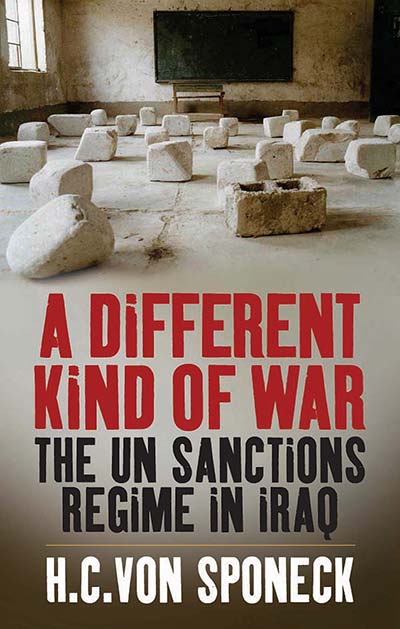
A Different Kind of War
The UN Sanctions Regime in Iraq
H. C. von Sponeck
Translated from German
Foreword by Celso N. Amorim, Foreign Minister of Brazil
336 pages, bibliog., index
ISBN 978-1-84545-222-3 $34.95/£27.95 / Hb / Published (October 2006)
Reviews
“In this sober and impressive study, Hans Graf Sponeck reminds us of the provisions of the Hague Convention of 1907 that bar any penalty inflicted on people for actions for which they are not responsible, an elementary moral principle and for the past century, a binding obligation on all states. In his meticulous and carefully reasoned review, he demonstrates with painful care and precision that the UN Security Council, but particularly the US and UK, radically violated these minimal conditions of civilized behavior in their sanctions program directed against the tortured population of Iraq, including the oil for food program that he valiantly tried to direct in a humane manner, struggling against their cruel and unremitting interference. It is necessary reading, with crucial lessons for the immediate future as well. And immensely sad.” • Noam Chomsky
“von Sponeck’s analysis is wide-ranging, taking in not just the minutiae of economic sanctions but also what he sees as the flawed priorities of the UN Compensation Commission, the illegal maintenance of the northern and southern no-fly zones… At a time when Washington finds itself asserting a moral justification for continued intervention in Iraq, A Different Kind of War reminds us…that the moral authority of the United States on the issue is seriously wanting.” • Journal of Genocide Research
“This is one of the most important books I can remember. Hans von Sponeck, one of the UN's most senior and respected officials, who resigned rather than carry out inhuman US Administration-driven policies against the ordinary people of Iraq, has blown the whistle on one of the greatest acts of aggression: the medieval siege of Iraq. Read this superb book and you will understand the danger the world faces from an imperialist power.” • John Pilger
“This book is my personal history. I grew up during the embargo years - no health care, poor education, not enough food. God and my parents helped me to survive.” • Wissam Khalifa (18), Al-Fallujah/Iraq
Description
“Crucial lessons for the immediate future”–Noam Chomsky
At a time when the international community is imposing sanctions and discussing no-fly zones, A Different Kind of War delivers a frightening parallel and a heart-rending accounting of suffering in Iraq among locals who bore the brunt of the 13-year sanctions from 1990 until 2003.
H. C. von Sponeck, the former “UN Humanitarian Coordinator for Iraq,” explores the UN's sanction policies against Iraq, their consequences, and the domestic conditions during this period. His extensive research is based on previously unpublished internal UN documents and discussions with UN decision makers (such as General Secretary Kofi Annan), Iraqi officials and politicians (including Saddam Hussein), and ordinary Iraqis. The author’s findings question who really benefited from the program, what role the UN Security Council and its various member states played, and whether there were then and are today alternatives to the UN's Iraq policies.
- Chapter 1. The Oil for Food Programme: An Adequate Humanitarian Exemption?
- Chapter 2. The UN Compensation Commission: Benefit for Some, Deprivation for Others
- Chapter 3. The No-Fly Zones: Zones of Protection and Zones of Confrontation?
- Chapter 4. The United Nations Special Commission and the UN Office of the Humanitarian Coordinator for Iraq: Two Units of the Same Organisation?
- Chapter 5. The Government of Iraq, its People and their Rights
- Chapter 6. The UN Sanctions Structure: Confrontation, Fragmentation, Conclusions
What customers are saying:
5.0 out of 5 stars Excellent expose
Reviewed in the United States
Verified Purchase
excellent expose from someone who knew all the details how the US government uses sanctions to wage war
5.0 out of 5 stars Great book
Reviewed in the United Kingdom
Verified Purchase
This is an excellent book, so well written and the amount of detailed research that has gone in is amazing to say the least - hard work to write I'm sure but so easy to read - it flows beautifly. I left Iraq as a child a few months after the first Gulf war - it has been emotionally challenging to read this at times at the same time it is written in such a logical way as to keep the reader engaged.
H. C. von Sponeck worked for the United Nations for more than thirty years and in 1998 was appointed UN Assistant Secretary General. During his service he worked for the UN Development program in Ghana, Turkey, Botswana, Pakistan and India. Since his resignation from the UN he has served as a member of the board of trustees of various non-governmental organizations in Switzerland, Italy and the US, as an adviser for multilateral issues, and as a consultant for personnel development in international organizations.
Ten Key Points of A Different Kind of War
Interview with the Brussels Tribune
Subject: Peace and Conflict Studies
Area: Middle East & Israel
Contents
Of Related Interest
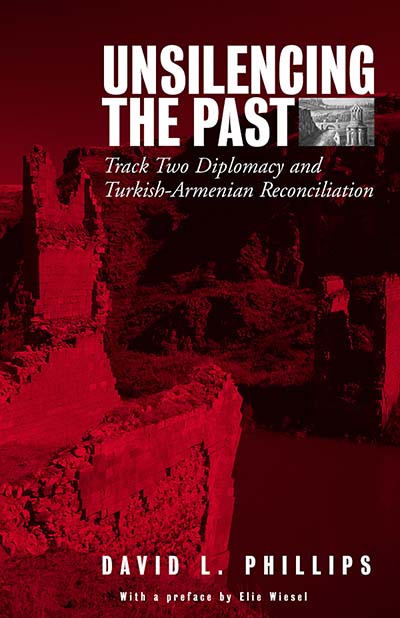
Unsilencing the Past
Track-Two Diplomacy and Turkish-Armenian Reconciliation