New Titles: Spring/Summer 10
(5.8Mb PDF file)

History 2010
(2.0Mb PDF file)

Anthropology Texts for Teaching
(5.7Mb PDF file)

Middle East/Israel Studies 09
(3.4Mb PDF file)

Slavic Studies 09
(3.2Mb PDF file)


advanced search

Browse all titles by:
Author | Title | Series
Celebrating 16 Years of Independent PublishingLast updated: February 4th, 2010


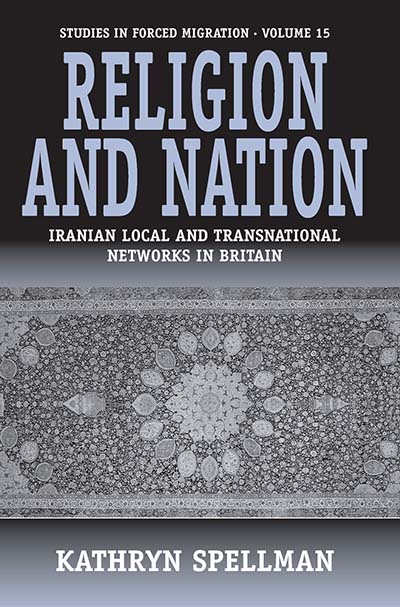
RELIGION AND NATION

Iranian Local and Transnational Networks in Britain

Kathryn Spellman


248 pages, bibliog., index
ISBN 978-1-57181-577-4 Pb $27.95/£15.00 Published (Winter 2005)
ISBN 978-1-57181-576-7 Hb $75.00/£50.00 Published ( 2004)
Buy now and get 15% off listed price
Pb 
Hb 

Download this title All chapters available for download - see below.

(may not yet be available for newest titles)
 Google Book Search

"Spellman's Religion and Nation does bring to light a vibrant community that, due to its small size and peaceful demeanor, often goes unmentioned when discussions of British immigrant populations arise. Her detailed accounts of the religious practices of Iranians in London provide an overview of an immigrant community trying to adapt and reconcile the former identities and practices of its members to their new home. Spellman's is a study that has demystified the religious lives of British Iranians, placing religious change into a transnational context.”  ·  H-Net Reviews

"Given the lack of information about this population in the Westrn world, the focused materials presented in this book help build a better information base on the diverse practices and beliefs of Iranian outside their homeland."  ·  Choice

“[This] first full-length study of the Iranian Muslim diaspora in Britain…enhances our empirical and theoretical understanding.”  ·  The Muslim World Book Review

An estimated 75,000 Iranians emigrated to Britain after the 1979 revolution and the establishment of the Islamic Republic. They are politically, religiously, socio-economically and ethnically heterogeneous, and have found themselves in the ongoing process of settlement. The aim of this book is to explore facets of this process by examining the ways in which religious traditions and practices have been maintained, negotiated and rejected by Iranians from Muslim backgrounds and how they have served as identity-building vehicles during the course of migration, in relation to the political, economic, and social situation in Iran and Britain. While the ethnographic focus is on Iranians, this book touches on more general questions associated with the process of migration, transnational societies, Diasporas, and religious as well as ethnic minorities.

Kathryn Spellman received her MSc. and Ph.D. in Politics and Sociology at Birkbeck College, University of London, where she is currently an Honorary Research Fellow. She is a lecturer of sociology at Huron International University in London and Syracuse University (London Campus). Kathryn is also a Visiting Research Fellow in the Centre of Migration Studies Department at the University of Sussex.

Series: Volume 15, Forced Migration


Download chapters from this title

Table of Contents (Free download)


Preface (Free download)


Acknowledgments (Free download)


Introduction (Free download)


The Iranian Revolution and the Subsequent Waves of Emigration

An estimated one million Iranians left Iran in response to the political struggles leading up to the establishment of the Islamic Republic and the repressive measures used to indoctrinate and implement the revolutionary discourse. The diaspora consists of Iranians from a range of political, socio-economic, religious and ethnic backgrounds, including those tied to the Shah and the royal family; intellectuals and skilled professionals; political activists; members of ethnic and religious minority groups, including Zoroastrians, Armenians, Assyrians, Anglicans, Pentecostalists, Catholics, Baha'is and Jews; feminists; families fearing the military draft for the Iran-Iraq war; and many others who felt they were negatively affected by Khomeini's attempt to Islamise Iran.

Download full chapter (PDF $9.00)


Iranians in Britain

Iranians affect and are affected by socio-economic and political processes in Britain in many different ways. The aim of this chapter is to shed light on some of the underlying conditions informing the social and cultural transformations that bear on Iranians during the process of migration. Since there was no prior research on Iranians living in Britain, it was necessary to conduct an exploratory preliminary study in order to become familiar with various facets of the Iranian diaspora in London. It is important to recognize that the purpose of this preliminary study was not to map out a single Iranian community or make all-encompassing and sweeping claims about Iranians' lives in London. I wish instead to emphasise some of the underlying political and socio-economic currents that Iranians have come across during their time outside of Iran, that have in turn influenced their activities, intentions and interpretations in London. I have found that three historical conjunctures - the revolution, Khomeini's death in 1989 and Khatami's presidency - and the way in which they have intersected with the particular situation of different groupings of Iranians living in London, have been important in shaping and reshaping the cultural, political, economic and religious practices of Iranians in London. In order to examine this process in greater detail the following chapters will show the links between various Iranian religious practices in London and socio-economic and political processes presented below.

Download full chapter (PDF $9.00)


Sofreh

a Shia Muslim Religious Ritual for Iranian Women

I first heard about sofreh gatherings being held outside Iran from a university student who was relieved to hear that a good family friend, living in Germany, organised a women's religious gathering in order to put forth a special wish for him to pass his university exams. This prompted me to ask Iranians to describe their religious practices in more detail, and subsequently I learned about a number of religious gatherings, such as sofreh and jaleseh gatherings for women, mixed-sex private religious gatherings, Sufi Orders and various religious charity organisations. This chapter concentrates on sofreh gatherings: the central aim is to unfold the continuities and changing forms and practices of a Shia Muslim religious tradition in London.

Download full chapter (PDF $9.00)


Iranian Sufi Orders in London

The tradition of Sufism has gained currency among some Iranians living outside of Iran. Sufism [tasavof] is a term applied to the mystical tradition within Islam which emphasises the love of God and the grasp of divine realities. Generally speaking, it teaches that 'Sufis are God's friends, perpetually engaged in remembrance [zekr] of him. Sufism also constitutes a Path [tariqat], which begins with repentance and leads through a number of "stations", representing virtues such as absolute trust in God, to a higher series of ecstatic "states".'

This chapter concentrates on the social significance of two London branches of the transnational Nimatullahi Sufi Order and the Maktab Tariqat Oveyssi Shahmaghsoudi (School of Islamic Sufism). The purpose is not to detail the various histories and lineages of these orders but to provide an overview of their trajectories which serve to illuminate contemporary developments. This examination sheds light on the processes whereby they simultaneously carve out a distinct Iranian place in London, and adapt to and make an impact on British society. It shows how Sufism, a culturally familiar Iranian tradition, provides a space for Iranians to shape and to express their Muslim identities, while staying clear of the politicised and culturally remote versions of Islam in both Iran and Britain.

Download full chapter (PDF $9.00)


The Iranian Christian Fellowship and Elam Ministries

This chapter focuses on Iranians from Muslim backgrounds who have converted to Pentecostal Christianity. Since the revolution Christian missionaries have been successful for the first time in converting some Iranian Muslims to Christianity both inside and outside Iran. Conservative Christian missionary groupings have shown a greater interest in evangelising Christianity to Muslims. According to the Center for the Study of Global Christianity at Gordon-Conwell Theological Seminary in Massachusetts, the number of missionaries to Islamic countries grew from 15,000 to 27,000 between the years 1982 and 2001 - and around 1 out of every 3 is Evangelical. The following research is mainly based on the experiences of those who are involved in the Iranian Christian Fellowship (ICF) and Elam Ministries. Both were developed in the London area in 1986. The Iranian Christian Fellowship provides a Persian language Bible study and a Persian and English language church service every Sunday. Reverend Yeghnazar is also the main organiser of Elam Ministries located west of London, which is the first residential Iranian Bible College that trains Persian speakers from Muslim backgrounds to become Christian pastors. It also claims to be the first college in Christian history to have many of its courses taught via computer links from the International Correspondence Institute (ICI) in the U.S. All of the courses are taught in Persian.

Download full chapter (PDF $9.00)


Conclusions and Findings

By tapping into the diversity and complexity of Iranian lives in London this study has demonstrated that finding a distinct Iranian place in London, and adaptation to British society, are both processes at work. The social dynamics I encountered at a big open party for Châhârshanbeh Souri (a celebration that marks the beginning of the Iranian New Year celebrations), can serve as a microcosm to illustrate some of the continuities and transformations of Iranian identity and practices that have been explored throughout this book. Unlike noruz parties in the past, where political and religio-ethnic boundaries were tightly drawn, I came across Iranians from a variety of backgrounds and orientations. During the evening I spoke to women who attend Ms. Parvizi's sofrehs, non-religious Iranians, members of the Shahmaghsoudi Sufi Order, Baha'is, Zoroastrians and Armenians. While some women wore headscarves, others wore revealing dresses. A few people were drinking alcohol, while others were not. The hired band, which included a musician who plays at the Iranian Christian Fellowship, performed popular Iranian music. While many danced throughout the evening, others, such as the women who wore scarves, took pleasure in watching.

Download full chapter (PDF $9.00)


Index (Free download)


Bibliog (Free download)


If you have any questions or comments about this site, please email us
All prices listed on this website are subject to change without notice.