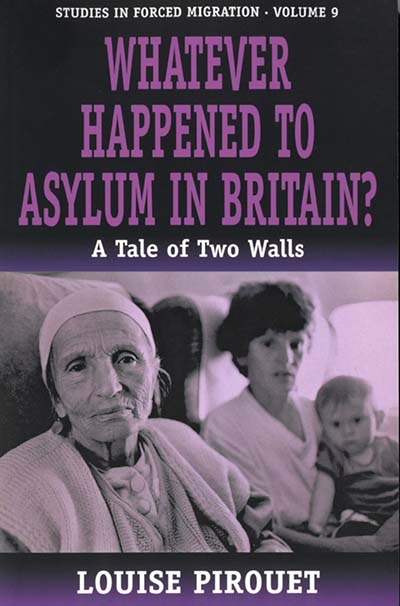
WHATEVER HAPPENED TO ASYLUM IN BRITAIN?
A Tale of Two Walls
Louise Pirouet
| 208 pages, bibliog., index ISBN 978-1-57181-468-5 Pb $19.95/£13.50 Published ( 2001) ISBN 978-1-57181-991-8 Hb $59.95/£40.00 Published ( 2001) Buy now and get 15% off listed price |
All chapters available for download - see below.
"An exceptionally lucid history of asylum issue in the United Kingdom since the mid-1980s." · International Migration Review
"An unusual and highly successful book: a review of the changes which have taken place in asylum law in recent years, painted in their political context and described in accurate detail, but peppered with the personal experiences of asylum seekers which adds a poignant reality to what might otherwise appear a dry description." · Nicky Padfield, Fellow of Fitzwilliam College, Cambridge
Refugees and asylum-seekers are high up on many people's political agenda. Even so, there is a remarkable lack of information. Who are these asylum-seekers? Aren't they almost all "bogus"? How do western immigration authorities decide whether or not they are genuine? Is the UN convention on Refugees out of date and in need of renegotiation?
This book brings insider knowledge to the study of asylum in Britain today. It is based on visits to places where asylum seekers are detained, on working with lawyers representing asylum-seekers and on a close knowledge of many of the refugee organisations. It argues passionately that Britain shall not throw away, through ignorance and misunderstanding, a reputation for providing a place of safety for the persecuted, and the chance of welcoming people who have much to contribute to national life and culture
Louis Pirouet has been involved with refugee concerns for many years both in Africa and Britain. She is a trustee of Asylum Aid, helps to run a group in Cambridge which works for safeguards for asylum seekers held at a detention centre near Cambridge, and assists Kenyans and Ugandans appealing against refusal of asylum.
Series: Volume 9, Forced Migration
Download chapters from this title
Table of Contents (Free download)
Abbreviations (Free download)
Foreword (Free download)
Introduction (Free download)
Setting the Scene
The decade 1987 to 1997 saw great changes, both in the pattern of asylum-seeking and in the procedures adopted by the Home Office, to deal with people who came to Britain as refugees. A shaping event was the fall of the Berlin Wall in 1989. Erected to keep people inside the former Eastern Bloc and prevent them from reaching the West, the Berlin Wall is the first of the two walls of the subtitle. Its demolition had global repercussions, and one of its long-term results was a large increase in the numbers of people seeking asylum in Western Europe. That in turn led to the heightening of another wall, the second of our 'two walls', an invisible wall round Western Europe, designed to keep people out. Neither wall has been impregnable, although it is somewhat easier to breach the second, invisible wall than it was to escape through no man's land, past the border-guards' field of fire and over the barbed wire of the Berlin Wall. As a row of graves demonstrates, many died in trying to escape over that wall. The invisible wall around what is often referred to as 'Fortress Europe' has its casualties too.
Price: $9
Download full chapter (PDF)
The Tamils and the 1987 Watershed
The Tamils, whose arrival was noted in Chapter 1, did not travel directly from Sri Lanka. One of them told his story to an Independent reporter: after his neighbour had been killed by shellfire and other neighbours injured he had fled because he feared that he too was in personal danger. He made his way to Colombo but found that it was impossible to get a visa to come to the UK. However, he was told of an agent who said he could help him and his family at a cost of £1,300 per person if they first flew to Malaysia as tourists. The agent would meet them there and provide them with tickets and visas for the UK. They spent ten days in Kuala Lumpur whilst arrangements were made, and then flew to Dhaka in Bangladesh on the first leg of their journey. 'George', the agent, travelled with them.
At Dhaka, George got them boarding passes for the journey to London, but refused to give them their tickets. Later they discovered that George had removed the visa page from their passports.1 This man and his family were just part of the group of fifty-eight Tamils who arrived at Heathrow on Friday 13 February.2 Among the reasons for the strong reaction against them was the fact that an agent had facilitated their travel, they had arrived without tickets and with damaged passports and they had not come directly from Sri Lanka but had travelled through Malaysia and Bangladesh. It was to Dhaka, their last stopover, that it was intended to remove them. This the Tamils objected to on the grounds that Dhaka would be likely to send them back to Malaysia, a country which had recently returned other Sri Lankans to Colombo against their will.3
Price: $9
Download full chapter (PDF)
Making Decisions
The most important part of the whole asylum procedure is the Home Office's initial decision as to whether or not a person is a Convention refugee. The process by which that decision is reached is therefore crucial. These initial decisions are made on the basis of interviews with the asylum-seeker and information about the human rights record of the country from which the asylum-seeker has fled. No one would suggest that these decisions are easy to make, and no system can be completely foolproof. This chapter will examine the process, and the following chapter will look at the system that enables unsuccessful asylum-seekers to appeal against refusal.
Price: $9
Download full chapter (PDF)
A Right of Appeal
At the end of Chapter 3 the importance of appeals against refusal of asylum was noted, but the right of all rejected asylum-seekers to remain in the UK whilst an appeal was heard was not won easily. The saga of the Tamil asylum-seekers might have turned out very differently had they had the right to remain in the UK whilst appealing against the decision to refuse them asylum. Until 1992 the government remained steadfastly opposed to extending to those who applied for asylum at a port of entry full rights of appeal, with the right to remain in the country while their appeals were being heard.
Price: $9
Download full chapter (PDF)
Without Charge or Trial
In late September 1998, a delegation of the United Nations Working Party on Arbitrary Detention visited the United Kingdom, and met with a group of NGOs. These gave evidence about the use of detention without charge or trial in the UK, and explained their reasons for believing that the way in which asylum-seekers are detained is arbitrary and in breach of their basic human rights.1
Price: $9
Download full chapter (PDF)
Protecting Women, Children and Families
For a variety of reasons women face particular difficulties when applying for asylum. They may come from societies where women are not expected to take initiatives, and so, finding themselves endangered and forced to flee, they may then be disadvantaged as women as they try to make their claims for asylum. The newly-produced gender guidelines recommend that 'if a woman is interviewed in connection with her asylum claim, she should have access to a woman interviewer and interpreter'.1 The acceptance of this advice might well be advantageous to the Home Office in that some women's stories would be likely to emerge at an earlier stage of the asylum procedure, making fewer appeals necessary.
Price: $9
Download full chapter (PDF)
Building Walls Around Fortress Europe
Before we can look at the walls that the UK has erected to keep asylum-seekers out, we need to look at the wider European scene, as policies decided among EU member states, to which the UK contributes, are of increasing importance.1 In 1985 Michael Marrus published a classic study entitled The Unwanted: European Refugees in the Twentieth Century. It deals with the enormous migrations across Europe of millions of people uprooted by the wars and revolutions that characterised the continent in the first half of this century. A large part of Caroline Moorehead's massive history of the Red Cross deals, perforce, with the same phenomenon, and includes a lengthy discussion of the Red Cross's efforts to ameliorate the suffering caused by these events.2 At the time he was writing, Marrus felt able to conclude that the European scene had radically changed. He noted that European governments saw their prime responsibility as being to the trickle of people who managed to escape to the West from behind the Iron Curtain, whilst at the same time they were hardening their attitudes to the refugees fleeing persecution in poor countries, who were managing to reach their shores in growing numbers. What he found extraordinary was that there were no longer refugee crises within Europe itself: Of course, no one can say that a new tide of refugees may not one day engulf the continent, and few believe that existing legal structures or international agencies could themselves prevent such an inundation. If this history suggests any lesson, it is that ultimately the flow of refugees can only be controlled by favorable economic circumstances and the stabilization of the economic order. Until the achievement of these elusive goals worldwide, the consciences of Europeans will forever be tested by refugees, wherever they appear.3
Price: $9
Download full chapter (PDF)
Keeping Them Out
Building a Wall Around the UK
It is against the background of EU decision-making that legislative developments in the UK must be seen. The government has seldom referred to decisions taken on asylum by EU Justice and Home Affairs Ministers. They have preferred to let it be thought that that the British were making their own decisions. The Conservative Party was divided in its attitude to the EU, and wanted harsh policies to look like their own initiatives because harshness on immigration played well to a large section of the population. The Labour government which came to power in 1997 seems no more anxious to point to decisions made at EU level than were their predecessors. Only Home Secretary Douglas Hurd, introducing carrier sanctions in 1987, pointed out that other countries were introducing the same deterrent. If the world worked in the way the West thought it ought to, carrier sanctions should have been sufficient. Once airlines could be fined for bringing in improperly documented passengers, all that was needed to stem the flow of people seeking asylum was a visa requirement for nationals of countries likely to generate refugees. However, visas can be obtained on false pretences, airline staff in many countries can be bribed, and documents can be forged. On top of that, the imposition of strict visa regimes and carrier sanctions gave rise to profitable rackets of various kinds: the theft of passports from British and other Western nationals, forgery, bribery, and human trafficking. It became a matter of crimes emerging to fit the punishment.
Price: $9
Download full chapter (PDF)
Supporting Asylum-Seekers
The 1999 edition of the Refugee Council's publication, Refugee Resources in the UK, lists 745 organisations that provide some sort of assistance for refugees and asylum-seekers. The range is enormous, from the London office of the UN High Commissioner for Refugees to small refugee community groups, from groups that are partly or wholly government funded, to organisations totally dependent on membership fees and donations, from very large international organisations to tiny, locally-based groups. They can be categorised in several ways: official/voluntary, insider/outsider, advice and representation/support in kind, those which specialise in assisting refugees and asylum-seekers and those which assist refugees and asylum-seekers as part of a wider clientele. It is among these groups that the people are to be found who strive to keep the UK a welcoming society whose members were once proud to provide a place of refuge for the persecuted.
Price: $9
Download full chapter (PDF)
Index (Free download)
Bibliog (Free download)
Afterword (Free download)